
Upper primary, 11+ entrance preparation · Ages 8-11
11+ Maths Tutor for Grammar and Independent Schools
One-to-one maths preparation for the 11+, matched to the test your area or chosen school actually uses.
Prefer to ask a question first? Chat on WhatsApp

How it works, in short
TaleemSquare 11+ maths tutoring is live, one-to-one online lessons of 45 minutes that prepare children in Years 4 to 6 for the maths in grammar and independent school entrance tests. Tutors secure the Key Stage 2 content these papers draw on, then build speed, accuracy and familiarity with the question styles used in your area.
Formats differ by region and by school: many areas use GL Assessment papers, others use different providers or their own tests, and not every 11+ includes maths. Check your local authority or school admissions information first. Tutoring builds skills and confidence, but places are decided by each school. Plans start at £69 a month.
- Format
- Live, one-to-one, online
- Lesson length
- 45 minutes
- Level
- Ages 8-11
- Price
- From £69 a month
What changes after a term of lessons
Secure in the maths the test uses
Confident with number, fractions, decimals, percentages, ratio, simple algebra, measures and geometry up to early Year 6 level.
Faster and more accurate on time
Works at a steady pace, checks answers with estimation and moves past a hard question instead of losing minutes on it.
At ease with the question styles
Knows how the local paper is laid out, including multiple-choice answer sheets where they are used, so test day holds fewer surprises.
What we cover
Lessons follow your child's own school or homeschool curriculum. These are the areas we work on most at this level.
Number and place value
Large numbers, rounding, negative numbers, factors, multiples, primes, square and cube numbers: the building blocks behind most 11+ maths questions.
Mental and written calculation
Quick mental strategies alongside long multiplication and long division, with estimation used to catch slips before they cost marks.
Fractions, decimals and percentages
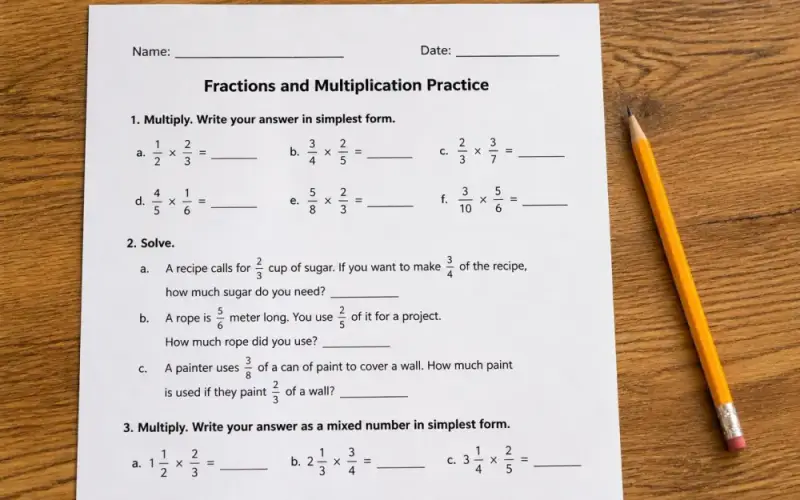
Converting between forms, comparing sizes, finding fractions and percentages of amounts, and multi-step problems that mix all three.
Ratio, proportion and simple algebra
Sharing in a given ratio, scaling quantities, number sequences, simple formulae and missing-number problems written with letters.
Measures, area and volume
Converting units of length, mass, capacity and time, perimeter, area of triangles and parallelograms, and volume of cubes and cuboids.
Geometry and position
Angle facts, properties of 2D and 3D shapes, nets, coordinates in all four quadrants, reflections and translations.
Data and averages
Reading tables, bar charts, line graphs and pie charts quickly and accurately, and calculating the mean.
Problem solving under time
Unpicking long word problems, choosing the most efficient method and pacing through a timed paper in your area's format.

Signs your child could use help
- Strong at school maths but slow on timed practice papers
- Loses marks on word problems by reading them too quickly
- Has not met some Year 6 topics that the test may include
- Unsure how to fill in a multiple-choice answer sheet
- Still hesitates over fractions and percentages
- The test is less than a year away and there is no plan
One of these on its own is normal. Two or three together usually point to a specific gap, and finding it is what the free assessment is for.
Taught to your curriculum, wherever you live
No national equivalent; overlaps with Grades 4-5 Common Core maths
The US has no 11+ style test. Some private schools and gifted programmes set their own entry tests, which vary by school and district. The maths overlaps with Grade 4 and 5 content: multi-digit arithmetic, fractions, decimals, measurement and geometry.
Level: Grades 3-5
11+ selection tests for grammar and independent schools in England
Grammar schools select pupils by academic ability using an entrance test, usually sat early in Year 6. Local authorities, school consortia or individual schools choose the provider and subjects, so papers differ by area. Independent schools set their own tests and dates.
No province-wide equivalent; Grades 4-5 provincial maths
Canada has no 11+. Some independent schools use their own admission tests. The maths overlaps with Grade 4 and 5 provincial curricula in Ontario, British Columbia and Alberta: number sense, fractions, decimals, measurement and geometry.
Level: Grades 3-5
State selective school tests, such as the NSW Selective High School Placement Test
Australia has state selective tests rather than an 11+. In NSW, the Selective High School Placement Test is sat in May of Year 6 for Year 7 entry and includes a mathematical reasoning section.
Level: Years 3-5
Inside a 45-minute 11+ maths lesson
One 45-minute session. Tutors adjust the timings to your child.
5 min
Mental warm-up
Quick-fire number facts and mental calculation.
12 min
Topic teaching
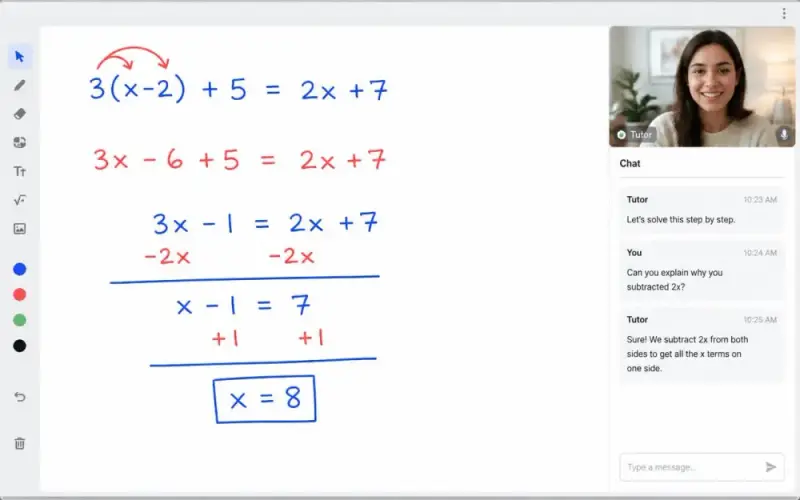
One Key Stage 2 topic taught with diagrams on the whiteboard.
12 min
Guided practice
11+ style questions on the topic, worked through with the tutor.
10 min
Timed section
A short timed set in your area's format, then a review of every error.
6 min
Wrap-up
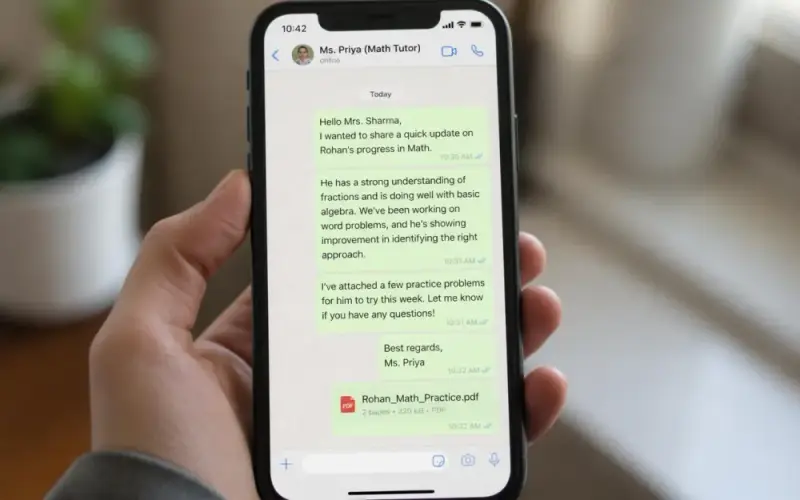
Your child names one strategy to remember. You get a WhatsApp summary.
How we prepare children for 11+ maths
Start from the local format
We begin with the information your area or school publishes: which subjects are tested, how answers are recorded and how long each section lasts. Practice then mirrors that format.
Content before speed
Timed papers only help once the maths is secure. Early lessons fill Key Stage 2 gaps, and timed practice grows as the test date approaches.
Thinking out loud
On harder questions your child talks through the method, so the tutor can tell whether a wrong answer was a slip, a misread or a real gap.
Honest progress notes
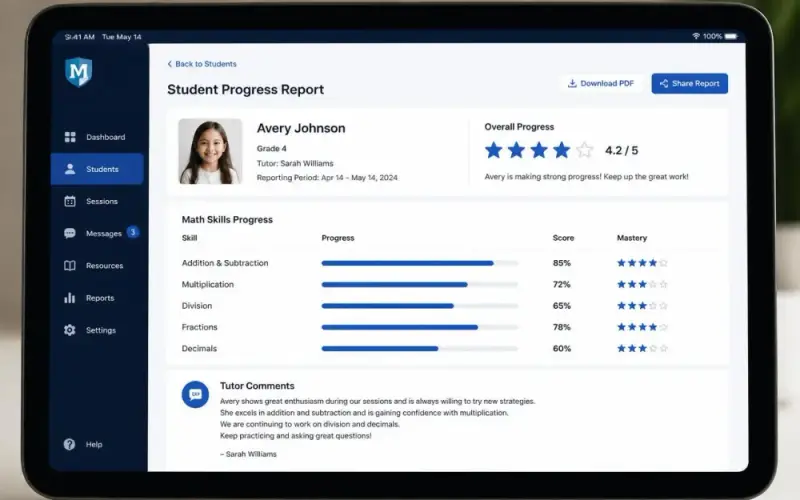
WhatsApp updates say which topics are secure and which are not, with no score predictions, so you can plan with real information.
Simple monthly plans
£69a month for 2 one-to-one maths lessons a week
- Free 45-minute assessment first
- No contract, cancel any month
- No registration fee
- 4-class money-back promise
- Switch tutor at no cost
- WhatsApp update after every class
Starter
2 lessons a week, best for keeping up with school
£69/mo
GrowthMost chosen
3 lessons a week, best for catching up + building confidence
£95/mo
Intensive
4 lessons a week, best for exam prep & fast improvement
£119/mo
Common worries, honest answers
“Will tutoring get my child into a grammar school?”
We cannot promise that, and no honest tutor can. Places depend on each school's required standard, how many children apply and its admission rules. What lessons can do is make sure your child knows the maths and is not thrown by the question style on the day.
“We don't know which test our area uses.”
Your local authority, the grammar school or its consortium publishes the test details each year, and providers sometimes change. Bring whatever you have to the free assessment and we will help you find the current information before planning lessons around it.
“The test is only a few weeks away.”
Short-notice preparation is possible but limited. With a few weeks left, lessons concentrate on familiar question types, pacing and the topics your child finds hardest, rather than trying to cover the whole of Key Stage 2.
Frequently asked questions
What maths is in the 11+?
When do children sit the 11+?
Which 11+ test does my area use?
How much does an online 11+ maths tutor cost?
Does passing the 11+ guarantee a grammar school place?
When should we start 11+ maths tutoring?
Book a free 45-minute assessment
Your child meets a tutor for a real one-to-one session. You get an honest read on where they are and what would help, even if the answer is that they don't need tutoring right now.
- 1
We reply on WhatsApp
Usually within 10 minutes, to find a time that suits your family.
- 2
Your child meets the tutor
A relaxed 45-minute session to see their level and how they learn.
- 3
You decide
You get a recommendation and a plan. No card details, no pressure.