
High school, AP level · Ages 15-18
AP Precalculus Tutor: Exam Prep for May 2027
Focused one-to-one prep on the three units the AP Precalculus exam actually tests, plus calculator skills.
Prefer to ask a question first? Chat on WhatsApp

How it works, in short
TaleemSquare AP Precalculus tutoring is one-to-one, 45-minute online exam preparation for the College Board's AP Precalculus course. Tutors cover the three assessed units, polynomial and rational, exponential and logarithmic, and trigonometric and polar functions, and practise every part of the exam, with and without a graphing calculator.
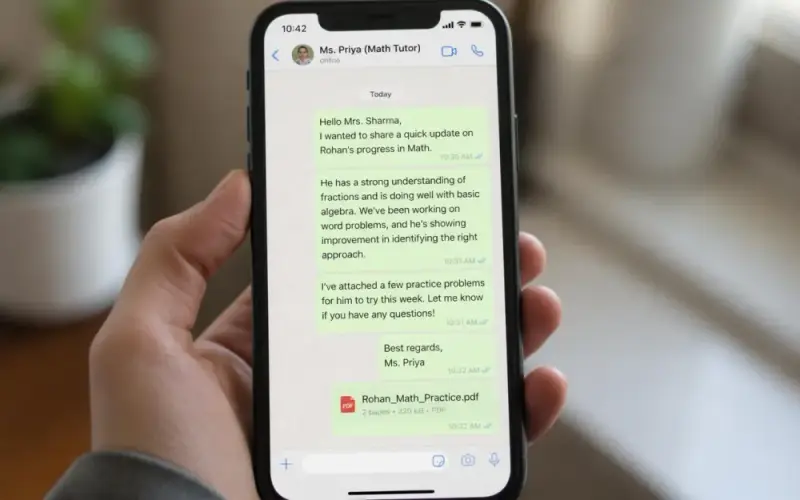
Unit 4, on parameters, vectors and matrices, is taught in many classes but is not on the AP Exam, so exam-season lessons put time where the score comes from. Parents receive WhatsApp updates, and plans start at $85 a month after a free assessment.
- Format
- Live, one-to-one, online
- Lesson length
- 45 minutes
- Level
- Ages 15-18
- Price
- From $85 a month
What changes after a term of lessons
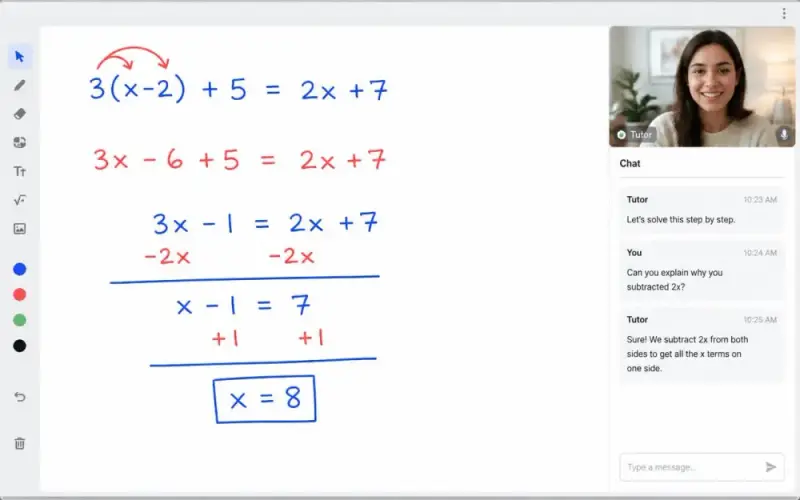
Models with the right function
Chooses linear, quadratic, exponential, logarithmic or sinusoidal models from data or a context and explains why the choice fits.
Exact answers by hand
Rewrites and solves log, exponential and trig expressions without a calculator, as the no-calculator parts of both sections require.
Clear free-response reasoning
Justifies conclusions about rates of change, concavity and periodic behavior in complete sentences, as the free-response rubric expects.
What we cover
Lessons follow your child's own school or homeschool curriculum. These are the areas we work on most at this level.
Polynomial and rational functions (Unit 1)
Rates of change, zeros, end behavior, asymptotes, holes and transformations, weighted 30-40% of the multiple-choice section.
Exponential and logarithmic functions (Unit 2)
Arithmetic and geometric sequences, exponential models, log properties, inverses and semi-log plots, weighted 25-40% of the multiple-choice section.
Trigonometric and polar functions (Unit 3)
Sine, cosine and tangent as periodic functions, sinusoidal models, inverse trig, identities and polar graphs, weighted 30-35% of the multiple-choice section.
Function concepts (FRQ 1)
Reading behavior from graphs and tables, composing and inverting functions and average rates of change, answered with a graphing calculator available.
Modeling questions (FRQ 2 and 3)
Building and interpreting a non-periodic model with the calculator, then a periodic model without it, both set in real contexts.
Symbolic manipulation (FRQ 4)
Solving and rewriting exponential, logarithmic and trigonometric expressions and equations by hand, with no calculator allowed.
Unit 4 for class, if needed
Parametric functions, vectors and matrices taught for school grades when your child's class covers them, kept separate from exam review.

Signs your child could use help
- Trig and log rules slip under no-calculator conditions
- Picks the wrong model type in word problems
- Free-response answers lack a written justification
- Wants a strong base before AP Calculus AB or BC
- Semi-log plots and sequences feel unfamiliar
- Class has moved on to Unit 4 and review is slipping
One of these on its own is normal. Two or three together usually point to a specific gap, and finding it is what the free assessment is for.
Taught to your curriculum, wherever you live
AP Precalculus (College Board), May 2027
Usually taken after Algebra 2. The hybrid digital exam is on Tuesday, May 11, 2027, Session 1, usually the morning, and assesses Units 1-3 only. Scores run from 1 to 5, and each college sets its own credit and placement policy.
AP Precalculus for families in the UK
Offered at some American and international schools in the UK. Its function and trigonometry content overlaps with the pure strand of AS and A-level Maths, so tutors can show a student moving between systems what carries over.
Level: AS-level Maths functions and trig
AP Precalculus and provincial pre-calculus courses
Some Canadian schools offer AP Precalculus beside Ontario's Advanced Functions (MHF4U) or BC's Pre-calculus 12. The topics overlap a great deal, so lessons can serve the school course and the AP Exam together.
Level: Pre-calculus 12 or MHF4U
AP Precalculus for students in Australia
AP courses are not part of Australian state certificates. The closest local content is in Year 11 Mathematical Methods or Mathematics Advanced. Students at international schools taking AP Precalculus get lessons built on the College Board framework.
Level: Year 11 Methods or Advanced
Inside a 45-minute AP Precalculus lesson
One 45-minute session. Tutors adjust the timings to your child.
5 min
Hand-skills warm-up
Two quick symbolic problems, no calculator.
12 min
Unit concept
The current function type shown as graph, table and formula.
9 min
Calculator practice
Multiple-choice questions from the calculator-required part.
14 min
Free-response question
One exam-style FRQ written by your child, coached by the tutor.
5 min
Recap and plan
Feedback, a practice set and a WhatsApp note to you.
How we prepare students for the AP Precalculus exam
Exam units first
From spring, review time goes to Units 1-3, since Unit 4 does not appear on the exam even when the class teaches it.
Every representation
Each function is seen as a graph, a table, a formula and a verbal description, because exam questions switch between them without warning.
Calculator rules practised
Students learn which parts require a graphing calculator and which forbid one, and rehearse each part under its own rules.
Free-response writing
Tutors model short, precise justifications, then your child writes their own and compares them with official scoring guidelines.
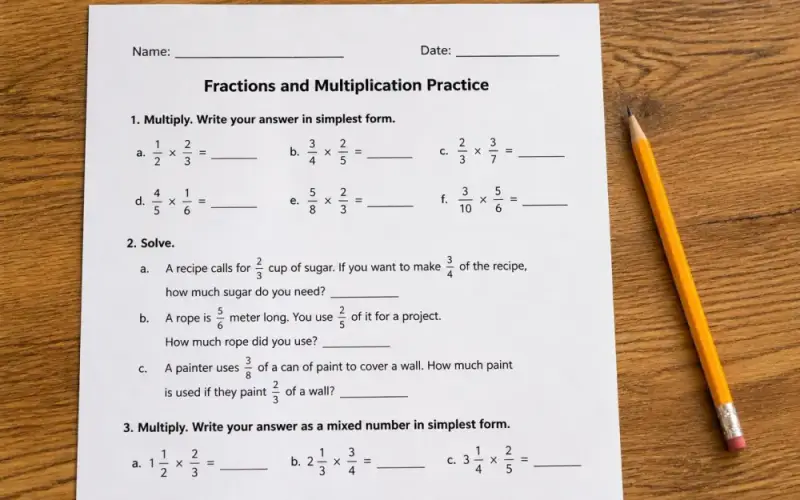
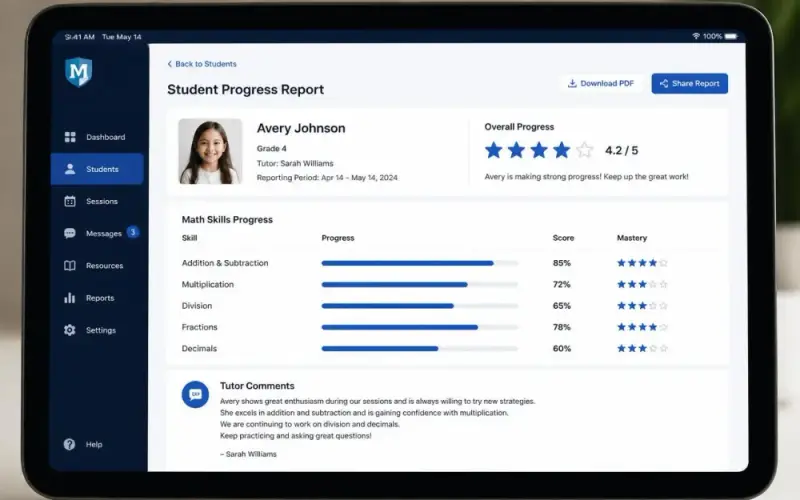
Simple monthly plans
$85a month for 2 one-to-one math lessons a week
- Free 45-minute assessment first
- No contract, cancel any month
- No registration fee
- 4-class money-back promise
- Switch tutor at no cost
- WhatsApp update after every class
Starter
2 lessons a week, best for keeping up with school
$85/mo
GrowthMost chosen
3 lessons a week, best for catching up + building confidence
$119/mo
Intensive
4 lessons a week, best for exam prep & fast improvement
$149/mo
Common worries, honest answers
“My child's class is behind and has not reached trig yet.”
We can teach Unit 3 ahead of the class so it is not brand new in April. Previewing a unit early also makes the school lessons feel like useful review.
“Does AP Precalculus matter if my child is taking calculus next?”
It matters a lot for that very reason. The course trains the function fluency that calculus depends on, and strong habits built now make the jump to AP Calculus smoother.
“Our school teaches Unit 4. Will you ignore it?”
No. If Unit 4 is graded at school, lessons cover it for class tests. We simply keep it out of AP Exam review because the exam does not assess it.
Frequently asked questions
What is the format of the AP Precalculus exam in May 2027?
Which units are on the AP Precalculus exam?
Is the AP Precalculus exam digital?
How much does an online AP Precalculus tutor cost?
Is AP Precalculus the same as regular precalculus?
Does AP Precalculus earn college credit?
Book a free 45-minute assessment
Your child meets a tutor for a real one-to-one session. You get an honest read on where they are and what would help, even if the answer is that they don't need tutoring right now.
- 1
We reply on WhatsApp
Usually within 10 minutes, to find a time that suits your family.
- 2
Your child meets the tutor
A relaxed 45-minute session to see their level and how they learn.
- 3
You decide
You get a recommendation and a plan. No card details, no pressure.