
A-level, sixth form · Ages 16-18
A-level Maths Tutor, Including Further Maths
One-to-one help with pure, statistics and mechanics for Years 12 and 13, matched to your child's exam board.
Prefer to ask a question first? Chat on WhatsApp

How it works, in short
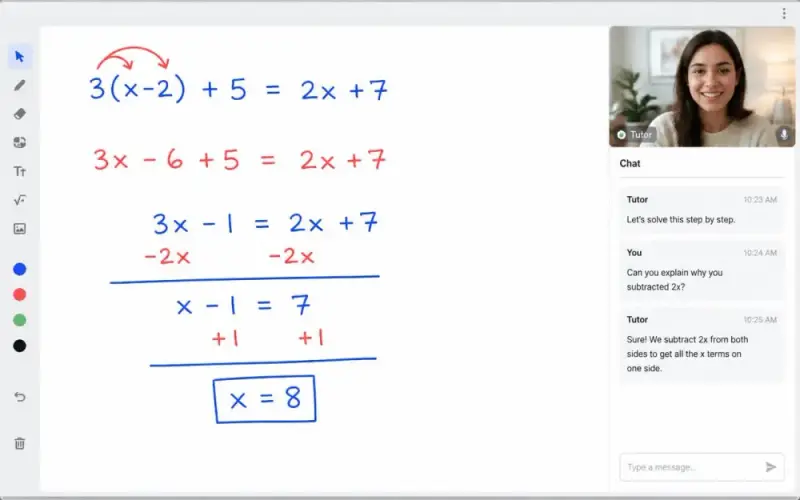
TaleemSquare A-level maths tutoring is live, one-to-one online teaching in 45-minute lessons for sixth-form students taking A-level Mathematics or Further Mathematics with AQA, Pearson Edexcel, OCR A or OCR B (MEI). Tutors cover pure maths, statistics and mechanics in the order your child's school teaches them, then move on to full past papers.
A-level Maths is examined through three 2-hour papers at the end of Year 13, graded A* to E, with a calculator allowed on every paper and a large data set behind some statistics questions. Lessons run on video with a shared whiteboard, after a free assessment, from £69 a month.
- Format
- Live, one-to-one, online
- Lesson length
- 45 minutes
- Level
- Ages 16-18
- Price
- From £69 a month
What changes after a term of lessons
Fluent in the pure core
Works confidently with proof, functions, trigonometry, exponentials and logarithms, differentiation, integration and vectors.
Applied topics that make sense
Models motion and forces in mechanics, and carries out a hypothesis test with binomial or normal distributions, explaining each step.
Ready for full papers
Can sit a 2-hour paper under timed conditions, set out working clearly for method marks and check results with the calculator.
What we cover
Lessons follow your child's own school or homeschool curriculum. These are the areas we work on most at this level.
Proof and algebra
Proof by deduction, exhaustion and contradiction, partial fractions, the binomial expansion, and functions with their inverses and transformations.
Trigonometry
Radians, small-angle approximations, reciprocal and inverse trig functions, compound and double-angle identities, and expressions in the form R cos(x + a).
Calculus
Differentiation from first principles, the chain, product and quotient rules, integration by substitution and by parts, and separable differential equations.
Sequences, exponentials and numerical methods
Arithmetic and geometric series, exponential growth and decay, logarithms, and numerical methods such as Newton-Raphson and the trapezium rule.
Statistics
Sampling, data presentation, probability, binomial and normal distributions and hypothesis testing, including questions set in the context of the board's large data set.
Mechanics
Units, kinematics with constant and variable acceleration, projectiles, forces and Newton's laws, friction and moments.
Further Maths
Complex numbers, matrices, further calculus, polar coordinates, hyperbolic functions and differential equations, plus optional units in mechanics, statistics or discrete and decision maths.
Exam technique
Using the formulae provided, recording calculator steps in proper notation, and tackling the longer problem-solving questions near the end of each paper.

Signs your child could use help
- Got a strong GCSE grade but is struggling in Year 12
- Pure marks are fine, but mechanics or statistics marks keep slipping
- Writes answers from the calculator without showing the method
- A university offer depends on a particular A-level maths grade
- Finding Further Maths much faster than A-level Maths
- Copes with routine questions but gets stuck on proof
One of these on its own is normal. Two or three together usually point to a specific gap, and finding it is what the free assessment is for.
Taught to your curriculum, wherever you live
A-level Maths for families in the US
A-levels are mostly taken at British-curriculum schools in the US. The content overlaps with precalculus, AP Calculus and parts of AP Statistics, plus mechanics that US schools usually teach in physics. US universities set their own policies on how they treat A-level results.
Level: Grades 11-12 (precalculus and calculus)
A-level Mathematics and Further Mathematics
Students in England, Wales and Northern Ireland usually study A-level Maths in Years 12 and 13, with all exams at the end. AQA, Pearson Edexcel, OCR A and OCR B (MEI) share the same Department for Education content but arrange the papers differently. Scotland uses Highers and Advanced Highers.
Level: Year 12 and Year 13 (sixth form)
A-level Maths for families in Canada
Canadian schools teach provincial courses instead, such as Ontario's Advanced Functions (MHF4U) and Calculus and Vectors (MCV4U), or Pre-calculus 12 and Calculus 12 in BC. A-level students in Canada are usually at international schools or applying to UK universities.
Level: Grade 12 functions and calculus
A-level Maths for families in Australia
The nearest Australian courses are senior subjects such as Mathematics Advanced and Extension 1 in NSW, or Mathematical Methods and Specialist Mathematics in Victoria and Queensland. A-level students in Australia are usually at international schools, and lessons follow their A-level board.
Level: Years 11-12 senior maths
Inside a 45-minute A-level maths lesson
One 45-minute session. Tutors adjust the timings to your child.
5 min
Retrieval question
A short question from an earlier pure topic.
13 min
Teaching
New content or a weak area, with notation and proofs written out in full.
15 min
Exam problem
A multi-part past-paper question, with hints only when needed.
7 min
Mark scheme and notation
Checking method marks and how calculator work should be shown.
5 min
Next steps
Independent questions set and a WhatsApp summary for parents.
How we teach A-level maths
Pure maths as the base
Weak algebra undermines mechanics and statistics answers too, so tutors close gaps in algebra and calculus before anything else.
Board-specific papers
Your child practises with past papers from their own board, so the mix of pure, statistics and mechanics matches what they will sit.
Large data set familiarity
Statistics lessons use the board's large data set throughout the course, not just in revision, so questions set in its context feel familiar.
Further Maths alongside
Students taking Further Maths can split their weekly lessons between the two courses, keeping both on track through Year 13.

Simple monthly plans
£69a month for 2 one-to-one maths lessons a week
- Free 45-minute assessment first
- No contract, cancel any month
- No registration fee
- 4-class money-back promise
- Switch tutor at no cost
- WhatsApp update after every class
Starter
2 lessons a week, best for keeping up with school
£69/mo
GrowthMost chosen
3 lessons a week, best for catching up + building confidence
£95/mo
Intensive
4 lessons a week, best for exam prep & fast improvement
£119/mo
Common worries, honest answers
“My child did well at GCSE but is finding A-level very hard.”
A-level expects fluent algebra from the first week, so small gaps left over from GCSE show up quickly. The free assessment pinpoints those skills, and early lessons repair them while keeping pace with Year 12 work.
“Can one tutor handle both Maths and Further Maths?”
Yes. The same tutor can teach both, which helps because Further Maths builds directly on A-level Maths. You decide how to split the weekly lessons, and the balance can shift as exams approach.
“Lessons might clash with sixth-form commitments.”
We schedule around your child's timetable, including evenings and weekends in UK time, and lessons can move around mocks and study leave.
Frequently asked questions
Which A-level maths exam boards do you tutor?
How is A-level maths assessed?
Are formulae given in A-level maths exams?
How much does an online A-level maths tutor cost?
Should my child take Further Maths?
What is the A-level maths large data set?
Book a free 45-minute assessment
Your child meets a tutor for a real one-to-one session. You get an honest read on where they are and what would help, even if the answer is that they don't need tutoring right now.
- 1
We reply on WhatsApp
Usually within 10 minutes, to find a time that suits your family.
- 2
Your child meets the tutor
A relaxed 45-minute session to see their level and how they learn.
- 3
You decide
You get a recommendation and a plan. No card details, no pressure.