
GCSE, Key Stage 4 · Ages 14-16
GCSE Maths Tutor for Foundation and Higher Tier
One-to-one lessons built around your child's exam board, tier and past papers, from Year 9 to the final exam.
Prefer to ask a question first? Chat on WhatsApp

How it works, in short
TaleemSquare GCSE maths tutoring is live, one-to-one online teaching in 45-minute lessons for students sitting GCSE Mathematics with AQA, Pearson Edexcel or OCR, at Foundation or Higher tier. Tutors teach the topics your child's school is covering, then build exam technique with past-paper questions on video and a shared whiteboard.
Every board sets three written papers of 1 hour 30 minutes, one of them non-calculator. Foundation covers grades 1-5 and Higher covers grades 4-9. A free assessment shows which tier and topics need attention first, and monthly plans begin at £69 for two lessons a week, with no contract.
- Format
- Live, one-to-one, online
- Lesson length
- 45 minutes
- Level
- Ages 14-16
- Price
- From £69 a month
What changes after a term of lessons
Secure on the core topics
Works through number, algebra, ratio, geometry, probability and statistics questions at their tier without stalling after the first step.
Steadier on the non-calculator paper
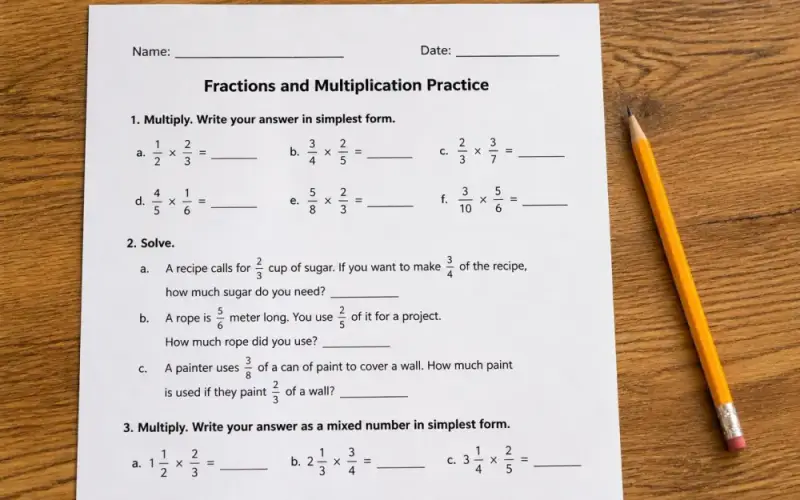
Uses reliable written methods for fractions, percentages and, at Higher, surds, so arithmetic slips cost fewer marks.
A revision plan that fits
Knows which topics lost marks in school mocks and follows a weekly plan of past-paper practice towards the summer exams.
What we cover
Lessons follow your child's own school or homeschool curriculum. These are the areas we work on most at this level.
Number
Fractions, decimals, percentages, standard form and error intervals, plus surds, recurring decimals and bounds calculations for Higher students.
Algebra
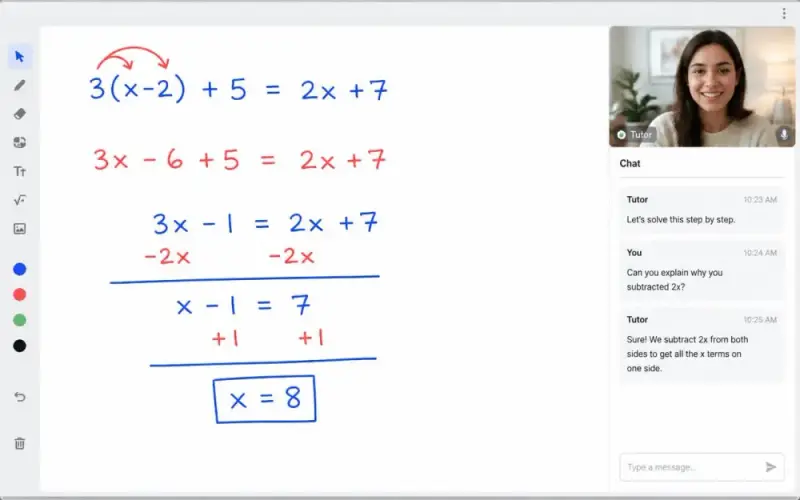
Expanding and factorising, linear and quadratic equations, simultaneous equations, sequences and graphs. Higher adds functions, iteration and algebraic proof.
Ratio, proportion and rates of change
Sharing in a ratio, direct and inverse proportion, compound interest, speed and density, and at Higher, gradients and areas under graphs.
Geometry and measures
Angles, area and volume, Pythagoras' theorem, trigonometry, constructions and transformations. Higher adds circle theorems, vector proofs and the sine and cosine rules.
Probability
Tree diagrams, Venn diagrams, relative frequency and expected outcomes, with conditional probability for Higher tier students.
Statistics
Sampling, averages and spread, charts and scatter graphs, plus cumulative frequency, box plots and histograms with unequal class widths at Higher.
Using the formulae sheet
Knowing which formulae the exam sheet gives and, more importantly, recognising which one a question needs and substituting into it correctly.
Exam technique
Reading command words, showing working that earns method marks, and pacing a full paper in 1 hour 30 minutes.

Signs your child could use help
- The school is deciding between Foundation and Higher entry
- Mock results sit well below the target grade
- Arithmetic slips keep costing marks on the non-calculator paper
- Follows worked examples but freezes on multi-step problems
- Revision so far means rereading notes, not doing past papers
- A sixth-form place depends on a particular GCSE maths grade
One of these on its own is normal. Two or three together usually point to a specific gap, and finding it is what the free assessment is for.
Taught to your curriculum, wherever you live
GCSE Maths for families in the US
GCSE is an English qualification, so US families usually meet it at British international schools or after relocating from the UK. The content sits roughly alongside Grades 9-10, mainly Algebra 1 and Geometry with some Algebra 2 ideas, and lessons follow the GCSE specification rather than state standards.
Level: Grades 9-10 (Algebra 1, Geometry)
GCSE Mathematics in England (AQA, Pearson Edexcel, OCR)
Students in England sit GCSE Maths at the end of Year 11, and all three boards teach the same Department for Education subject content. Wales and Northern Ireland have their own exam boards, WJEC and CCEA, while Scotland uses National 5 Mathematics.
Level: Year 10 and Year 11 (Key Stage 4)
GCSE Maths for families in Canada
Canadian provinces do not offer GCSEs, so this tutoring mostly supports students at British-curriculum schools or families planning a move to the UK. The closest provincial level is Grade 9 and 10 maths, and tutors teach to the GCSE board your child will sit.
Level: Grades 9-10 maths
GCSE Maths for families in Australia
Australian schools follow the Australian Curriculum or a state syllabus, so GCSE matters mainly for families moving between the UK and Australia. GCSE content compares broadly with Year 9 and 10 maths, and lessons keep to the English specification and exam style.
Level: Years 9-10 maths
Inside a 45-minute GCSE maths lesson
One 45-minute session. Tutors adjust the timings to your child.
5 min
Warm-up
Quick non-calculator questions on earlier topics.
12 min
New content
One topic from the school's scheme of work, taught on the shared whiteboard.
15 min
Exam questions
Past-paper questions on that topic, solved by your child with coaching.
8 min
Mark scheme check
Comparing working with the official mark scheme to see where marks come from.
5 min
Plan and update
Practice set for the week and a short WhatsApp note for you.
How we teach GCSE maths
Board and tier first
Lessons start from your child's specification and tier, so time goes on what their papers can ask rather than on content they will never see.
Non-calculator fluency
Short arithmetic warm-ups in most lessons keep written methods sharp for the paper where calculators are not allowed.
Real papers, real mark schemes
Practice uses past and specimen papers from your child's own board, marked against the official mark scheme so method marks make sense.
Mock-led planning
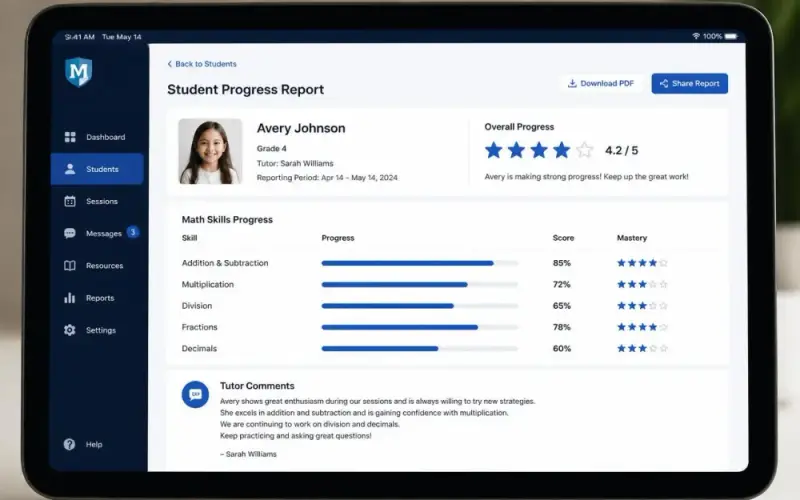
After each school mock, the tutor looks at where marks were lost and sends you an updated topic plan on WhatsApp.

Simple monthly plans
£69a month for 2 one-to-one maths lessons a week
- Free 45-minute assessment first
- No contract, cancel any month
- No registration fee
- 4-class money-back promise
- Switch tutor at no cost
- WhatsApp update after every class
Starter
2 lessons a week, best for keeping up with school
£69/mo
GrowthMost chosen
3 lessons a week, best for catching up + building confidence
£95/mo
Intensive
4 lessons a week, best for exam prep & fast improvement
£119/mo
Common worries, honest answers
“The school says Foundation, but I think my child could manage Higher.”
Tier entry is the school's decision, usually made after mocks. Our tutor can show you which Higher topics your child already handles and which are missing, so you have something concrete to discuss with their maths teacher.
“We have left it late and the exams are only months away.”
Focused lessons still help in that time. The tutor ranks topics by how many marks your child is currently dropping and spends lesson time where improvement is most within reach.
“My child goes blank in exams even when they know the work.”
Lessons include timed sections that grow gradually longer, so working against the clock becomes familiar. Tutors also teach a simple routine for unfamiliar questions: write down what is known, try a first step, and move on if stuck.
Frequently asked questions
Which GCSE maths exam boards do you cover?
How is GCSE maths assessed?
Is there a formulae sheet in GCSE maths exams?
How much does an online GCSE maths tutor cost?
What is the difference between Foundation and Higher tier?
When should my child start GCSE maths tutoring?
Book a free 45-minute assessment
Your child meets a tutor for a real one-to-one session. You get an honest read on where they are and what would help, even if the answer is that they don't need tutoring right now.
- 1
We reply on WhatsApp
Usually within 10 minutes, to find a time that suits your family.
- 2
Your child meets the tutor
A relaxed 45-minute session to see their level and how they learn.
- 3
You decide
You get a recommendation and a plan. No card details, no pressure.