
Primary school, Key Stage 2 · Ages 7-11
KS2 Maths Tutor for Years 3-6, Times Tables and SATs
One-to-one Key Stage 2 maths that follows the national curriculum, from Year 3 times tables to Year 6 SATs.
Prefer to ask a question first? Chat on WhatsApp

How it works, in short
TaleemSquare KS2 maths tutoring is live, one-to-one online lessons of 45 minutes for children in Years 3 to 6, following the national curriculum in England. Tutors cover place value, the four operations, times tables, fractions, decimals, measures, geometry and statistics, plus ratio and algebra in Year 6, repairing gaps from earlier years first.
Lessons also prepare children for the two statutory maths checks in Key Stage 2: the multiplication tables check in June of Year 4, and the Year 6 SATs in May, made up of an arithmetic paper and two reasoning papers. A free assessment comes first, and plans start at £69 a month.
- Format
- Live, one-to-one, online
- Lesson length
- 45 minutes
- Level
- Ages 7-11
- Price
- From £69 a month
What changes after a term of lessons
Instant times tables
Recalls multiplication and division facts up to 12 x 12 quickly enough to use them inside bigger calculations.
Reliable written methods
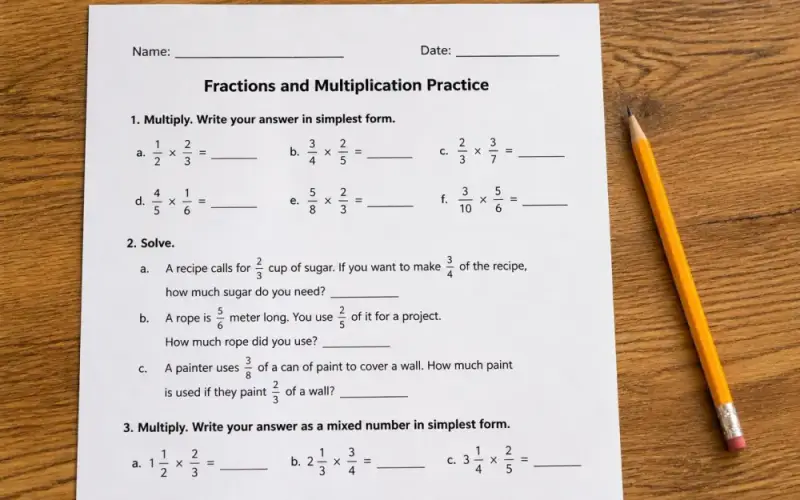
Uses column addition and subtraction, short and long multiplication, and short and long division accurately, checking with estimation.
Ready for SATs-style questions
Tackles arithmetic questions and multi-step reasoning problems in the style of the Key Stage 2 papers, and can explain each step.
What we cover
Lessons follow your child's own school or homeschool curriculum. These are the areas we work on most at this level.
Place value and rounding
Numbers to 1,000 in Year 3, growing to 10,000,000 by Year 6, with rounding, negative numbers and Roman numerals along the way.
Times tables and mental maths
The 3, 4 and 8 tables in Year 3 and every table up to 12 x 12 by the end of Year 4, practised for speed and recall.
Written calculation
Column methods first, then short multiplication, long multiplication in Year 5, long division in Year 6 and the order of operations.
Fractions, decimals and percentages
From unit fractions in Year 3 to adding fractions with different denominators, decimals to three places and percentages in Years 5 and 6.
Ratio and algebra
Year 6 introduces ratio and proportion, simple formulae, linear number sequences and missing-number problems expressed with letters.
Measurement
Money, time, converting units, perimeter, area of rectangles, triangles and parallelograms, and volume of cubes and cuboids.
Geometry and position
Angles measured in degrees, properties of 2D and 3D shapes, parts of a circle, coordinates in all four quadrants, reflections and translations.
Statistics
Bar charts, pictograms and tables in Year 3, line graphs and timetables later, then pie charts and the mean in Year 6.

Signs your child could use help
- Still counts on fingers for times tables in Year 4 or later
- Times tables practice at home ends in tears or guessing
- Gets lost halfway through long multiplication or long division
- Cannot say which of two fractions is bigger
- Leaves reasoning homework blank because the question looks confusing
- The teacher says they are not yet at the expected standard
One of these on its own is normal. Two or three together usually point to a specific gap, and finding it is what the free assessment is for.
Taught to your curriculum, wherever you live
Common Core State Standards, Grades 2-5
Key Stage 2 roughly matches US Grades 2 to 5. Both build place value, multiplication and division, fractions and measurement, but the pace differs: Common Core expects all products of one-digit numbers from memory by the end of Grade 3, while England expects tables up to 12 x 12 by Year 4.
Level: Grades 2-5
National Curriculum in England: Key Stage 2 mathematics
Children take the multiplication tables check in June of Year 4 and the KS2 maths tests in May of Year 6: Paper 1 arithmetic (30 minutes) and Papers 2 and 3 reasoning (40 minutes each), with no calculator. Results are reported as scaled scores.
Provincial mathematics curricula, Grades 2-5
Ontario, British Columbia and Alberta each set their own elementary maths curriculum. The content overlaps with Key Stage 2: number sense, operations, fractions and decimals, measurement, geometry and data. In Ontario, EQAO assesses maths in Grade 3 and Grade 6.
Level: Grades 2-5
Australian Curriculum: Mathematics, Years 2-5
Number, algebra, measurement, space, statistics and probability, set out year by year. NAPLAN numeracy is sat in Years 3 and 5, which fall within this age range.
Level: Years 2-5
Inside a 45-minute KS2 maths lesson
One 45-minute session. Tutors adjust the timings to your child.
5 min
Times tables warm-up
A quick recall game with mixed tables.
7 min
Revisit
One earlier skill that today's topic depends on.
12 min
New learning
Taught with a visual model on the whiteboard, then the written method.
13 min
Practice
Arithmetic questions, then a reasoning problem in the KS2 style.
8 min
Explain and wrap up
Your child explains one answer aloud. You get a WhatsApp note on progress.
How we teach KS2 maths
Back to where it broke
If Year 5 fractions are shaky because Year 3 equivalence never stuck, lessons start there. The free assessment pinpoints the earliest missing step.
Models, then methods
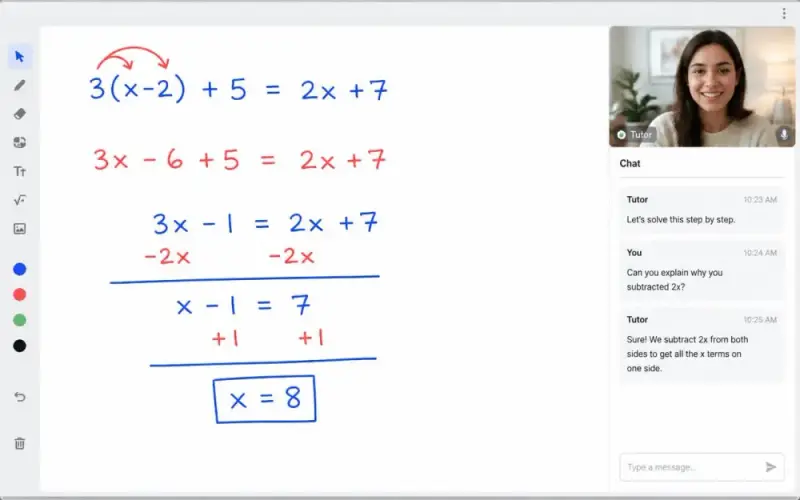
Place value counters, bar models and arrays on the whiteboard show why a written method works before your child practises it alone.
Little and often for tables
A few minutes of varied times tables recall in every lesson builds speed for the Year 4 check without cramming.
Reasoning in full sentences
Children explain how they know an answer is right, the habit the Year 6 reasoning papers reward, instead of just writing a number.

Simple monthly plans
£69a month for 2 one-to-one maths lessons a week
- Free 45-minute assessment first
- No contract, cancel any month
- No registration fee
- 4-class money-back promise
- Switch tutor at no cost
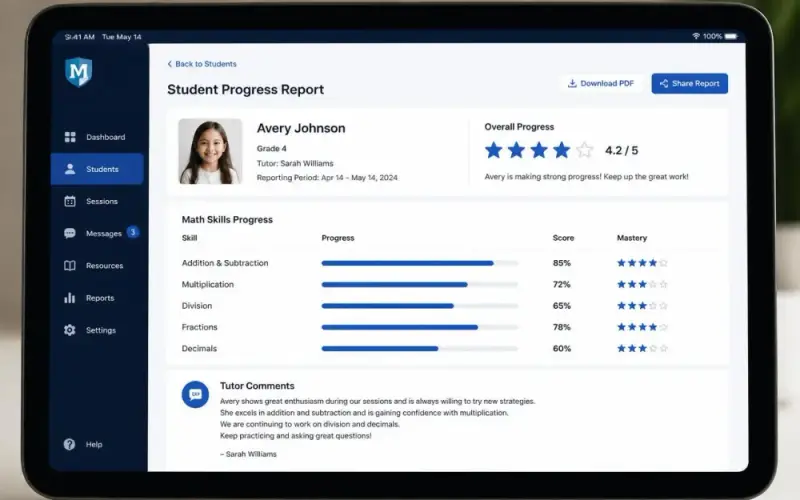
- WhatsApp update after every class
Starter
2 lessons a week, best for keeping up with school
£69/mo
GrowthMost chosen
3 lessons a week, best for catching up + building confidence
£95/mo
Intensive
4 lessons a week, best for exam prep & fast improvement
£119/mo
Common worries, honest answers
“Is it too late to help before SATs in May?”
Even a term of weekly lessons can improve arithmetic accuracy and confidence with reasoning questions. We prioritise the topics your child finds hardest and practise questions in the style of past papers, without promising a particular scaled score.
“My child panics about the times tables check.”
The check has no pass mark. We practise tables through short games and quick-fire rounds, so recall becomes automatic and the six-second timer feels far less frightening.
“Will this clash with how the school teaches?”
Tutors use national curriculum methods and vocabulary, such as column methods, bar models and partitioning. If the school teaches a particular approach, share a homework sheet and the tutor will match it.
Frequently asked questions
What is in the KS2 maths SATs?
When are the 2027 KS2 maths SATs?
What is the Year 4 multiplication tables check?
How much does an online KS2 maths tutor cost?
Is KS2 maths the same across the UK?
Can you help a child who is already ahead in maths?
Book a free 45-minute assessment
Your child meets a tutor for a real one-to-one session. You get an honest read on where they are and what would help, even if the answer is that they don't need tutoring right now.
- 1
We reply on WhatsApp
Usually within 10 minutes, to find a time that suits your family.
- 2
Your child meets the tutor
A relaxed 45-minute session to see their level and how they learn.
- 3
You decide
You get a recommendation and a plan. No card details, no pressure.