
Secondary school, Key Stage 3 · Ages 11-14
KS3 Maths Tutor: Strong Foundations Before GCSE
One-to-one Key Stage 3 maths for Years 7 to 9, closing gaps now so GCSE starts on firm ground.
Prefer to ask a question first? Chat on WhatsApp

How it works, in short
TaleemSquare KS3 maths tutoring is live, one-to-one online lessons of 45 minutes for students in Years 7, 8 and 9, following the national curriculum in England. Tutors cover number, algebra, ratio and proportion, geometry and measures, probability and statistics, the content that GCSE Maths builds on directly in Years 10 and 11.
There is no national exam at Key Stage 3, so progress is judged through school tests and teacher assessment. That makes these years the right time to fix gaps calmly, before GCSE pressure arrives. A free assessment shows where your child stands, and plans start at £69 a month.
- Format
- Live, one-to-one, online
- Lesson length
- 45 minutes
- Level
- Ages 11-14
- Price
- From £69 a month
What changes after a term of lessons
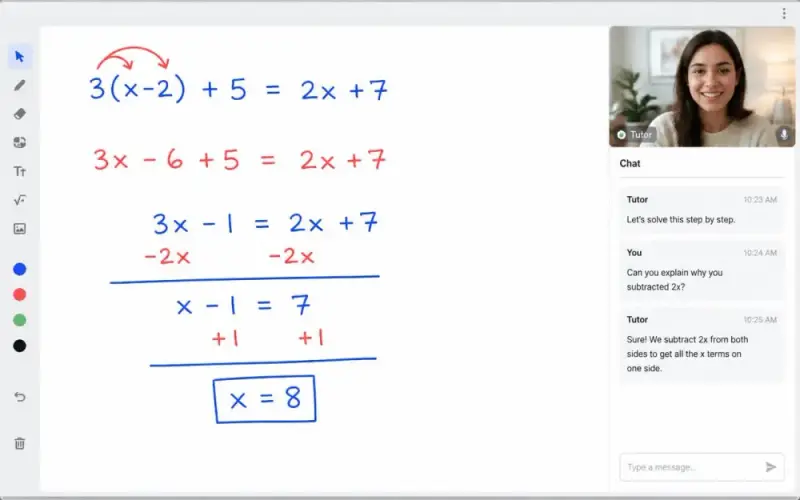
Fluent with algebra
Simplifies, expands and factorises expressions, solves linear equations that need rearranging and reads straight-line graphs with confidence.
Comfortable with proportion
Handles percentage change, ratio, direct and inverse proportion, and compound units such as speed and density in real problems.
Ready for the GCSE course
Starts Year 10 with Key Stage 3 foundations secure, so new GCSE topics build on understanding rather than on gaps.
What we cover
Lessons follow your child's own school or homeschool curriculum. These are the areas we work on most at this level.
Number
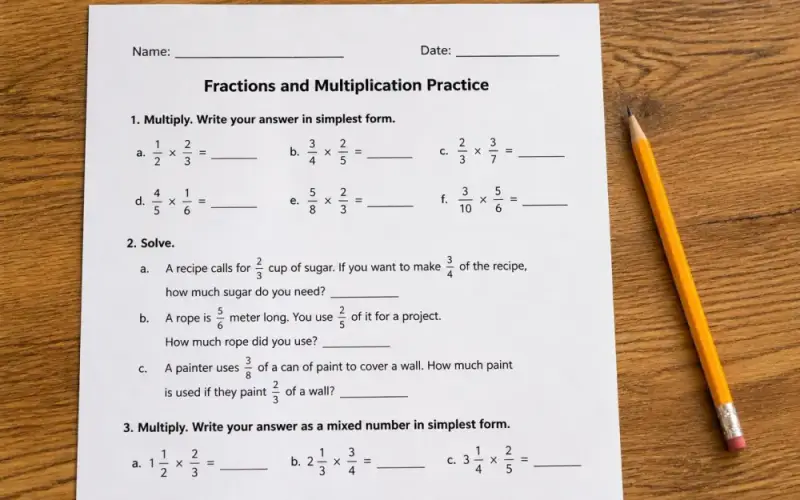
Negative numbers, fractions, decimals and percentages, powers and roots, primes, HCF and LCM, standard form, rounding and estimation.
Algebraic expressions
Notation, substitution, simplifying, expanding brackets and factorising, including products of two binomials.
Equations and graphs
Solving linear equations that need rearranging, plotting and sketching linear and quadratic graphs, and using y = mx + c for gradients and intercepts.
Sequences
Term-to-term and position-to-term rules, finding the nth term of an arithmetic sequence and recognising geometric sequences.
Ratio, proportion and rates of change
Ratio notation, scale diagrams and maps, percentage increase and decrease, direct and inverse proportion, and compound units like unit pricing.
Geometry and measures
Area and volume, circles, angles with parallel lines, constructions, transformations, Pythagoras' theorem and trigonometric ratios in right-angled triangles.
Probability
Sample spaces, Venn diagrams, mutually exclusive outcomes and comparing experimental results with theoretical probability.
Statistics
Mean, median, mode and range, frequency tables, charts and scatter graphs, and describing the relationship between two variables.

Signs your child could use help
- Primary maths felt easy, but Year 7 suddenly feels hard
- Avoids any question with letters in it
- Placed in a lower set, or worried about moving down
- End-of-year school test results were lower than expected
- Negative numbers and fractions keep tripping them up in algebra
- GCSE options are coming up and maths confidence is low
One of these on its own is normal. Two or three together usually point to a specific gap, and finding it is what the free assessment is for.
Taught to your curriculum, wherever you live
Common Core State Standards, Grades 6-8
Key Stage 3 roughly lines up with US middle school. Grades 6-8 cover ratios and proportional relationships, the number system, expressions and equations, and an introduction to functions, with the Pythagorean theorem in Grade 8.
Level: Grades 6-8 (middle school)
National Curriculum in England: Key Stage 3 mathematics
Years 7-9 cover number, algebra, ratio and proportion, geometry and measures, probability and statistics. There are no national tests at this stage; schools assess progress themselves. A revised national curriculum is due for first teaching from September 2028.
Provincial mathematics, Grades 6-8
Ontario, British Columbia and Alberta set their own Grades 6-8 maths. The content overlaps closely with Key Stage 3: integers, ratios and rates, linear relations, geometry and data. In Ontario, EQAO assesses maths in Grade 6 and Grade 9.
Level: Grades 6-8
Australian Curriculum: Mathematics, Years 6-8
Years 6 to 8 cover integers, fractions and percentages, ratios and rates, algebra and linear equations, area and volume, and probability. NAPLAN numeracy is sat in Year 7.
Level: Years 6-8
Inside a 45-minute KS3 maths lesson
One 45-minute session. Tutors adjust the timings to your child.
6 min
Retrieval starter
Three quick questions on earlier topics to keep them fresh.
7 min
Homework check
Anything from this week's class or homework that did not make sense.
12 min
Core topic
Today's idea taught on the whiteboard with worked examples.
14 min
Independent practice
Questions that build from routine to problem solving.
6 min
Summary
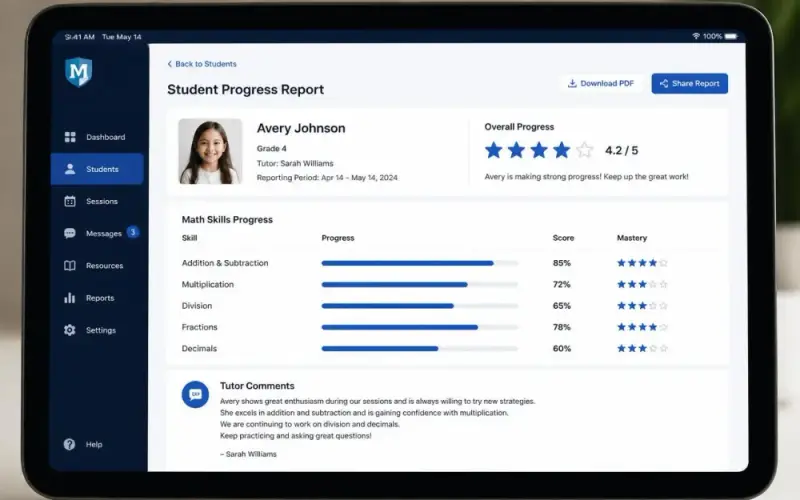
Your child sums up the method. You receive a WhatsApp update.
How we teach KS3 maths
Check the jump from primary
Year 7 assumes Key Stage 2 is secure. We test fractions, negative numbers and written methods first, because algebra quietly depends on all three.
Algebra as general number
Letters are treated as numbers we have not named yet and checked by substituting values, so the rules make sense instead of feeling arbitrary.
Run alongside the school
Send the topic list or homework and lessons will follow the class, with extra time on whatever was rushed.
One eye on GCSE
Where it helps, the tutor shows how today's topic appears in GCSE questions, so the step up in Year 10 feels familiar.

Simple monthly plans
£69a month for 2 one-to-one maths lessons a week
- Free 45-minute assessment first
- No contract, cancel any month
- No registration fee
- 4-class money-back promise
- Switch tutor at no cost
- WhatsApp update after every class
Starter
2 lessons a week, best for keeping up with school
£69/mo
GrowthMost chosen
3 lessons a week, best for catching up + building confidence
£95/mo
Intensive
4 lessons a week, best for exam prep & fast improvement
£119/mo
Common worries, honest answers
“Isn't Year 7 too early to think about GCSE?”
There is no need to teach GCSE content early. The point of KS3 tutoring is to make number and algebra secure, because the GCSE course in Years 10 and 11 assumes them and moves quickly.
“My child was fine at primary and is now struggling.”
The move to secondary brings abstract algebra at the same time as a new school, new teachers and faster lessons. Tutors rebuild confidence by revisiting the primary skills that sit underneath each new topic.
“Will the tutor follow my child's set and scheme of work?”
Yes. Share the topic list, the set your child is in or recent test papers, and the tutor will plan around them, adding catch-up on older gaps where needed. If your child changes set, lessons adjust.
Frequently asked questions
What maths is taught in KS3?
Is there a national maths exam in KS3?
When should my child start KS3 maths tutoring?
How much does an online KS3 maths tutor cost?
Is the national curriculum changing?
Do academies and independent schools follow KS3?
Book a free 45-minute assessment
Your child meets a tutor for a real one-to-one session. You get an honest read on where they are and what would help, even if the answer is that they don't need tutoring right now.
- 1
We reply on WhatsApp
Usually within 10 minutes, to find a time that suits your family.
- 2
Your child meets the tutor
A relaxed 45-minute session to see their level and how they learn.
- 3
You decide
You get a recommendation and a plan. No card details, no pressure.