
VCE Units 1-4 · Ages 15-18
VCE Maths Tutor for Methods, Specialist and General
One-to-one lessons for VCE Units 1-4, planned around your child's SAC dates and end-of-year exams.
Prefer to ask a question first? Chat on WhatsApp

How it works, in short
TaleemSquare VCE maths tutoring is live, one-to-one online lessons of 45 minutes for Victorian students in Foundation Mathematics, General Mathematics, Mathematical Methods or Specialist Mathematics, Units 1 to 4. Tutors teach to the VCAA study design introduced in 2023 and practise both the technology-free and the CAS-allowed exam styles.
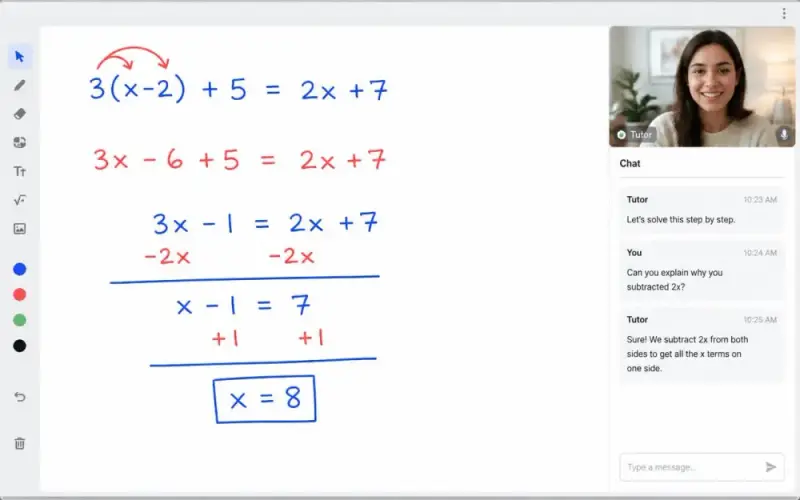
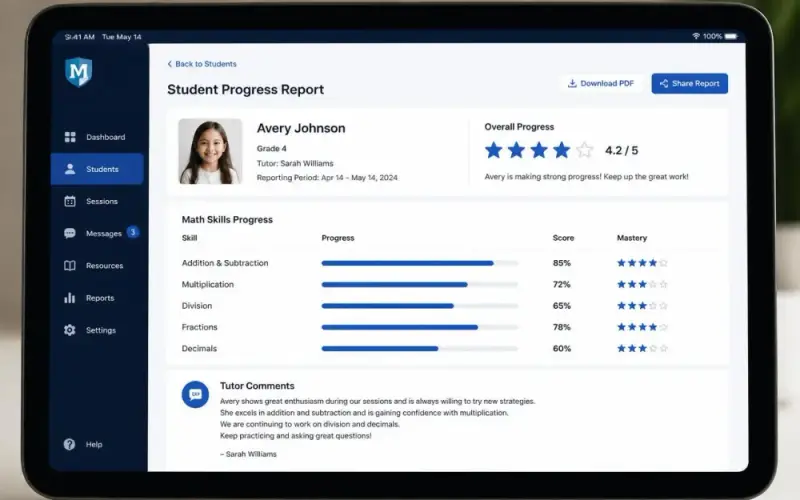
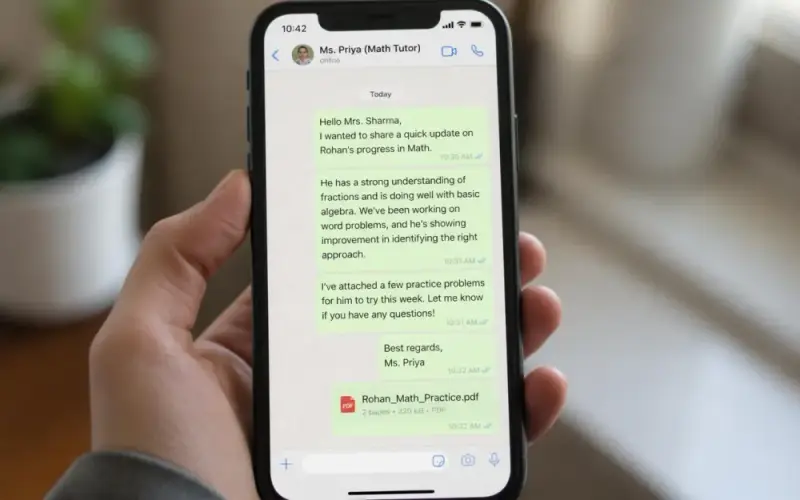
Lessons run on video with a shared whiteboard, so the tutor sees every line of working, and you receive a WhatsApp update after each one. Plans are A$130 a month for two lessons a week, with no contract and no registration fee, after a free assessment.
- Format
- Live, one-to-one, online
- Lesson length
- 45 minutes
- Level
- Ages 15-18
- Price
- From A$130 a month
What changes after a term of lessons
Fluent without the CAS
Handles algebra, derivatives and exact values by hand, which Exam 1 in Methods and Specialist requires with no calculator and no notes.
Efficient with the CAS
Knows when to reach for the CAS calculator, how to set up a problem on it and how much working to show for multi-mark questions.
Prepared for the next SAC
Has practised the modelling and problem-solving style of the coming task, so the SAC itself holds fewer surprises.
What we cover
Lessons follow your child's own school or homeschool curriculum. These are the areas we work on most at this level.
Functions, relations and graphs
Polynomial, power, exponential, logarithmic and circular functions, their transformations and graphs, and composite and inverse functions in Methods.
Calculus in Methods
Derivatives and antiderivatives, the chain, product and quotient rules, tangents, optimisation, areas under curves and the trapezium rule approximation.
Probability and statistics
Discrete and continuous random variables, the binomial and normal distributions and sample proportions in Methods, extended to hypothesis testing for means in Specialist.
Specialist: proof, complex numbers, vectors
Logic and proof including induction, complex numbers in polar form and De Moivre's theorem, and vectors in three dimensions, including lines and planes.
Specialist: further calculus
Integration by substitution and by parts, volumes of revolution, arc length, differential equations, slope fields, Euler's method and kinematics.
General Mathematics
Data analysis and recursion with financial modelling in Unit 3, then matrices, and networks and decision mathematics, in Unit 4.
Foundation Mathematics
Practical maths for everyday and work settings, covering number and algebra, data, financial maths, and space and measurement, with Units 3 and 4 available since 2023.
Exam 1 and Exam 2 technique
In Methods and Specialist, Exam 1 is one hour with no technology or notes, and Exam 2 is two hours with CAS and a bound reference.

Signs your child could use help
- Deciding between General and Methods for Units 3 and 4
- Gets answers on the CAS but cannot do them by hand
- SAC results lower than class test results
- Finding Specialist moves much faster than Methods
- Bound reference is thick but rarely helps in the exam
- Worried about study scores and how maths counts in the ATAR
One of these on its own is normal. Two or three together usually point to a specific gap, and finding it is what the free assessment is for.
Taught to your curriculum, wherever you live
Precalculus, AP Calculus and AP Statistics
Mathematical Methods overlaps with precalculus and much of AP Calculus AB, plus distributions and sampling seen in AP Statistics. Specialist adds proof, complex numbers, vectors and differential equations, some of it beyond most US high school courses. General Mathematics is closer to applied data and finance courses.
Level: Grades 11-12, precalculus, calculus and statistics
A-level Mathematics and Further Mathematics
Methods covers much of the pure and statistics content in A-level Mathematics, including calculus, functions and the normal distribution. Specialist's complex numbers, proof by induction and differential equations overlap with A-level Further Mathematics.
Level: Sixth form, A-level Maths and Further Maths
Grade 12 university-preparation maths
Methods is broadly comparable to Grade 12 functions and calculus courses such as Ontario's MHF4U and MCV4U. Specialist goes further into complex numbers, vectors and differential equations, and General Mathematics is closer to data management and applied courses.
Level: Grade 12 functions, calculus and data management
VCE Mathematics Study Design (VCAA), from 2023
Foundation, General, Methods and Specialist each run as Units 1-4, with Units 3 and 4 taken as a sequence, usually in Year 12. In Methods and Specialist, SACs are 40% of the study score and two exams 60%. Specialist 3 and 4 assumes Methods 3 and 4.
Inside a 45-minute VCE maths lesson
One 45-minute session. Tutors adjust the timings to your child.
6 min
By-hand starter
A short technology-free question to keep Exam 1 skills sharp.
12 min
Current topic
The area of study your child's class is on, taught with the notation VCAA exams use.
10 min
CAS practice
An Exam 2 style question, with the tutor checking how your child uses the CAS.
12 min
Extended response
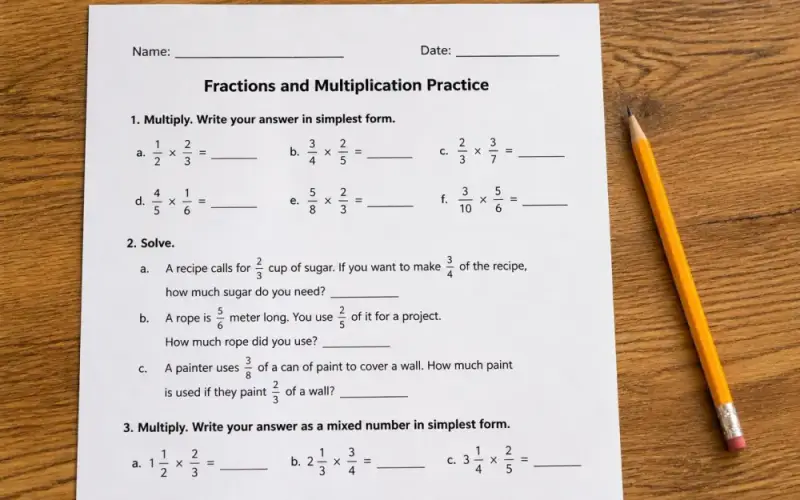
A multi-part question on the whiteboard, with feedback on setting out and reasoning.
5 min
Wrap-up
Key points and next steps, sent to you on WhatsApp.
How we teach VCE maths
Two kinds of fluency
Each week mixes by-hand work for the technology-free paper with CAS work for the technology-active one, so neither skill fades.
SAC-aware planning
Lessons follow your child's school calendar and build the skills that an upcoming application or problem-solving task will draw on.
A bound reference they know
Students build and trim their own bound reference across the year, so in Exam 2 it is a tool they trust rather than a stack of pages.
Integrity on assessed work
Tutors explain the mathematics and set similar practice, but never complete or edit SAC work, which VCAA rules require to be the student's own.
Simple monthly plans
A$130a month for 2 one-to-one maths lessons a week
- Free 45-minute assessment first
- No contract, cancel any month
- No registration fee
- 4-class money-back promise
- Switch tutor at no cost
- WhatsApp update after every class
Starter
2 lessons a week, best for keeping up with school
A$130/mo
GrowthMost chosen
3 lessons a week, best for catching up + building confidence
A$179/mo
Intensive
4 lessons a week, best for exam prep & fast improvement
A$229/mo
Common worries, honest answers
“My child chose Methods but might be better off in General.”
Subject choices belong to your child and their school, and each school sets its own deadline for changing Units 3 and 4 subjects. The free assessment shows where the difficulties sit, so you can have that conversation with clearer information.
“Will the tutor know our CAS calculator and textbook?”
Tell us which CAS model and textbook your child's school uses when you book. The tutor plans lessons around what your child actually has on the desk, including their own notes for the bound reference.
“My child is only in Year 10 and still choosing VCE subjects.”
Units 1 and 2 rely heavily on algebra and functions, and Specialist builds on Methods. Strengthening those skills before Year 11 helps whichever maths your child picks, and the free assessment can show where to start.
Frequently asked questions
What is the difference between VCE General Maths and Methods?
What do technology-free and technology-active mean in VCE maths exams?
Can a tutor help with VCE maths SACs?
How much does an online VCE maths tutor cost?
Does my child need Methods to take Specialist Maths?
What changed in the VCE Mathematics study design in 2023?
Book a free 45-minute assessment
Your child meets a tutor for a real one-to-one session. You get an honest read on where they are and what would help, even if the answer is that they don't need tutoring right now.
- 1
We reply on WhatsApp
Usually within 10 minutes, to find a time that suits your family.
- 2
Your child meets the tutor
A relaxed 45-minute session to see their level and how they learn.
- 3
You decide
You get a recommendation and a plan. No card details, no pressure.