
Elementary school · Ages 6-7
1st Grade Math Tutor: Playful One-to-One Lessons
Counting, adding within 20 and tens and ones, taught with games and pictures your six-year-old enjoys.
Prefer to ask a question first? Chat on WhatsApp

How it works, in short
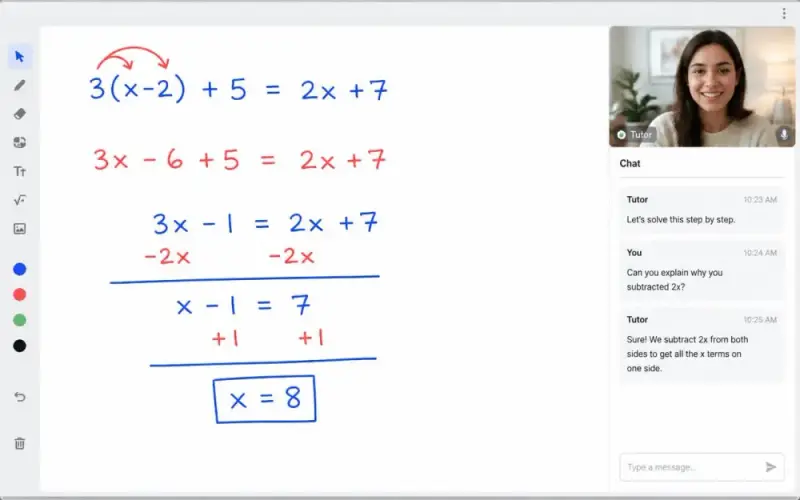
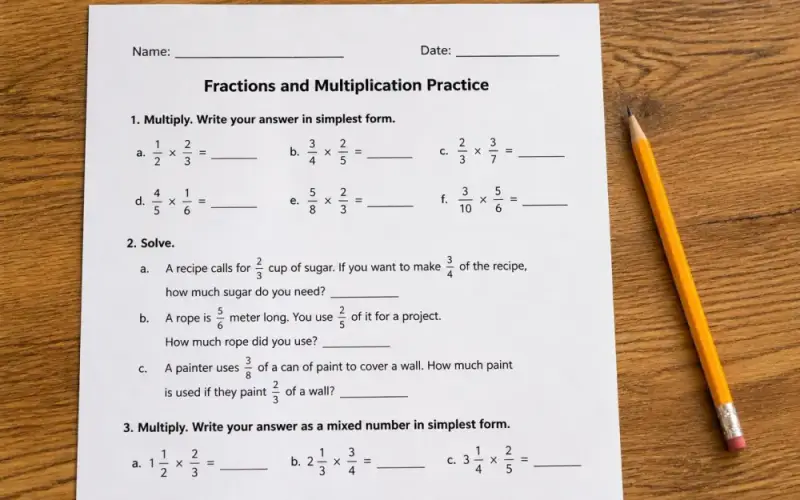
First grade math tutoring at TaleemSquare is a live, one-to-one online lesson where a patient tutor works on the skills first graders need: counting to 120, adding and subtracting within 20, understanding tens and ones, telling time to the half hour, and simple word problems.
Lessons are short bursts of activity on a shared whiteboard, with counters, number lines and drawings. Your child meets the tutor in a free assessment first, and plans start at $85 a month.
- Format
- Live, one-to-one, online
- Lesson length
- 45 minutes
- Level
- Ages 6-7
- Price
- From $85 a month
What changes after a term of lessons
Adds and subtracts within 20
Uses strategies like making ten and counting on instead of counting every object from one.
Understands tens and ones
Knows that 34 means three tens and four ones, which makes two-digit addition make sense.
Enjoys math time
Looks forward to lessons because they feel like games, and stops saying math is too hard.
What we cover
Lessons follow your child's own school or homeschool curriculum. These are the areas we work on most at this level.
Counting to 120
Counting forward and back from any number, reading and writing numbers, and counting by 2s, 5s and 10s.
Addition and subtraction within 20
Making ten, doubles, near doubles and the link between addition and subtraction.
Place value: tens and ones
Bundling objects into tens, comparing two-digit numbers with greater than and less than.
Adding within 100
Adding a two-digit number and a one-digit number or a multiple of ten using models.
Word problems
Simple story problems about adding to, taking from, putting together and comparing.
Measurement and time
Comparing lengths, measuring with units, and telling time to the hour and half hour.
Shapes
Naming and drawing shapes, and splitting circles and rectangles into halves and fourths.

Signs your child could use help
- Counts every object from one each time
- Writes some numbers backwards, like 12 as 21
- Struggles to remember facts like 5 + 5
- Gets upset or hides during math homework
- Can count high but not compare numbers
- Teacher says they are behind in math
One of these on its own is normal. Two or three together usually point to a specific gap, and finding it is what the free assessment is for.
Taught to your curriculum, wherever you live
Common Core Grade 1 (or your state's standards)
Grade 1 focuses on addition and subtraction within 20, place value with tens and ones, measuring length, and shapes. States such as Texas and Florida use their own standards with very similar content.
National Curriculum in England, Year 2 (Key Stage 1)
Year 2 covers number to 100, addition and subtraction facts to 20, 2, 5 and 10 times tables, fractions like half and quarter, money, time and shapes.
Level: Year 2
Ontario Grade 1 mathematics (other provinces similar)
Number sense to 50 and beyond, early addition and subtraction, patterns, spatial sense and financial literacy with coins. We follow your province's curriculum.
Level: Grade 1
Australian Curriculum v9.0, Year 1
Numbers to 120, partitioning, adding and subtracting with physical and virtual materials, halves, time and shapes.
Level: Year 1
What a 1st grade math lesson looks like
One 45-minute session. Tutors adjust the timings to your child.
6 min
Hello and number game
A quick counting or dice game to settle in.
10 min
Today's idea
Shown with counters or a ten-frame on the whiteboard.
10 min
Try it together
Your child moves, draws and counts with the tutor.
7 min
Story problem
A short word problem read aloud and acted out.
8 min
Fact game
Fast, fun practice of addition or subtraction facts.
4 min
Goodbye
Your child tells the tutor one thing they learned.
How we teach first graders
Hands and eyes first
Every idea starts with counters, ten-frames or drawings on the whiteboard before it becomes a written sum.
Activities that change often
Tutors switch tasks every few minutes to match a six-year-old's attention span.
Games for fact practice
Number facts are practised with quick games, so recall builds without drill-and-kill worksheets.
Praise for effort
Tutors celebrate trying and explaining, not just right answers, so your child keeps having a go.
Simple monthly plans
$85a month for 2 one-to-one math lessons a week
- Free 45-minute assessment first
- No contract, cancel any month
- No registration fee
- 4-class money-back promise
- Switch tutor at no cost
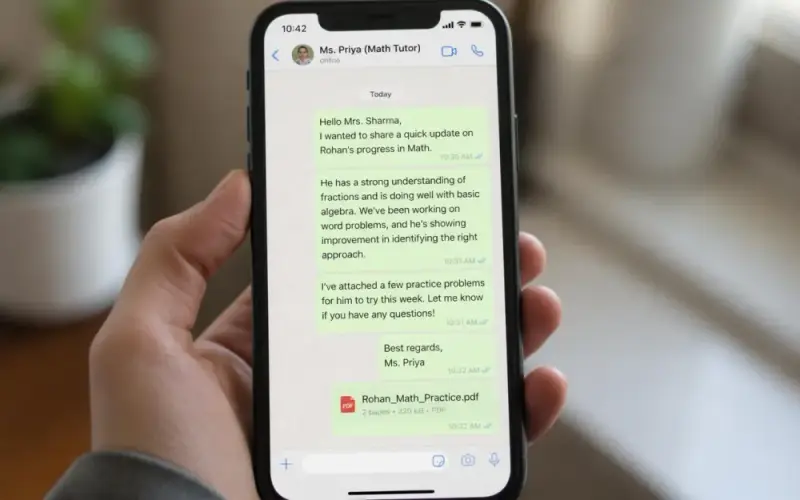
- WhatsApp update after every class
Starter
2 lessons a week, best for keeping up with school
$85/mo
GrowthMost chosen
3 lessons a week, best for catching up + building confidence
$119/mo
Intensive
4 lessons a week, best for exam prep & fast improvement
$149/mo
Common worries, honest answers
“Is my six-year-old too young for online lessons?”
Not usually, as long as lessons are active. Tutors keep first graders drawing and moving things on screen. A parent nearby for the first lesson or two helps them settle.
“Will 45 minutes be too long?”
We break the lesson into short activities, and most first graders manage well. If your child needs it, we can discuss a shorter format at the assessment.
“Is it normal to reverse numbers at this age?”
Reversing numbers is common in first grade and usually fades. Tutors practise number formation gently, and we will tell you if anything seems worth raising with the school.
Frequently asked questions
What math should a 1st grader know?
How can I help my 1st grader with math at home?
Does my 1st grader need a math tutor?
How much does a 1st grade math tutor cost?
Can a 1st grader use a tablet for lessons?
Should I sit with my child during lessons?
Book a free 45-minute assessment
Your child meets a tutor for a real one-to-one session. You get an honest read on where they are and what would help, even if the answer is that they don't need tutoring right now.
- 1
We reply on WhatsApp
Usually within 10 minutes, to find a time that suits your family.
- 2
Your child meets the tutor
A relaxed 45-minute session to see their level and how they learn.
- 3
You decide
You get a recommendation and a plan. No card details, no pressure.