
Elementary school · Ages 8-9
3rd Grade Math Tutor: Multiplication and Fractions
Times tables, division and first fractions taught one-to-one, so the jump to third grade math feels manageable.
Prefer to ask a question first? Chat on WhatsApp

How it works, in short
Third grade math tutoring at TaleemSquare is live and one-to-one, focused on the big new ideas of the year: multiplication and division within 100, fractions as numbers on a number line, area and perimeter, and two-step word problems.
Third grade is often the first year children feel math getting hard, and the first year of state testing in many places. Lessons start at $85 a month after a free assessment.
- Format
- Live, one-to-one, online
- Lesson length
- 45 minutes
- Level
- Ages 8-9
- Price
- From $85 a month
What changes after a term of lessons
Knows the times tables
Recalls multiplication facts to 10 x 10 and uses them to divide, instead of skip counting from zero.
Sees fractions as numbers
Places fractions on a number line and compares them, a foundation for all later fraction work.
Solves two-step problems
Reads a word problem, decides on the operations and checks if the answer is sensible.
What we cover
Lessons follow your child's own school or homeschool curriculum. These are the areas we work on most at this level.
Multiplication meaning and facts
Equal groups, arrays and strategies that lead to knowing all products to 10 x 10.
Division
Sharing and grouping, and the link between multiplication and division facts.
Fractions
Unit fractions, fractions on a number line, equivalent fractions and comparing fractions.
Area and perimeter
Counting squares, multiplying side lengths and telling area and perimeter apart.
Place value and rounding
Rounding to the nearest 10 or 100 and adding and subtracting within 1,000.
Two-step word problems
Choosing operations, using a letter for the unknown and checking with estimation.
Time, measurement and data
Time to the minute, elapsed time, mass and volume, and scaled bar graphs.

Signs your child could use help
- Skip counts from zero to answer 7 x 8
- Times tables learned one week, gone the next
- Fractions make no sense yet
- Confuses area and perimeter
- Freezes on word problems
- Worried about the state test this spring
One of these on its own is normal. Two or three together usually point to a specific gap, and finding it is what the free assessment is for.
Taught to your curriculum, wherever you live
Common Core Grade 3 (or your state's standards)
Grade 3 focuses on multiplication and division within 100, fractions, area, and two-step problems. Most states begin annual math testing in Grade 3, such as STAAR in Texas or FAST in Florida.
National Curriculum in England, Year 4 (Key Stage 2)
Year 4 covers all times tables to 12 x 12, place value to 10,000, fractions and decimals, area and perimeter. Children take the statutory multiplication tables check in June of Year 4.
Level: Year 4
Ontario Grade 3 mathematics (other provinces similar)
Multiplication and division facts, fractions, measurement, data and coding. Ontario students take the EQAO primary assessment in Grade 3.
Level: Grade 3
Australian Curriculum v9.0, Year 3
Multiplication facts for 2, 3, 4, 5 and 10, fractions on number lines, time, measurement and data. Year 3 students sit NAPLAN numeracy in March.
Level: Year 3
What a 3rd grade math lesson looks like
One 45-minute session. Tutors adjust the timings to your child.
6 min
Facts warm-up
A quick times tables game.
12 min
New idea
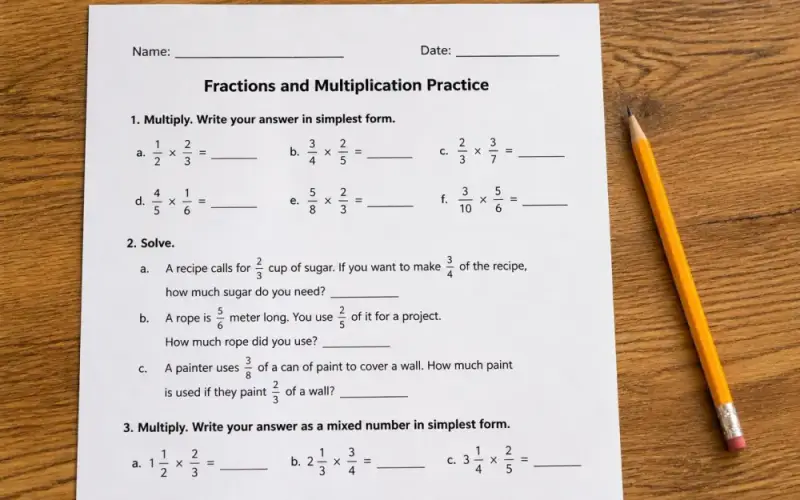
Taught with arrays, fraction strips or drawings.
12 min
Guided practice
Your child works with the tutor's support.
8 min
Word problem
A two-step problem using the routine.
4 min
Fact check
A short recall round to track progress.
3 min
Wrap-up
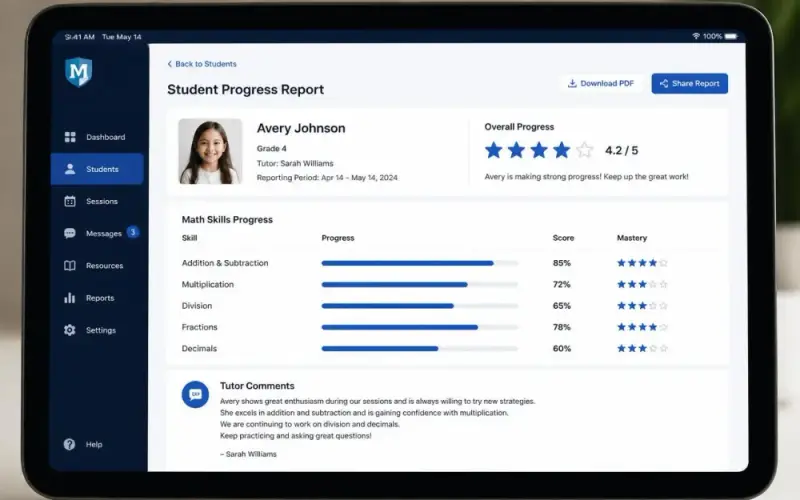
Summary for you on WhatsApp.
How we teach third graders
Understand first, then memorize
Children build facts from arrays and patterns, then practise recall in short daily bursts.
Fraction strips and number lines
Visual models make fractions concrete before any rules are introduced.
Word problem routine
Read, draw, decide, solve, check. A simple routine your child can use on tests.
Confidence before speed
Timed practice only comes once a child is accurate, so speed builds without panic.

Simple monthly plans
$85a month for 2 one-to-one math lessons a week
- Free 45-minute assessment first
- No contract, cancel any month
- No registration fee
- 4-class money-back promise
- Switch tutor at no cost
- WhatsApp update after every class
Starter
2 lessons a week, best for keeping up with school
$85/mo
GrowthMost chosen
3 lessons a week, best for catching up + building confidence
$119/mo
Intensive
4 lessons a week, best for exam prep & fast improvement
$149/mo
Common worries, honest answers
“My child is anxious about the third grade test.”
Tutors build skills and confidence first, then introduce practice questions in the test format, so the real test feels familiar.
“We tried times tables apps and they didn't stick.”
Apps drill recall but rarely teach strategies. Tutors show how facts connect, which makes them easier to remember.
“Is it too early for tutoring?”
Not if your child is struggling. Third grade topics, especially multiplication and fractions, underpin the next several years.
Frequently asked questions
What math should a 3rd grader know?
How can I help my 3rd grader learn multiplication facts?
Why is 3rd grade math so hard?
How much does a 3rd grade math tutor cost?
Do you help with the Year 4 multiplication tables check?
Can tutoring help with state test preparation?
Book a free 45-minute assessment
Your child meets a tutor for a real one-to-one session. You get an honest read on where they are and what would help, even if the answer is that they don't need tutoring right now.
- 1
We reply on WhatsApp
Usually within 10 minutes, to find a time that suits your family.
- 2
Your child meets the tutor
A relaxed 45-minute session to see their level and how they learn.
- 3
You decide
You get a recommendation and a plan. No card details, no pressure.