
Grades 4-9 · Ages 9-15
Accelerated Math Tutoring for Students Moving Ahead
Readiness for placement tests, compacted courses and early Algebra 1, without gaps left behind.
Prefer to ask a question first? Chat on WhatsApp

How it works, in short
TaleemSquare accelerated math tutoring helps students who are ready to move ahead: preparing for a school placement or validation test, keeping up in a compacted course, or taking Algebra 1 in 7th or 8th grade. In live, one-to-one 45-minute lessons, a tutor checks the skills that acceleration tends to skip and fills them first.
The National Association for Gifted Children recommends that all schools offer accelerative options, and says more research supports acceleration than any other intervention for advanced students. Placement is always the school's decision. Plans start at $85 a month after a free assessment.
- Format
- Live, one-to-one, online
- Lesson length
- 45 minutes
- Level
- Ages 9-15
- Price
- From $85 a month
What changes after a term of lessons
Ready for the placement test
Shows secure, quick skills in the content a placement or validation test checks, without relying on guesses.
No gaps behind the jump
Has filled the topics a compacted course or skipped year moves past quickly, from fractions to equations.
Confident in the harder class
Keeps up with older classmates because the foundations are solid and the faster pace feels familiar.
What we cover
Lessons follow your child's own school or homeschool curriculum. These are the areas we work on most at this level.
Pre-algebra fluency
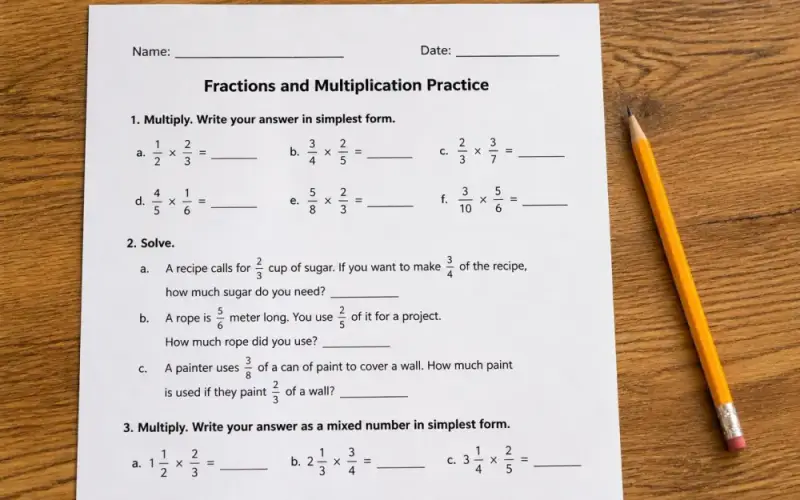
Integers, fractions, decimals, ratios, rates and percents, made quick and accurate before any acceleration.
Expressions and equations
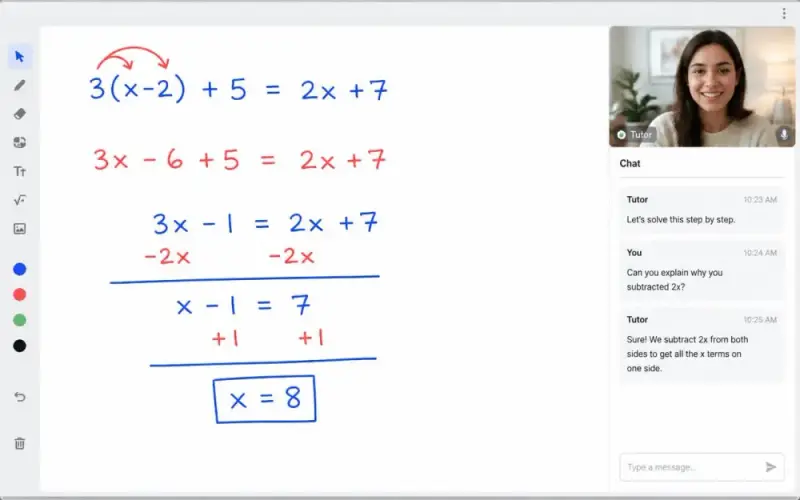
Variables, the distributive property, one- and two-step equations and inequalities, written out with clear steps.
Linear relationships
Slope, graphs and tables of linear functions, the bridge from middle school math into Algebra 1.
Geometry readiness
Angles, area, volume, the Pythagorean theorem and transformations, topics that compacted courses often compress.
Statistics and probability
Data displays, measures of center and simple probability, which are easy to skim past when moving fast.
Placement test practice
Mixed, timed review of the course being skipped, matched to the topics your school says its test covers.
Algebra 1 head start
Systems, exponents, polynomials and quadratics introduced at a steady pace for students starting Algebra 1 early.

Signs your child could use help
- School has offered a math placement or validation test
- Finishes math homework quickly and asks for more
- Moving into a compacted or accelerated course
- Aiming for Algebra 1 in 7th or 8th grade
- Skipped a year of math and has small gaps
- Teacher suggests acceleration and you want it secure first
One of these on its own is normal. Two or three together usually point to a specific gap, and finding it is what the free assessment is for.
Taught to your curriculum, wherever you live
Middle school acceleration in the US
Districts set their own routes for moving ahead, such as compacted courses or Algebra 1 in grade 7 or 8. In New York, for example, students taking Algebra I in grade 7 or 8 can sit the Algebra I Regents exam instead of the grade 8 state math test.
Able mathematicians in the UK
Where a UK school keeps able pupils in their own year group, tutoring can go deeper into Key Stage 2 and 3 content, or prepare early for GCSE topics where the school agrees.
Level: Years 5-10, able mathematicians
Advanced math in Canada
Provinces and school boards set their own routes for advanced students, from enriched classes to pre-AP or IB pathways. Tutoring prepares students for whichever placement step their school uses.
Level: Grades 4-9, enriched or advanced math
Accelerated maths in Australia
Some Australian schools run accelerated or extension maths classes, with entry decided by the school. Tutoring builds the year-level content and reasoning those classes expect.
Level: Years 4-9, accelerated maths classes
Inside a 45-minute accelerated math lesson
One 45-minute session. Tutors adjust the timings to your child.
5 min
Mental math warm-up
Quick mixed arithmetic and fraction practice.
12 min
Gap repair
One skill from the skipped content, taught and checked.
15 min
New content
The next course's topic at a steady pace.
9 min
Mixed review
Timed questions mixing old and new topics.
4 min
Next steps
Practice for the week and a WhatsApp note for you.
How we support acceleration in math
Readiness before speed
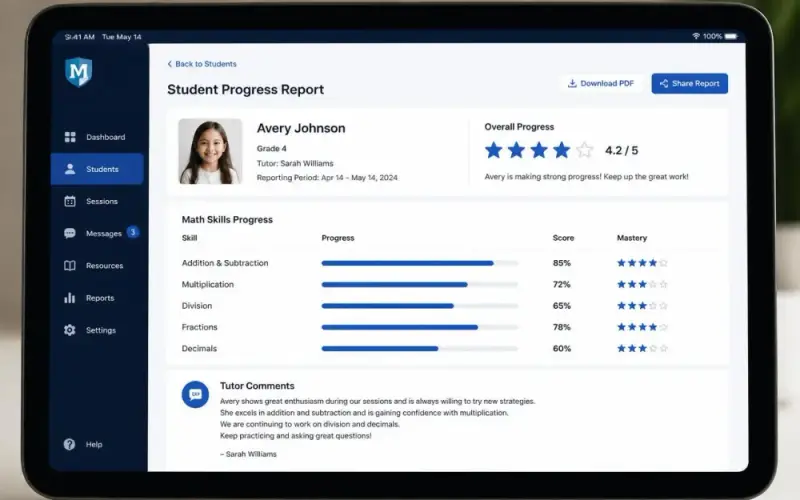
The free assessment checks the foundations first, because gaps hidden by a quick learner often surface later in Algebra 1.
Fill, then extend
Lessons close missing skills quickly, then move into the next course's content at a steady pace.
Matched to the school's test
If your school publishes what its placement test covers, practice follows that list exactly.
Confidence as well as content
NAGC reports that acceleration does not harm students socially, but every child differs, so we tell you how your child is coping as well as what they know.

Simple monthly plans
$85a month for 2 one-to-one math lessons a week
- Free 45-minute assessment first
- No contract, cancel any month
- No registration fee
- 4-class money-back promise
- Switch tutor at no cost
- WhatsApp update after every class
Starter
2 lessons a week, best for keeping up with school
$85/mo
GrowthMost chosen
3 lessons a week, best for catching up + building confidence
$119/mo
Intensive
4 lessons a week, best for exam prep & fast improvement
$149/mo
Common worries, honest answers
“Will moving ahead leave gaps?”
It can if the jump skips topics. That is why lessons start by checking the skipped content, so the new course rests on solid ground.
“Can you make sure my child passes the placement test?”
No. Each school writes and grades its own test and makes the placement decision. We can make sure your child knows the content well and has practised under time.
“Is acceleration right for my child?”
It depends on readiness, motivation and the school's options. NAGC recommends that educators and parents decide together as a team, and the free assessment gives you one more honest view.
Frequently asked questions
What is a compacted math course?
Is it a good idea to take Algebra 1 in 7th grade?
What do math placement tests usually check?
How much does accelerated math tutoring cost?
Does acceleration harm children socially?
How is this different from math enrichment?
Book a free 45-minute assessment
Your child meets a tutor for a real one-to-one session. You get an honest read on where they are and what would help, even if the answer is that they don't need tutoring right now.
- 1
We reply on WhatsApp
Usually within 10 minutes, to find a time that suits your family.
- 2
Your child meets the tutor
A relaxed 45-minute session to see their level and how they learn.
- 3
You decide
You get a recommendation and a plan. No card details, no pressure.