
Kindergarten to Grade 12 · Ages 5-18
Online Math Classes for Kids, Taught One-to-One
Live 45-minute classes with a tutor who gets to know your child, on the math they are doing at school.
Prefer to ask a question first? Chat on WhatsApp

How it works, in short
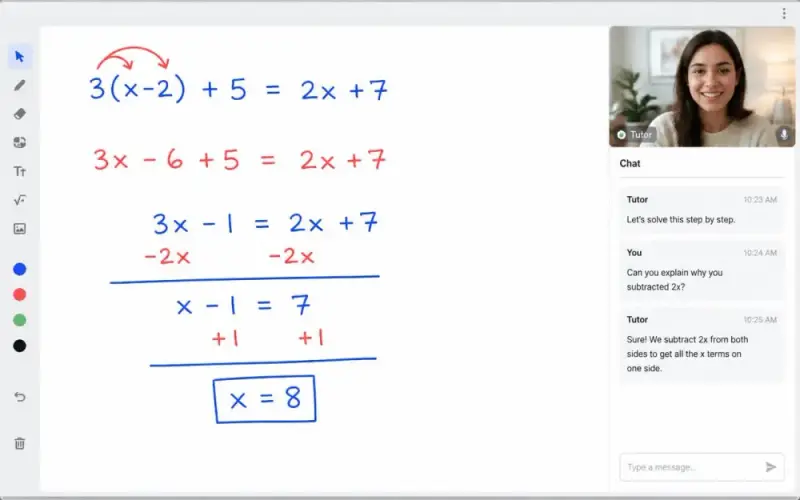
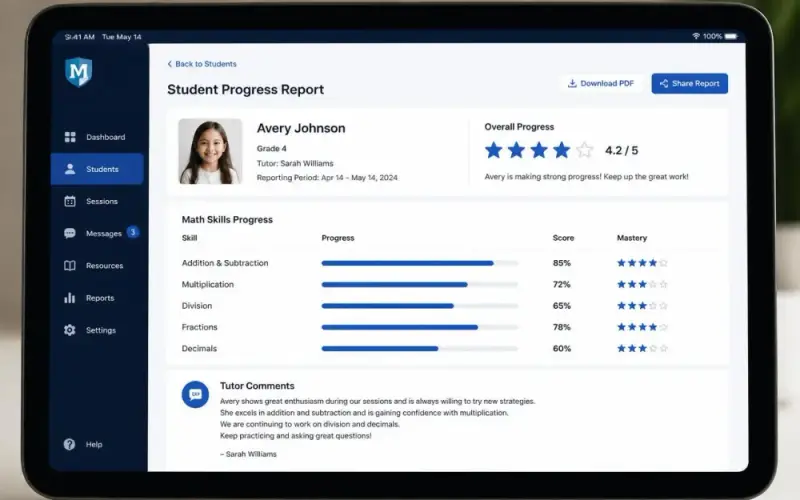
TaleemSquare's online math classes are live, one-to-one lessons for children in Kindergarten to Grade 12 (ages 5-18): one tutor, one child, 45 minutes on Zoom with a shared whiteboard. Each class follows your child's grade and the unit their school is on, from counting to calculus. Your child keeps the same tutor every week, and you get a short WhatsApp update after each class.
Plans cost $85, $119 or $149 a month in US dollars for two, three or four classes a week, about $10.63, $9.92 or $9.31 a class, billed monthly with no contract or registration fee. The first class is a free 45-minute assessment with no card needed, and if your child isn't confident after the first four paid classes, we refund those four classes.
- Format
- Live, one-to-one, online
- Lesson length
- 45 minutes
- Level
- Ages 5-18
- Price
- From $85 a month
What changes after a term of lessons
Fewer gaps holding them back
Topics missed in earlier grades are found and retaught, so new work at school starts to make sense.
Asks for help early
With no classmates watching, your child says when they are stuck instead of hiding it until the test.
Keeps up with the class
Lessons track the unit your child is on at school, so homework and quizzes feel familiar.
What we cover
Lessons follow your child's own school or homeschool curriculum. These are the areas we work on most at this level.
Number sense and arithmetic
Counting, place value, the four operations and times tables, taught with objects and pictures before written methods.
Fractions, decimals and percentages
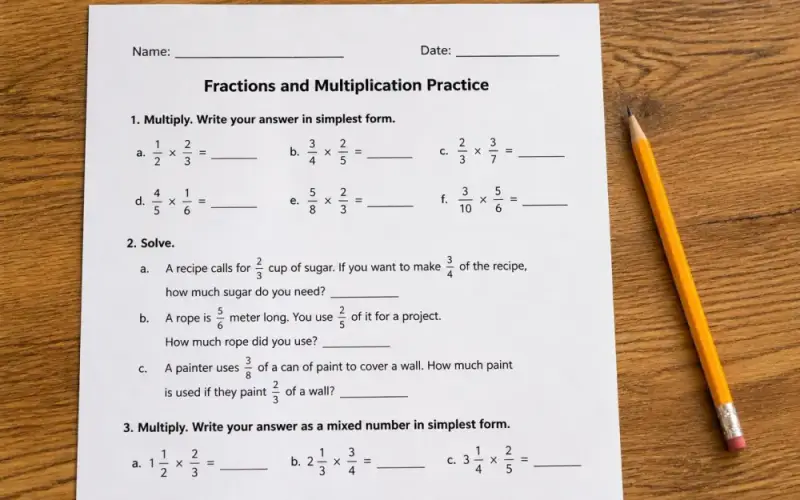
The upper elementary topics that middle school math builds on, taught from visual models before the rules.
Ratios and pre-algebra
Proportional reasoning, negative numbers and expressions: the bridge from arithmetic to algebra in middle school.
Algebra 1 and Algebra 2
Linear equations, functions, quadratics and exponentials, worked through one step at a time.
Geometry and trigonometry
Angles, proofs, area and volume, right triangles and the unit circle.
Precalculus, calculus and statistics
Senior courses including AP Calculus, AP Precalculus and AP Statistics, and their UK, Canadian and Australian equivalents.
Homework and test review
Class time for this week's assignment or a review before a unit test, whenever your child needs it.

Signs your child could use help
- Your child goes quiet in group lessons and never asks questions
- The class at school moved on before your child understood
- Math grades have slipped over the past year
- Math homework ends in frustration most evenings
- There is no good math center near you
- You want a fixed weekly time with a tutor who knows your child
One of these on its own is normal. Two or three together usually point to a specific gap, and finding it is what the free assessment is for.
Taught to your curriculum, wherever you live
Common Core and state math standards
Classes follow your state's standards and the course your child takes at school, from early number sense through Algebra 1, Geometry and Algebra 2 to AP Calculus, AP Precalculus and AP Statistics.
National Curriculum in England, Reception to Year 13
Classes match your child's year group and the methods their school uses, such as bar models and column methods, through the Year 4 multiplication tables check, Key Stage 2 SATs, GCSE and A-level Maths.
Level: Reception to Year 13
Provincial math curricula, K-12
Classes follow your province's curriculum, such as Ontario, British Columbia or Alberta, including preparation for provincial assessments like EQAO in Ontario.
Level: Kindergarten to Grade 12
Australian Curriculum and state syllabuses, F-12
Classes follow your child's year level and state syllabus, including NAPLAN numeracy in Years 3, 5, 7 and 9 and senior courses such as Mathematical Methods and Specialist Mathematics.
Level: Foundation to Year 12
What happens in a 45-minute class
One 45-minute session. Tutors adjust the timings to your child.
4 min
Check-in
A quick chat about school and one warm-up question.
6 min
Review
Two or three problems from last class to see what stuck.
13 min
Teach
One new skill on the whiteboard, with your child explaining each step aloud.
17 min
Practice
Problems that get harder as your child gets them right.
5 min
Wrap-up
A recap, a short task for the week and a WhatsApp note to you.
Why a one-to-one class instead of a group
Every question gets answered
In a group, a shy child can sit through a whole lesson confused. One-to-one, the tutor sees the first wrong step and stops to fix it.
The pace is your child's
The tutor slows down on a hard topic and moves on as soon as your child shows they have it, without waiting for anyone else.
Planned from the assessment
Classes start from what the free assessment found, so time goes on the gaps that matter rather than topics your child already knows.
Honest when a group is better
The Education Endowment Foundation finds small group tuition effective too, and more cost-effective. If a group would suit your child better, we will say so at the assessment.

Simple monthly plans
$85a month for 2 one-to-one math lessons a week
- Free 45-minute assessment first
- No contract, cancel any month
- No registration fee
- 4-class money-back promise
- Switch tutor at no cost
- WhatsApp update after every class
Starter
2 lessons a week, best for keeping up with school
$85/mo
GrowthMost chosen
3 lessons a week, best for catching up + building confidence
$119/mo
Intensive
4 lessons a week, best for exam prep & fast improvement
$149/mo
Common worries, honest answers
“Will my child really focus in a video class?”
In a class your child is writing on the shared whiteboard and talking through each step, not watching a video. The tutor moves between a quick review, one new skill and practice, so no part of the 45 minutes runs long. If your child is young, it helps to sit nearby for the first few classes.
“Is one-to-one worth more than a cheaper group class?”
It depends on your child. A confident child who mainly needs practice may do well in a group, and the Education Endowment Foundation finds small group tuition effective and more cost-effective. For a child with gaps, or one who will not ask a question in front of others, one-to-one means nothing is skipped because the group moved on. On the two-classes-a-week plan, each class works out at about $10.63.
“What if the tutor isn't the right fit?”
Tell us and we will move your child to a different tutor at no cost. There is no contract holding you, and the start is covered by our 100% money-back promise: if your child is not confident after the first four paid classes, ask within 14 days of the fourth class and we refund those four classes.
Frequently asked questions
Are online math classes good for kids?
How much do online math classes cost?
Are TaleemSquare math classes group classes?
Can my child try a class before we pay?
Who teaches the classes?
When are classes held and what do we need?
Book a free 45-minute assessment
Your child meets a tutor for a real one-to-one session. You get an honest read on where they are and what would help, even if the answer is that they don't need tutoring right now.
- 1
We reply on WhatsApp
Usually within 10 minutes, to find a time that suits your family.
- 2
Your child meets the tutor
A relaxed 45-minute session to see their level and how they learn.
- 3
You decide
You get a recommendation and a plan. No card details, no pressure.