
Primary and lower secondary · Ages 8-15
NAPLAN Numeracy Tutor for Years 3, 5, 7 and 9
One-to-one online maths that fixes the skills behind a NAPLAN numeracy result, booked in Australian time.
Prefer to ask a question first? Chat on WhatsApp
How it works, in short
TaleemSquare NAPLAN numeracy tutoring is live, one-to-one online maths for students in Years 3, 5, 7 and 9, in 45-minute lessons on video with a shared whiteboard. Tutors follow the Australian Curriculum and work on the skills a numeracy report points to, such as place value, fractions, measurement or algebra, rather than drilling practice tests.
NAPLAN is held every March, and results are reported in four proficiency levels. If a report shows Developing or Needs additional support, the free assessment finds the earlier skill behind it. Plans are A$130 a month for two lessons a week, with no contract, and you get a WhatsApp update after every lesson.
- Format
- Live, one-to-one, online
- Lesson length
- 45 minutes
- Level
- Ages 8-15
- Price
- From A$130 a month
What changes after a term of lessons
Secure in the basics
Recalls times tables, reads place value and works with fractions without guessing, skills that carry across every NAPLAN year level.
Careful with worded problems
Says in their own words what a question asks before calculating, so fewer marks are lost to misreading short worded problems.
Calm with the format
Knows how the online test looks after one or two practice sessions and, in Years 7 and 9, when a calculator actually helps.
What we cover
Lessons follow your child's own school or homeschool curriculum. These are the areas we work on most at this level.
Number and place value
Place value, addition and subtraction and early multiplication in Year 3, building to multiplication and division with larger numbers by Year 5.
Fractions, decimals and percentages
Simple fractions in Year 3, fractions and decimals in Year 5, then percentages, ratio and rates in Year 7, which return in Year 9.
Algebra and patterns
Number patterns and simple algebraic expressions in Year 7, then linear equations and graphs and index laws in Year 9.
Measurement and geometry
Money and time in Year 3, area, perimeter and angles in Year 5, area and volume in Year 7, and Pythagoras and early trigonometry in Year 9.
Statistics and probability
Reading simple tables and graphs, chance, interpreting data and probability, plus the statistics and financial maths that appear in Year 9.
Worded problems
Many numeracy questions are short worded problems, so lessons practise working out what is being asked before choosing an operation.
Calculator decisions in Years 7 and 9
Years 7 and 9 have a non-calculator section and a calculator-allowed section, so students practise the simpler steps by hand.
One typical question, worked through
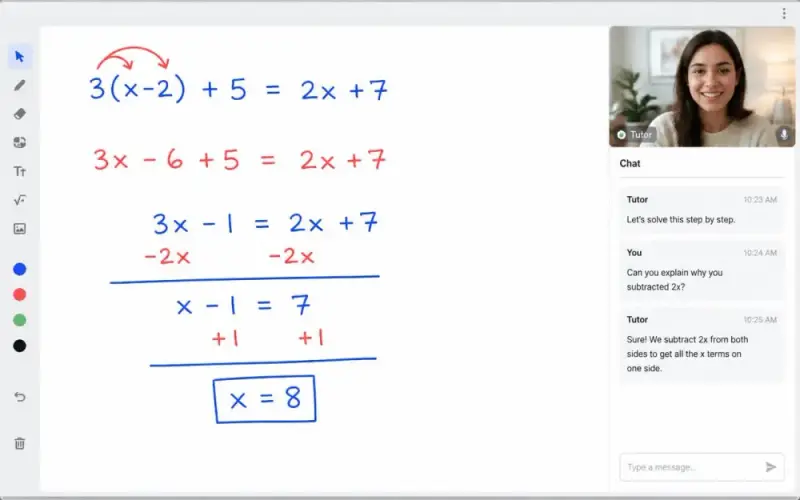
How a tutor talks a student through a maths question at this level. The student does the working on the shared whiteboard; the tutor asks the next question.
A jacket costs $80. It is on sale for 25% off. What is the sale price?
- 25% is one quarter, so find a quarter of $80: 80 ÷ 4 = 20. The discount is $20.
- Take the discount away from the original price: $80 − $20 = $60.
- Check with the other method: paying 75% of $80 is 0.75 × 80 = 60, the same answer.
Answer: $60
The slip we see most often
Subtracting 25 dollars instead of 25 percent, or stopping at the $20 discount and giving that as the answer. The fix is to write down what the question asks for before calculating: here it is the price after the discount.

Signs your child could use help
- Numeracy report shows Developing or Needs additional support
- Still counts on fingers for basic addition or times tables
- Gets lost in worded problems even when the sums are easy
- Fractions and decimals feel confusing or random
- Rushes or freezes when a test or quiz comes up
- School reports and the NAPLAN result point to the same gap
One of these on its own is normal. Two or three together usually point to a specific gap, and finding it is what the free assessment is for.
Taught to your curriculum, wherever you live
Common Core and state tests in grades 3-8
US states test maths every year from grade 3 to grade 8, so NAPLAN plays a similar role as a national snapshot. The content overlaps with Common Core grades 3 to 8: place value, fractions, ratio and rates, early algebra, geometry and data.
Level: Grades 3, 5, 7 and 9 (similar ages)
National curriculum and Key Stage 2 SATs
In England, pupils sit Key Stage 2 maths SATs in Year 6, and the national curriculum covers similar number, fraction, measurement and statistics content from Year 4 to Year 10. There is no national maths test in secondary school before GCSE.
Level: Years 4, 6, 8 and 10
Provincial tests such as Ontario's EQAO
Canada has no national test like NAPLAN. Provinces run their own, for example Ontario's EQAO assessments in Grade 3, Grade 6 and Grade 9 maths. Grades 3 to 9 cover close to the same ground: number sense, fractions, algebra, geometry and data.
Level: Grades 3, 5, 7 and 9
NAPLAN numeracy and the Australian Curriculum
NAPLAN tests Years 3, 5, 7 and 9 each March, online, with tests that adjust to how a student is going. Numeracy draws on number and algebra, measurement and geometry, and statistics and probability. Results use four proficiency levels, from Exceeding to Needs additional support.
Inside a 45-minute NAPLAN numeracy lesson
One 45-minute session. Tutors adjust the timings to your child.
5 min
Warm-up
Quick mental maths on times tables, place value or number facts.
15 min
Gap skill
The earlier skill the assessment found, taught with a visual model and then practised.
10 min
Class topic
Whatever the class is on now, so tutoring supports school, not just NAPLAN.
10 min
Worded problem
A short NAPLAN-style worded problem, read aloud and solved on the whiteboard.
5 min
Wrap-up
What to practise next, summarised for you on WhatsApp.
Who teaches your child
Every TaleemSquare math tutor passes the same five checks before their first class. Your child keeps the same tutor each week, and if the fit is not right we switch tutor at no cost. Tutors are based in the US, UK, Canada, Australia, Pakistan and India, and all of them teach in English.
Identity and references checked
Every tutor is identity-verified and reference-checked before teaching a student.
Subject test
Tutors pass a subject test before they are matched with a child.
Spoken-English assessment
Lessons are taught in English, so every tutor passes a spoken-English assessment.
Live sample lesson
Tutors teach a live sample lesson before they are hired, to show they can explain clearly.
Open to parents
Classes are one-to-one in a password-protected room. Sit in on any class or ask for a recording.
How we teach for NAPLAN numeracy
The skill, not the test
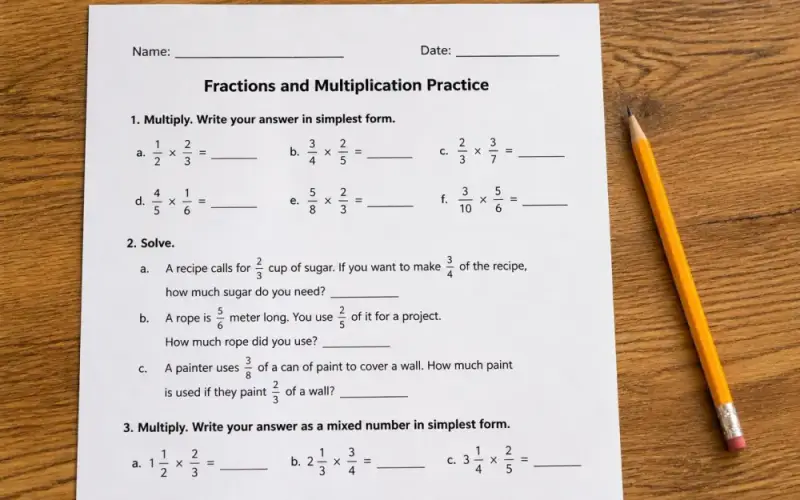
Lessons target the gap behind the result, such as place value or fractions, because that gap shows up in class every day as well as in NAPLAN.
Working back to the gap
The free assessment works back through earlier year levels to find where understanding stops, and the tutor plans the first month from there.
Worded problems out loud
Students read each question aloud and say what it asks before calculating, the habit that saves the most marks on short worded problems.
Light on practice tests
One or two sessions on ACARA's public demonstration site so the format holds no surprises, then back to the maths itself.

Simple monthly plans
A$130a month for 2 one-to-one maths lessons a week
- Free 45-minute assessment first
- No contract, cancel any month
- No registration fee
- 4-class money-back promise
- Switch tutor at no cost
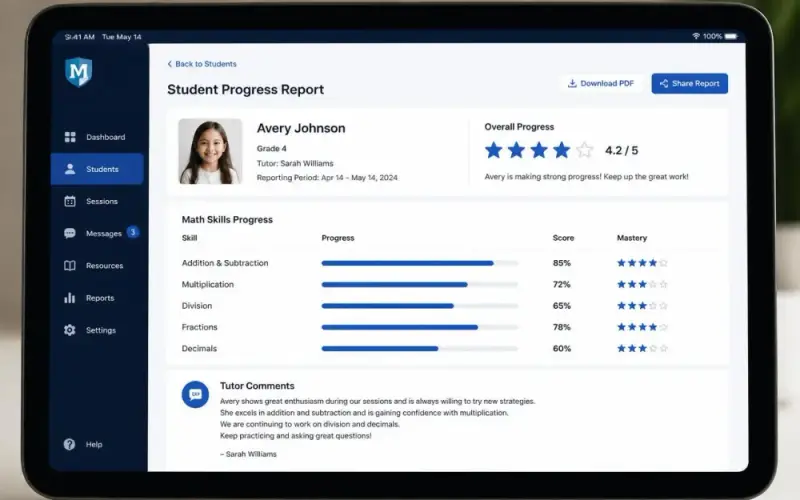
- WhatsApp update after every class
Starter
2 lessons a week, best for keeping up with school
A$130/mo
GrowthMost chosen
3 lessons a week, best for catching up + building confidence
A$179/mo
Intensive
4 lessons a week, best for exam prep & fast improvement
A$229/mo
Common worries, honest answers
“My child got Developing in numeracy. Are they failing?”
No. NAPLAN is not a pass or fail test, and Developing means working towards the expectation for the year level. Ask the teacher whether it matches what they see in class. The free assessment then shows which earlier skills sit behind the result.
“Won't tutoring just mean more practice tests?”
No. Drilling practice tests mostly teaches the format. Our tutors teach the maths underneath, which is what moves a result and helps in class. Students see the online format once or twice so the day itself feels familiar.
“NAPLAN is in March. Is there any point starting now?”
NAPLAN is one snapshot, and the skills it checks matter all year. Working on them helps with schoolwork whenever you start. Lessons are 45 minutes, booked in Australian time after school or on weekends.
Frequently asked questions
When is NAPLAN held?
Can my child use a calculator in NAPLAN numeracy?
What do the NAPLAN proficiency levels mean?
How much does an online NAPLAN numeracy tutor cost?
Does my child need a tutor for NAPLAN?
How should my child prepare for NAPLAN numeracy?
Book a free 45-minute assessment
Your child meets a tutor for a real one-to-one session. You get an honest read on where they are and what would help, even if the answer is that they don't need tutoring right now.
- 1
We reply on WhatsApp
Usually within 10 minutes, to find a time that suits your family.
- 2
Your child meets the tutor
A relaxed 45-minute session to see their level and how they learn.
- 3
You decide
You get a recommendation and a plan. No card details, no pressure.