
Primary school, Year 2 · Ages 6-7
Year 2 Maths Tutor: Number Bonds, Money and Fractions
Friendly one-to-one maths for ages 6 to 7, following the National Curriculum and built around your child's school.
Prefer to ask a question first? Chat on WhatsApp
Already decided? Choose a plan and enroll now, and we schedule the first class in your time zone.

How it works, in short
TaleemSquare Year 2 maths tutoring is live, one-to-one online lessons of 45 minutes for children aged 6 to 7, following the National Curriculum in England and your child's own school. Tutors cover number bonds, adding and subtracting two-digit numbers, the 2, 5 and 10 times tables, fractions, money, time, shape and simple charts, using objects and pictures first.
Year 2 has no compulsory national maths test. The end-of-key-stage-1 tests have been optional since 2023 to 2024, so your child's school decides whether to use them. A free assessment shows where your child stands. Plans start at £69 a month for two 45-minute lessons a week (about £8.63 a lesson).
- Format
- Live, one-to-one, online
- Lesson length
- 45 minutes
- Level
- Ages 6-7
- Price
- From £69 a month
- Per hour of tutoring
- About £11.50
- Families taught
- 500+ since 2023
What changes after a term of lessons
Number facts at their fingertips
Recalls addition and subtraction facts to 20 and uses them to work out related facts to 100, without counting on fingers.
Counting and times tables in step
Counts in 2s, 3s, 5s and 10s and recalls the 2, 5 and 10 times tables, using arrays and equal groups to explain why.
Maths in everyday life
Finds change from coins, tells the time to the nearest five minutes and finds a half, third or quarter of a shape or amount.
What we cover
Lessons follow your child's own school or homeschool curriculum. These are the areas we work on most at this level.
Place value to 100
Tens and ones in two-digit numbers, counting in 2s, 3s, 5s and 10s, and comparing and ordering numbers using the signs <, > and =.
Addition and subtraction
Number facts to 20, then adding and subtracting two-digit numbers with ones, tens or other two-digit numbers, checking with the inverse operation.
Multiplication and division
The 2, 5 and 10 times tables, odd and even numbers, and solving problems with arrays, equal groups and repeated addition.
Fractions
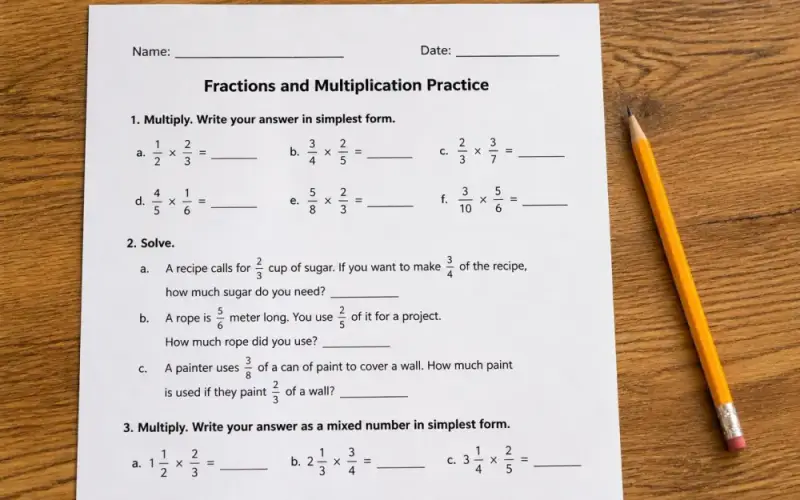
Finding 1/2, 1/3, 1/4, 2/4 and 3/4 of shapes, sets of objects and amounts, and seeing that 2/4 is the same as 1/2.
Money and time
Counting coins and notes, solving money problems with change, telling the time to the nearest five minutes and knowing minutes in an hour.
Measures
Choosing and reading rulers, scales, thermometers and measuring jugs for length, mass, temperature and capacity, then comparing and ordering measures.
Shape, position and direction
Sides, vertices, edges and faces, a vertical line of symmetry, and describing quarter, half and three-quarter turns, clockwise and anticlockwise.
Charts and tables
Reading and making tally charts, pictograms, block diagrams and simple tables, then answering questions by counting, sorting and comparing.
One typical question, worked through
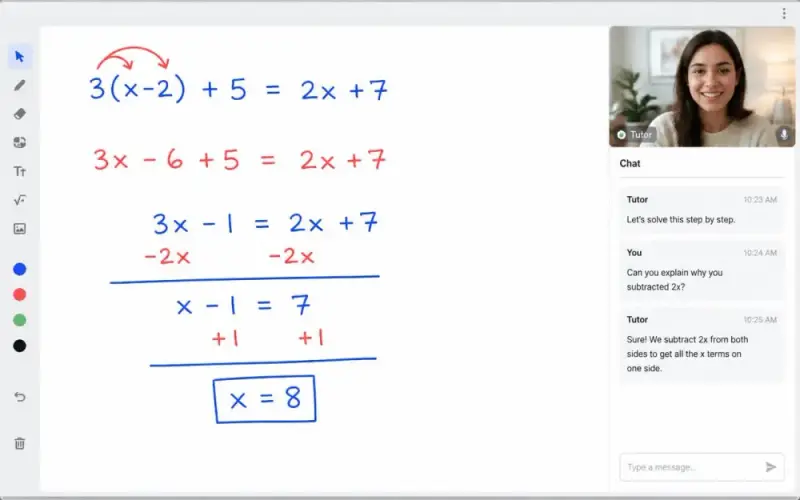
How a tutor talks a student through a maths question at this level. The student does the working on the shared whiteboard; the tutor asks the next question.
Sam buys a ruler for 27p and a rubber for 18p. He pays with a 50p coin. How much change does he get?
- Find the total first. Add the tens: 20 plus 10 is 30. Add the ones: 7 plus 8 is 15. Put them together: 30 plus 15 is 45p.
- Check it makes sense. 27p is close to 30p and 18p is close to 20p, and 30p plus 20p is 50p, so a total just under 50p is about right.
- Now find the change by counting up from 45p to 50p. One jump of 5 gets there, so the change is 5p.
- Check by adding back: 45p for the shopping plus 5p change makes 50p, the coin Sam paid with.
Answer: Sam gets 5p change.
The slip we see most often
Children often write 7 plus 8 as 15 but forget the new ten, so the total comes out as 35p. Many also grab the first sum they see and subtract 18 from 27. The fix is to ask 'what do I need to know first?' (the total) and to say the 15 aloud as 'one ten and five ones'.

Signs your child could use help
- Still counts on fingers for sums such as 8 plus 5
- Writes 41 when they mean 14, mixing up tens and ones
- Struggles to count in 2s, 5s and 10s without starting again
- Gets muddled with coins when playing shop or working out change
- Cannot read the time on a clock face to the nearest five minutes
- Says maths is boring or hides when homework comes out
One of these on its own is normal. Two or three together usually point to a specific gap, and finding it is what the free assessment is for.
Taught to your curriculum, wherever you live
Common Core State Standards, Grade 1
Grade 1 matches this age. Its four critical areas are addition and subtraction within 20, with fluency within 10, place value in tens and ones, measuring length with repeated units, and reasoning about shapes. State maths tests, required in Grades 3 to 8, start two grades later.
Level: Grade 1
National Curriculum in England: Key Stage 1, Year 2
Year 2 completes Key Stage 1. The end-of-key-stage tests, an arithmetic paper and a reasoning paper, have been optional since 2023 to 2024, so each school chooses whether to use them. The first compulsory national maths check is the multiplication tables check in Year 4.
Ontario Mathematics curriculum (2020), Grade 1
Ontario's Grades 1 to 8 curriculum has six areas: number, algebra, data, spatial sense, financial literacy, and social-emotional learning skills with mathematical processes. It brings in coding from the early grades. Other provinces set their own curricula, and Ontario's EQAO tests start in Grade 3.
Level: Grade 1
Australian Curriculum v9: Mathematics, Year 1
Year 1 covers numbers to at least 120, partitioning into tens and ones, addition and subtraction within 20, skip counting by twos, fives and tens, and measuring length with informal units. NAPLAN numeracy is first sat in Year 3.
Level: Year 1
Inside a 45-minute Year 2 maths lesson
One 45-minute session. Tutors adjust the timings to your child.
5 min
Counting warm-up
Counting in 2s, 5s and 10s forwards and back, plus a quick number bond game.
6 min
Revisit
A skill from last time, such as tens and ones, to keep it fresh.
12 min
Learn with objects
One new idea shown with counters, coins or a clock on the whiteboard.
14 min
Practice and games
Questions and games on the idea, with the tutor helping as needed.
8 min
Show and tell
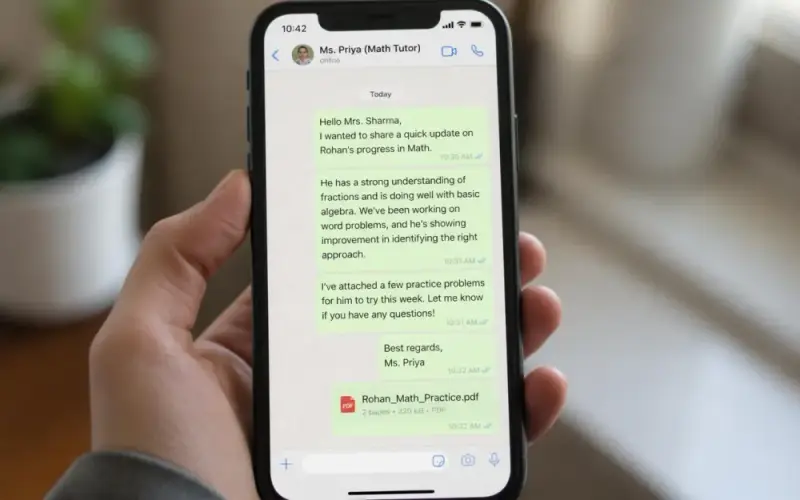
Your child explains one answer in their own words. You get a WhatsApp note on progress.
Who teaches your child
Every TaleemSquare math tutor passes the same five checks before their first class. Your child keeps the same tutor each week, and if the fit is not right we switch tutor at no cost. Tutors are based in the US, UK, Canada, Australia, Pakistan and India, and all of them teach in English.
Identity and references checked
Every tutor is identity-verified and reference-checked before teaching a student.
Subject test
Tutors pass a subject test before they are matched with a child.
Spoken-English assessment
Lessons are taught in English, so every tutor passes a spoken-English assessment.
Live sample lesson
Tutors teach a live sample lesson before they are hired, to show they can explain clearly.
Open to parents
Classes are one-to-one in a password-protected room. Sit in on any class or ask for a recording.
How we teach Year 2 maths
Objects first, then numbers
Counters, ten frames and number lines on the interactive whiteboard let your child see 14 as one ten and four ones before they write the sum.
Number bonds as games
Short rounds of make-10 and make-20 let facts stick through play and repetition, so counting on fingers fades without any pressure.
Shop and clock role play
Pretend shops with coins and a clock face your child can move make money, change and time feel like real life instead of worksheets.
Short steps, lots of praise
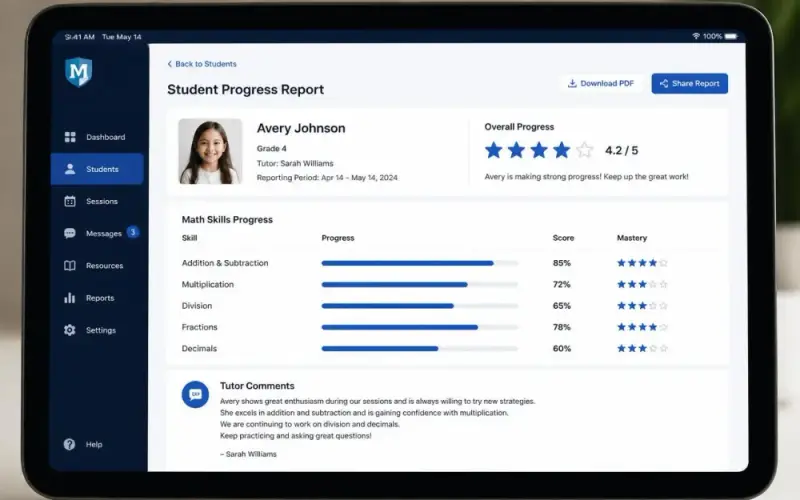
Activities change every few minutes to suit a six or seven year old, and WhatsApp updates tell you honestly what is secure and what needs more time.
Simple monthly plans
£69a month for 2 one-to-one maths lessons a week
About £8.63 a lesson, or £11.50 per hour of live one-to-one tutoring.
- Free 45-minute trial assessment, no card details
- No contract, cancel any month
- No registration fee
- 4-class money-back promise
- Switch tutor at no cost
- WhatsApp update after every class
Starter
2 lessons a week, best for keeping up with school
£69/mo
EnrollGrowthMost chosen
3 lessons a week, best for catching up + building confidence
£95/mo
EnrollIntensive
4 lessons a week, best for exam prep & fast improvement
£119/mo
EnrollCommon worries, honest answers
“Is 45 minutes too long for a six or seven year old?”
It is a fair worry. Lessons are split into five short activities with games and hands-on tasks, so your child is never asked to stay on one thing for long. The free assessment lets you see how they cope, and you can sit nearby for the first lessons.
“There are no SATs this year, so how will I know where my child is?”
Schools can choose not to use the optional tests and rely on classroom assessment instead. The free assessment shows which skills are secure, such as number bonds and the 2, 5 and 10 tables, and WhatsApp updates keep you informed. It also helps to ask the teacher what your child is working on.
“I don't want to put pressure on such a young child.”
There is no test to prepare for, so lessons aim at confidence and understanding rather than speed. Children learn best when they feel relaxed. There is no contract, so you can stop at the end of any billing month if lessons are not right for your child.
Frequently asked questions
What maths is taught in Year 2?
Are there SATs in Year 2?
Which times tables should a Year 2 child know?
How much does a Year 2 maths tutor cost?
Will the tutor follow my child's school?
Can a six or seven year old learn maths online?
Sources
- National curriculum in England: mathematics programmes of study (DfE)
- Optional key stage 1 national curriculum tests: information for parents (STA)
- Common Core State Standards for Mathematics: Grade 1 introduction
- Australian Curriculum v9 Mathematics: Year 1 achievement standard and content descriptions (via QCAA)
- Ontario: math curriculum for Grades 1 to 8
Book a free 45-minute assessment
Your child meets a tutor for a real one-to-one session. You get an honest read on where they are and what would help, even if the answer is that they don't need tutoring right now.
- 1
We reply on WhatsApp
Usually within 10 minutes, to find a time that suits your family.
- 2
Your child meets the tutor
A relaxed 45-minute session to see their level and how they learn.
- 3
You decide
You get a recommendation and a plan. No card details, no pressure.