
Primary school, Year 4 · Ages 8-9
Year 4 Maths Tutor for the Times Tables Check
One-to-one Year 4 maths for ages 8 to 9, building times tables recall ahead of the June check.
Prefer to ask a question first? Chat on WhatsApp
Already decided? Choose a plan and enroll now, and we schedule the first class in your time zone.

How it works, in short
TaleemSquare Year 4 maths tutoring is live, one-to-one online lessons of 45 minutes for children aged 8 to 9, following the National Curriculum in England and your child's own school. Tutors build recall of every times table up to 12 × 12, then cover written multiplication, fractions and decimals, area and perimeter, time and coordinates.
Year 4 is the year of the multiplication tables check, an on-screen check taken in June with 25 questions and 6 seconds for each. There is no pass mark. In 2027 the check period opens on Monday 7 June. A free assessment comes first, and plans start at £69 a month for two 45-minute lessons a week (about £8.63 a lesson).
- Format
- Live, one-to-one, online
- Lesson length
- 45 minutes
- Level
- Ages 8-9
- Price
- From £69 a month
- Per hour of tutoring
- About £11.50
- Families taught
- 500+ since 2023
What changes after a term of lessons
Instant recall up to 12 × 12
Answers multiplication and division facts quickly and calmly, including the 6, 7, 9, 11 and 12 tables, and is used to a six-second timer.
Written multiplication
Multiplies two- and three-digit numbers by a single digit in a column layout and checks the answer by estimating first.
Decimals and area
Links tenths and hundredths to decimals and money, finds area by counting squares and perimeter by adding the sides.
What we cover
Lessons follow your child's own school or homeschool curriculum. These are the areas we work on most at this level.
Times tables up to 12 × 12
The 6, 7, 9, 11 and 12 tables with matching division facts, factor pairs and multiplying three numbers, built for fast, secure recall.
Place value and rounding
Numbers beyond 1,000, counting back through zero into negative numbers, rounding to the nearest 10, 100 and 1,000, and Roman numerals to C.
Written methods
Column addition and subtraction up to four digits, and short multiplication of two- and three-digit numbers by one digit, checked by estimating.
Fractions
Equivalent fractions drawn as diagrams, counting in hundredths, finding fractions of amounts, and adding and subtracting fractions with the same denominator.
Decimals and money
Tenths and hundredths as decimals, writing 1/4, 1/2 and 3/4 as decimals, dividing by 10 and 100, and money problems in pounds and pence.
Area and perimeter
Perimeter of rectilinear shapes in centimetres and metres, area found by counting squares, and converting between units of measure.
Time
Reading and converting between analogue and digital clocks, 12-hour and 24-hour time, and converting hours to minutes, minutes to seconds and weeks to days.
Shape, symmetry and coordinates
Classifying triangles and quadrilaterals, acute and obtuse angles, lines of symmetry, and plotting points in the first quadrant, including translations.
One typical question, worked through
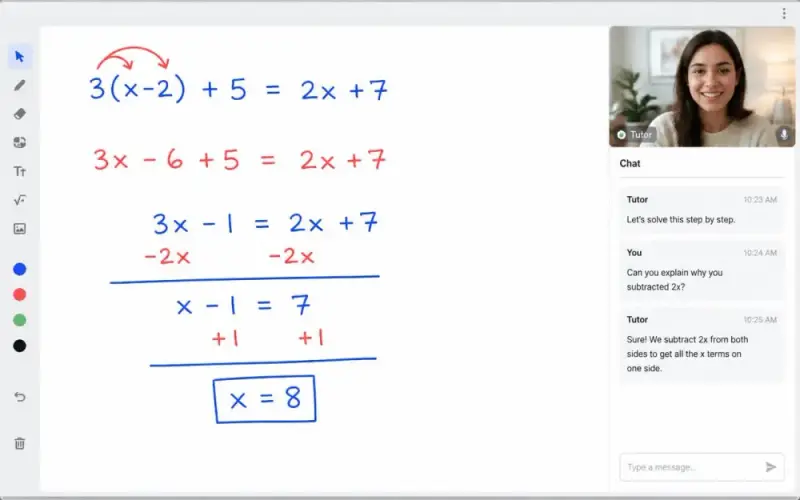
How a tutor talks a student through a maths question at this level. The student does the working on the shared whiteboard; the tutor asks the next question.
What is 7 × 8, and what can your child do when the answer will not come?
- Start from a fact your child knows well: 5 × 8 = 40.
- Split the 7 into 5 and 2. Then 7 × 8 is 5 lots of 8 plus 2 lots of 8, so 7 × 8 = 5 × 8 plus 2 × 8.
- Work out 2 × 8 = 16, then add: 40 plus 16 = 56.
- Check a second way: 8 × 8 = 64, and 7 × 8 is one lot of 8 less, so 64 take away 8 = 56.
Answer: 7 × 8 = 56.
The slip we see most often
Children often blurt out a neighbouring fact such as 54 (6 × 9) or 63 (7 × 9), because the facts blur together. The fix is to use the back-up route until the fact is secure, then practise that single fact in short mixed rounds, with a memory hook such as 5, 6, 7, 8: 56 = 7 × 8.

Signs your child could use help
- Freezes or guesses when asked a times table question quickly
- Knows the easy tables but guesses at 6, 7, 8 and 9
- Gets anxious about the timed multiplication check in June
- Forgets the carried numbers in written multiplication
- Finds hundredths and decimals confusing
- Mixes up area and perimeter
One of these on its own is normal. Two or three together usually point to a specific gap, and finding it is what the free assessment is for.
Taught to your curriculum, wherever you live
Common Core State Standards, Grade 3
Grade 3 matches this age. Its critical areas are multiplication and division within 100, fractions starting with unit fractions, area, and comparing shapes. By the end of Grade 3, children should know all products of two one-digit numbers from memory. State maths tests, required in Grades 3 to 8, begin here.
Level: Grade 3
National Curriculum in England: Key Stage 2, Year 4
Children are expected to know every table up to 12 × 12 by the end of Year 4. In June they take the on-screen multiplication tables check: 25 questions, 6 seconds each, no pass mark. It is statutory in maintained schools and academies, and independent schools cannot take part. The Year 6 SATs follow.
Ontario Mathematics curriculum (2020), Grade 3
Grade 3 is the first year of provincial testing. EQAO assesses reading, writing and mathematics in spring; the 2027 window runs from 4 May to 8 June. Results use four levels, with Level 3 the provincial standard. Grade 6 is the next EQAO year.
Level: Grade 3
Australian Curriculum v9: Mathematics, Year 3
Year 3 covers numbers beyond 10,000, unit fractions, multiplying and dividing with arrays, the 3, 4, 5 and 10 times tables, and time to the nearest minute. NAPLAN numeracy is first sat in Year 3, one of four NAPLAN years (3, 5, 7 and 9).
Level: Year 3
Inside a 45-minute Year 4 maths lesson
One 45-minute session. Tutors adjust the timings to your child.
8 min
Tables rapid-fire
Mixed table questions against a six-second timer, then a review of any misses.
6 min
Revisit
An earlier skill, such as place value or column addition.
12 min
New learning
One idea taught with a diagram on the whiteboard, such as an array or a fraction wall.
12 min
Practice
Questions from routine to word problems, with the tutor close by.
7 min
Explain and wrap up
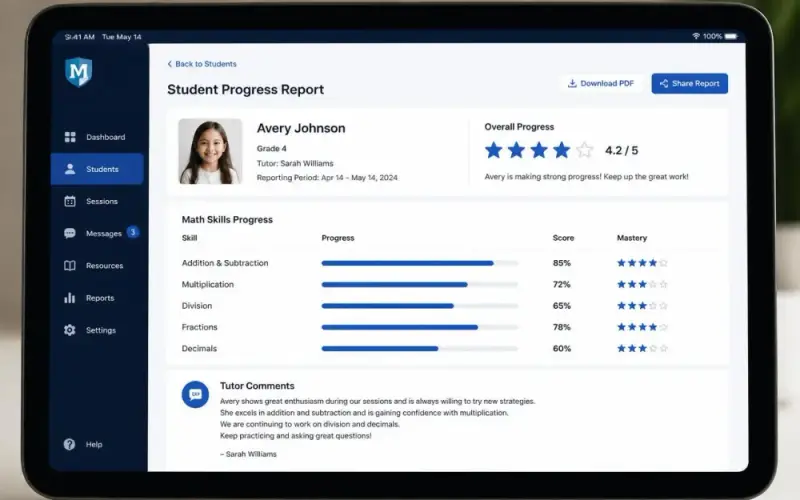
Your child explains one answer aloud. You get a WhatsApp note on which facts are secure.
Who teaches your child
Every TaleemSquare math tutor passes the same five checks before their first class. Your child keeps the same tutor each week, and if the fit is not right we switch tutor at no cost. Tutors are based in the US, UK, Canada, Australia, Pakistan and India, and all of them teach in English.
Identity and references checked
Every tutor is identity-verified and reference-checked before teaching a student.
Subject test
Tutors pass a subject test before they are matched with a child.
Spoken-English assessment
Lessons are taught in English, so every tutor passes a spoken-English assessment.
Live sample lesson
Tutors teach a live sample lesson before they are hired, to show they can explain clearly.
Open to parents
Classes are one-to-one in a password-protected room. Sit in on any class or ask for a recording.
How we prepare Year 4 children for the times tables check
Hard facts first
A short list of the facts your child misses, for many children among the 6, 7, 8, 9 and 12 tables, gets extra attention instead of reciting every table from the top.
Speed built gently
Quick rounds against a six-second timer, as in the real check, begin only once a fact is understood, so the timer feels like a game and not a threat.
Understand, then store
Arrays and patterns, such as 7 × 8 as 5 × 8 plus 2 × 8, give a back-up route when a fact slips, so one forgotten fact does not stall a whole problem.
Written methods with checks
Short multiplication is laid out in columns with carried digits written small, and an estimate made first to catch slips before they cost marks.

Simple monthly plans
£69a month for 2 one-to-one maths lessons a week
About £8.63 a lesson, or £11.50 per hour of live one-to-one tutoring.
- Free 45-minute trial assessment, no card details
- No contract, cancel any month
- No registration fee
- 4-class money-back promise
- Switch tutor at no cost
- WhatsApp update after every class
Starter
2 lessons a week, best for keeping up with school
£69/mo
EnrollGrowthMost chosen
3 lessons a week, best for catching up + building confidence
£95/mo
EnrollIntensive
4 lessons a week, best for exam prep & fast improvement
£119/mo
EnrollCommon worries, honest answers
“My child panics when the clock is running.”
The check has no pass mark and takes about five minutes at most. We practise in short, friendly rounds so the six-second timer becomes familiar, starting with facts your child already knows before adding harder ones.
“We've drilled times tables for months and still can't remember 7 × 8.”
Some facts need a different route than repetition. Tutors give a back-up strategy for each stubborn fact, then practise it in short mixed rounds. Recall usually builds with small, regular practice, though we cannot promise a particular score.
“Is it worth practising if the check might be scrapped?”
The check is still planned for June 2027, and the government has said its timed nature is important to its purpose. Whatever happens to the test, recall of tables up to 12 × 12 is part of the Year 4 curriculum and supports division, fractions and algebra later.
Frequently asked questions
What is the Year 4 multiplication tables check?
When is the 2027 multiplication tables check, and who takes it?
What is a good score on the times tables check?
What maths is taught in Year 4?
How much does a Year 4 maths tutor cost?
Will the tutor follow my child's school?
Sources
- National curriculum in England: mathematics programmes of study (DfE)
- Multiplication tables check: information for parents, text version (STA)
- 2027 key stage 2 assessment and reporting arrangements (STA)
- EQAO: Grade 3, Primary Division assessment
- Government response to the Curriculum and Assessment Review (DfE)
Book a free 45-minute assessment
Your child meets a tutor for a real one-to-one session. You get an honest read on where they are and what would help, even if the answer is that they don't need tutoring right now.
- 1
We reply on WhatsApp
Usually within 10 minutes, to find a time that suits your family.
- 2
Your child meets the tutor
A relaxed 45-minute session to see their level and how they learn.
- 3
You decide
You get a recommendation and a plan. No card details, no pressure.