
Primary school, Year 5 · Ages 9-10
Year 5 Maths Tutor: Long Multiplication and Fractions
One-to-one Year 5 maths for ages 9 to 10, ahead of the Year 6 SATs and the 11+.
Prefer to ask a question first? Chat on WhatsApp
Already decided? Choose a plan and enroll now, and we schedule the first class in your time zone.

How it works, in short
TaleemSquare Year 5 maths tutoring is live, one-to-one online lessons of 45 minutes for children aged 9 to 10, following the National Curriculum in England and your child's own school. Tutors cover numbers to 1,000,000, long multiplication, short division, fractions, decimals and percentages, factors and primes, area and volume, and angles.
Year 5 has no national maths test, but it sets up two that follow: the Key Stage 2 SATs in May of Year 6, and the 11+ in grammar school areas, where registration often falls in Year 5. A free assessment comes first, and plans start at £69 a month for two 45-minute lessons a week (about £8.63 a lesson).
- Format
- Live, one-to-one, online
- Lesson length
- 45 minutes
- Level
- Ages 9-10
- Price
- From £69 a month
- Per hour of tutoring
- About £11.50
- Families taught
- 500+ since 2023
What changes after a term of lessons
Long multiplication done right
Multiplies up to four-digit numbers by one- and two-digit numbers, using long multiplication with a placeholder zero, and checks by estimating.
At ease with fractions, decimals and percentages
Moves between the three forms, adds fractions with related denominators and multiplies fractions by whole numbers.
Ready for Year 6
Starts Year 6 secure in factors, primes, short division and multi-step problems, the skills that Year 6 builds on.
What we cover
Lessons follow your child's own school or homeschool curriculum. These are the areas we work on most at this level.
Place value to 1,000,000
Reading, writing and ordering numbers up to a million, counting in powers of 10, rounding, negative numbers in context and Roman numerals to M.
Factors, multiples and primes
Common factors and multiples, prime numbers up to 100, and square and cube numbers with their notation, ² and ³.
Long multiplication and short division
Multiplying up to four-digit numbers by two-digit numbers in columns, short division with remainders, and multiplying and dividing by 10, 100 and 1,000.
Fractions
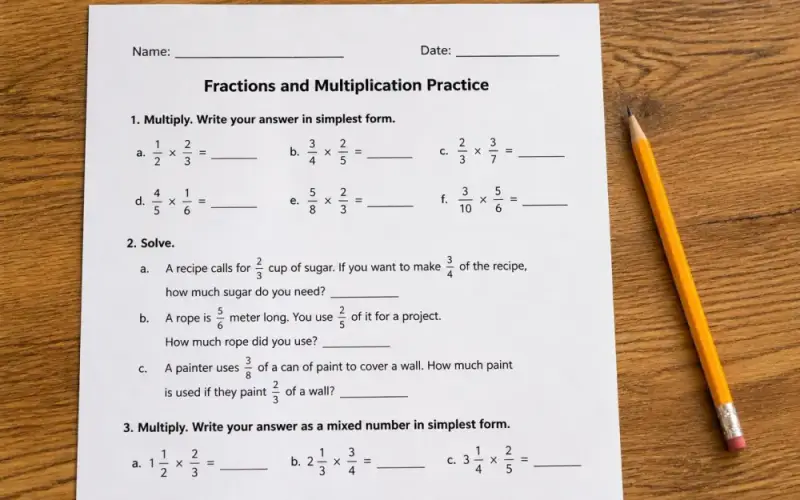
Equivalent fractions, mixed numbers and improper fractions, adding and subtracting with related denominators, and multiplying fractions by whole numbers.
Decimals and percentages
Decimals to three places, thousandths and rounding, and percentages as parts per hundred, linked to fractions and decimals such as 1/2, 1/4, 1/5 and 4/5.
Area, perimeter and volume
Perimeter and area of composite rectilinear shapes in cm² and m², estimating area, volume and capacity, and converting between metric units.
Angles and 3-D shape
Measuring and drawing angles in degrees, acute, obtuse and reflex angles, angles at a point and on a straight line, and 3-D shapes from 2-D drawings.
Position and graphs
Reflecting and translating shapes, reading line graphs, and using tables and timetables to answer comparison, sum and difference questions.
One typical question, worked through
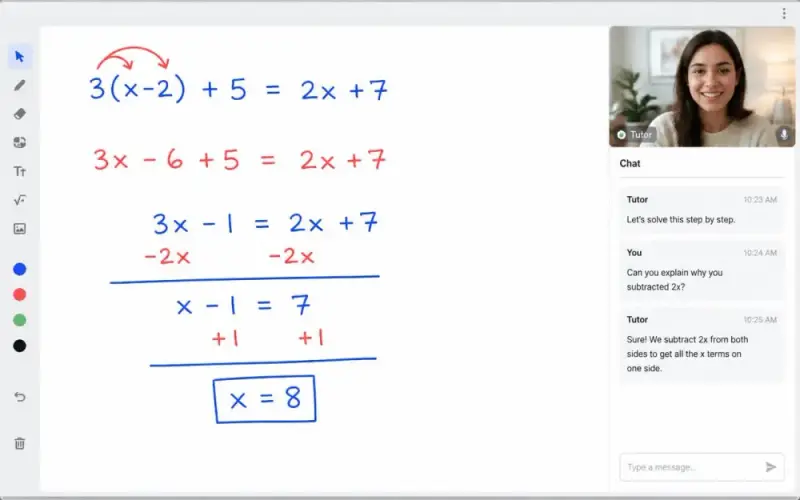
How a tutor talks a student through a maths question at this level. The student does the working on the shared whiteboard; the tutor asks the next question.
A hall has 24 rows with 36 chairs in each row. How many chairs are there altogether?
- Estimate first. Round to the nearest ten: 40 × 20 = 800, so the answer should be somewhere near 800.
- Multiply by the ones digit: 36 × 4 = 144, because 30 × 4 = 120 and 6 × 4 = 24, and 120 plus 24 is 144.
- Write a zero in the ones column of the next row, because the 2 in 24 means 2 tens, so we are really multiplying by 20. Then 36 × 2 = 72, and with the zero this row is 720.
- Add the two rows: 144 plus 720 = 864.
- Check a second way: 36 × 25 = 900, and 24 is one less than 25, so take away one 36: 900 take away 36 = 864.
Answer: There are 864 chairs.
The slip we see most often
The commonest slip is leaving out the placeholder zero, so 72 is added to 144 and the total comes out as 216. The estimate catches it, because 216 is nowhere near 800. The fix is to write the zero first, before multiplying by the tens digit.

Signs your child could use help
- Loses track of digits halfway through long multiplication
- Adds the denominators when adding fractions
- Cannot say what 0.5, 1/2 and 50% have in common
- Mixes up area and perimeter, or the units for each
- Times tables are still slow, which slows every written method
- Worried about Year 6 SATs or the 11+ and unsure where to start
One of these on its own is normal. Two or three together usually point to a specific gap, and finding it is what the free assessment is for.
Taught to your curriculum, wherever you live
Common Core State Standards, Grade 4
Grade 4 matches this age. Its three critical areas are multiplying and dividing multi-digit numbers, equivalent fractions with adding, subtracting and multiplying fractions by whole numbers, and analysing shapes by angles and symmetry. States test maths every year from Grade 3 to Grade 8.
Level: Grade 4
National Curriculum in England: Key Stage 2, Year 5
There is no national test in Year 5. Children sit the Key Stage 2 SATs in May of Year 6; for the current Year 5 they are timetabled for 8 to 11 May 2028, with arrangements under review. In grammar school areas, 11+ registration often opens in Year 5.
Ontario Mathematics curriculum (2020), Grade 4
Ontario Grade 4 sets multiplication facts from 1 × 1 to 10 × 10, and the 2020 curriculum includes financial literacy and coding. There is no provincial test in Grade 4: EQAO assesses mathematics in Grade 3 and then Grade 6.
Level: Grade 4
Australian Curriculum v9: Mathematics, Year 4
Year 4 extends place value to tenths and hundredths, equivalent fractions, multiplication facts to 10 × 10, perimeter and area, and line and rotational symmetry. NAPLAN numeracy is not sat in Year 4; the next sitting is in Year 5.
Level: Year 4
Inside a 45-minute Year 5 maths lesson
One 45-minute session. Tutors adjust the timings to your child.
6 min
Tables and mental maths
Quick-fire tables, factors and mental calculation.
6 min
Revisit
An earlier skill, such as column methods or equivalent fractions.
12 min
New learning
One idea taught with a model on the whiteboard, such as an area model or fraction strip.
13 min
Practice
Arithmetic questions, then a multi-step reasoning problem.
8 min
Explain and wrap up
Your child explains one answer aloud. You get a WhatsApp note on progress.
Who teaches your child
Every TaleemSquare math tutor passes the same five checks before their first class. Your child keeps the same tutor each week, and if the fit is not right we switch tutor at no cost. Tutors are based in the US, UK, Canada, Australia, Pakistan and India, and all of them teach in English.
Identity and references checked
Every tutor is identity-verified and reference-checked before teaching a student.
Subject test
Tutors pass a subject test before they are matched with a child.
Spoken-English assessment
Lessons are taught in English, so every tutor passes a spoken-English assessment.
Live sample lesson
Tutors teach a live sample lesson before they are hired, to show they can explain clearly.
Open to parents
Classes are one-to-one in a password-protected room. Sit in on any class or ask for a recording.
How we teach Year 5 maths
Long multiplication, step by step
We start with an area model so your child sees why each partial product exists, then move to the column layout with the placeholder zero written in first.
One amount, three forms
Fraction strips, a 100-square and a number line show 1/4, 0.25 and 25% as the same amount, so conversions make sense instead of being memorised.
Fill the gaps from Years 3 and 4
Slow times tables or shaky column methods hold back everything in Year 5, so the warm-up keeps those secure.
Test habits without test panic
Estimating first, checking with the inverse operation and reading each question twice are practised on ordinary topics, ready for the Year 6 SATs or any 11+.

Simple monthly plans
£69a month for 2 one-to-one maths lessons a week
About £8.63 a lesson, or £11.50 per hour of live one-to-one tutoring.
- Free 45-minute trial assessment, no card details
- No contract, cancel any month
- No registration fee
- 4-class money-back promise
- Switch tutor at no cost
- WhatsApp update after every class
Starter
2 lessons a week, best for keeping up with school
£69/mo
EnrollGrowthMost chosen
3 lessons a week, best for catching up + building confidence
£95/mo
EnrollIntensive
4 lessons a week, best for exam prep & fast improvement
£119/mo
EnrollCommon worries, honest answers
“Should we start 11+ preparation in Year 5?”
It depends on your area. Registration often falls in Year 5 and tests come early in Year 6, and not every 11+ includes maths. Check what your area or chosen school uses first. Lessons can then secure the Key Stage 2 maths the papers draw on, but we cannot promise a place.
“Year 5 maths looks like a big jump and my child is losing confidence.”
Year 5 brings long multiplication, mixed-number fractions and percentages in one year. Tutors find the first missing step, which is often a times table or a column method from earlier, and rebuild from there at a pace your child can manage.
“Isn't it too early to worry about the Year 6 SATs?”
Year 5 is the calm year to fix gaps: there is no national test now and the SATs are in May of Year 6. Securing times tables, written methods and fractions now lets Year 6 focus on practice and problem solving.
Frequently asked questions
What maths is taught in Year 5?
Are there SATs in Year 5?
When do children sit the 11+, and should Year 5 children prepare?
How much does a Year 5 maths tutor cost?
Will the tutor follow my child's school?
What changes between Year 4 and Year 5 maths?
Sources
- National curriculum in England: mathematics programmes of study (DfE)
- The national curriculum: key stages and assessments (GOV.UK)
- Primary assessments: future dates (STA)
- Buckinghamshire Council: grammar schools and Secondary Transfer Testing, timeline for 2028 entry
- 2027 key stage 2 assessment and reporting arrangements (STA)
Book a free 45-minute assessment
Your child meets a tutor for a real one-to-one session. You get an honest read on where they are and what would help, even if the answer is that they don't need tutoring right now.
- 1
We reply on WhatsApp
Usually within 10 minutes, to find a time that suits your family.
- 2
Your child meets the tutor
A relaxed 45-minute session to see their level and how they learn.
- 3
You decide
You get a recommendation and a plan. No card details, no pressure.