
Secondary school, Year 8 · Ages 12-13
Year 8 Maths Tutor: Algebra, Percentages and Proportion
One-to-one Year 8 maths that turns algebra, percentages and proportion from guesswork into method, before GCSE years begin.
Prefer to ask a question first? Chat on WhatsApp
Already decided? Choose a plan and enroll now, and we schedule the first class in your time zone.

How it works, in short
TaleemSquare Year 8 maths tutoring is live, one-to-one online lessons of 45 minutes following the National Curriculum in England and your child's school. Tutors work on sequences, linear equations and graphs, percentages and proportion, perimeter, area and volume, polygons, constructions and data, repairing Year 7 gaps first so the harder algebra ahead has something solid under it.
There is no national maths exam in Year 8, but the government has said it expects every school to assess pupils' maths progress that year, which makes it a good moment to spot gaps. Plans start at £69 a month for two 45-minute lessons a week (about £8.63 a lesson).
- Format
- Live, one-to-one, online
- Lesson length
- 45 minutes
- Level
- Ages 12-13
- Price
- From £69 a month
- Per hour of tutoring
- About £11.50
- Families taught
- 500+ since 2023
What changes after a term of lessons
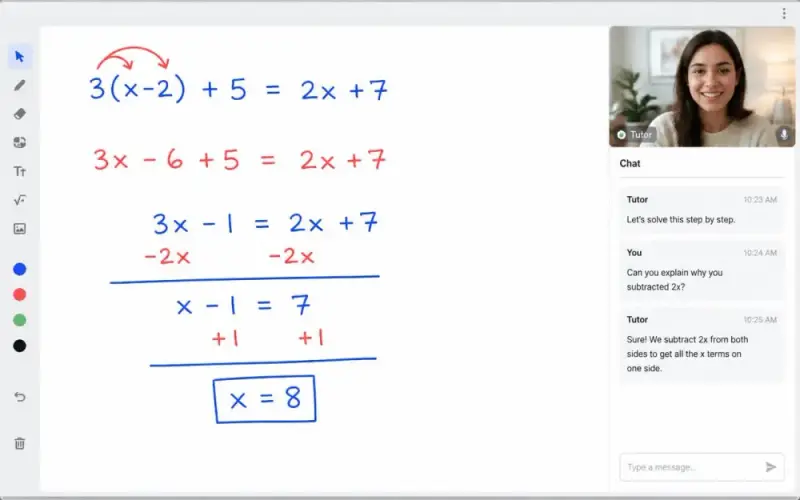
Solves equations methodically
Solves linear equations that need rearranging, such as those with brackets or letters on both sides, and checks each answer by substituting it back.
Confident with percentages
Increases, decreases and reverses percentages, and compares fractions, decimals and percentages in real situations such as sales and simple interest.
Reads and draws data sensibly
Picks a suitable chart, finds the mean, median, mode and range, and says what the numbers show in a sentence.
What we cover
Lessons follow your child's own school or homeschool curriculum. These are the areas we work on most at this level.
Estimation and rounding
Rounding to decimal places and significant figures, and estimating answers so that errors with calculators or written methods stand out.
Sequences
Term-to-term and position-to-term rules, and finding the nth term of an arithmetic sequence.
Linear equations and graphs
Solving equations that need rearranging, plotting straight-line graphs and reading gradient and intercept from y = mx + c.
Percentages and proportionality
Percentage increase and decrease, reverse percentages, simple interest and direct proportion in problems such as recipes and best buys.
Handling data
Frequency tables, pie charts, scatter graphs and averages, comparing two sets of data using the mean and the range.
Perimeter, area and volume
Area of triangles, parallelograms and trapezia, perimeter of compound shapes, and volume of cuboids and other prisms.
Polygons and angles
Angles in triangles, quadrilaterals and polygons, angle rules for parallel lines and the properties of special quadrilaterals.
Constructions
Using a ruler, protractor and compasses to construct triangles, bisect angles and draw perpendicular bisectors accurately.
One typical question, worked through
How a tutor talks a student through a maths question at this level. The student does the working on the shared whiteboard; the tutor asks the next question.
A jacket costs £80 in a sale after 20% was taken off. What was the original price?
- Taking 20% off means the sale price is 80% of the original price.
- So £80 is 80% of the original. Divide by 8 to find 10%: £80 ÷ 8 = £10.
- 100% is ten times 10%: £10 × 10 = £100.
- Check: 20% of £100 is £20, and £100 minus £20 = £80, which matches.
Answer: The original price was £100.
The slip we see most often
Finding 20% of £80 (£16) and adding it on to get £96. The 20% came off the original price, not off £80. Fix: write what £80 stands for (80%) before doing any arithmetic.

Signs your child could use help
- Gets lost once an equation has letters on both sides
- Adds a percentage back on instead of finding the original price
- Used to enjoy maths, but now says it is boring or pointless
- End-of-year test marks have dropped since Year 7
- Spends ages on graph and data questions but still misreads them
- The school says the maths set may change next year
One of these on its own is normal. Two or three together usually point to a specific gap, and finding it is what the free assessment is for.
Taught to your curriculum, wherever you live
Common Core State Standards, Grade 7
Grade 7 develops proportional relationships, operations with rational numbers, expressions and linear equations, scale drawings with area, surface area and volume, and inferences from samples. State maths tests are taken every year in Grades 3 to 8.
Level: Grade 7
National Curriculum in England: Key Stage 3, Year 8
There is no national maths test in Year 8. The government's November 2025 response to the Curriculum and Assessment Review says it expects all schools to assess pupils' progress in maths in Year 8, which is school assessment, not an exam. The next national exams are GCSEs.
Provincial curricula, Grade 7
Ontario's Grade 7 maths includes rational numbers, circle graphs, circle measurement, cylinders and exchange rates. British Columbia assesses numeracy in its Foundation Skills Assessment in Grades 4 and 7; Ontario's EQAO maths tests are in Grades 3, 6 and 9.
Level: Grade 7
Australian Curriculum v9: Mathematics, Year 7
Year 7 covers prime factors, squares and square roots, integers, all four operations with fractions and decimals, linear equations, angle facts and area of triangles and parallelograms. NAPLAN numeracy is sat in Year 7; the 2027 window is 10 to 22 March.
Level: Year 7
Inside a 45-minute Year 8 maths lesson
One 45-minute session. Tutors adjust the timings to your child.
6 min
Warm-up
Four questions on Year 7 skills and last lesson's topic.
7 min
Spot the gap
Anything from school this week that did not make sense.
12 min
Core topic
One Year 8 idea taught on the whiteboard with worked examples.
14 min
Practice
Questions that build from routine to a multi-step problem.
6 min
Summary
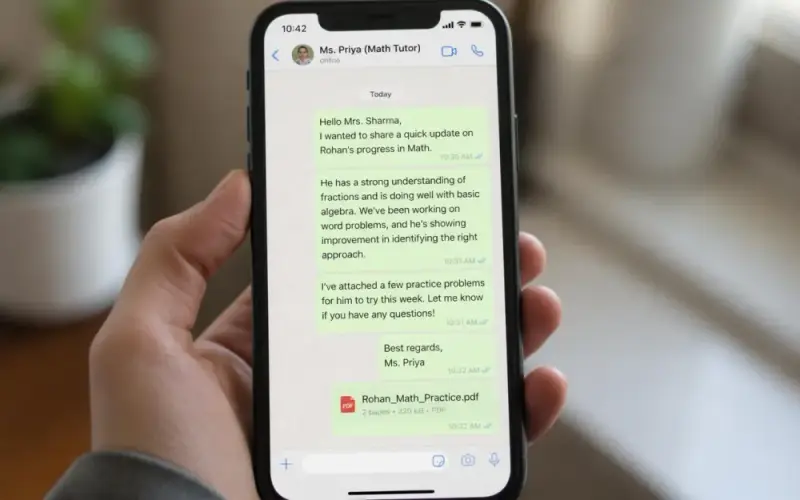
Your child sums up the method. You receive a WhatsApp update.
Who teaches your child
Every TaleemSquare math tutor passes the same five checks before their first class. Your child keeps the same tutor each week, and if the fit is not right we switch tutor at no cost. Tutors are based in the US, UK, Canada, Australia, Pakistan and India, and all of them teach in English.
Identity and references checked
Every tutor is identity-verified and reference-checked before teaching a student.
Subject test
Tutors pass a subject test before they are matched with a child.
Spoken-English assessment
Lessons are taught in English, so every tutor passes a spoken-English assessment.
Live sample lesson
Tutors teach a live sample lesson before they are hired, to show they can explain clearly.
Open to parents
Classes are one-to-one in a password-protected room. Sit in on any class or ask for a recording.
How we teach Year 8 maths
Proportion before percentages
Percentages, ratio and scaling are one idea in different clothes. Double number lines and bar models come first, so reverse percentages become logical instead of a memorised trick.
Equations by balance, then speed
Your child learns why each step keeps both sides equal before moving to quicker methods, which prevents sign slips with brackets and negatives.
Graphs from tables of values
Straight-line graphs are built from a table, then compared with y = mx + c, so gradient and intercept mean something real.
Old skills hidden in new questions
Every lesson briefly revisits Year 7 topics, because Year 8 questions often hide a Year 7 skill inside them.
Simple monthly plans
£69a month for 2 one-to-one maths lessons a week
About £8.63 a lesson, or £11.50 per hour of live one-to-one tutoring.
- Free 45-minute trial assessment, no card details
- No contract, cancel any month
- No registration fee
- 4-class money-back promise
- Switch tutor at no cost
- WhatsApp update after every class
Starter
2 lessons a week, best for keeping up with school
£69/mo
EnrollGrowthMost chosen
3 lessons a week, best for catching up + building confidence
£95/mo
EnrollIntensive
4 lessons a week, best for exam prep & fast improvement
£119/mo
EnrollCommon worries, honest answers
“My child says maths is boring and pointless now.”
Maths becomes more abstract in Year 8 and the praise of primary school fades. Tutors use real contexts such as sales, recipes and maps, and aim for early wins, because liking a subject usually follows being able to do it.
“Will gaps now cause trouble at GCSE?”
They can, because GCSE Maths assumes Key Stage 3 algebra, ratio and geometry. Gaps are far easier to close in Year 8, with no external exams, than in Year 10, when new content arrives every week.
“The school hasn't said anything, but I think they are behind.”
Schools must publish their year-by-year maths curriculum online, so check the website, then bring the latest test result to the free assessment. A 45-minute one-to-one session shows which Key Stage 3 topics are secure, so you are working from evidence, not a feeling.
Frequently asked questions
What maths is taught in Year 8?
Is there a national maths test in Year 8?
How much does a Year 8 maths tutor cost?
Will the tutor follow my child's school, and does this apply outside England?
Why do percentage questions trip up so many Year 8 pupils?
Which GCSEs will my Year 8 child sit?
Book a free 45-minute assessment
Your child meets a tutor for a real one-to-one session. You get an honest read on where they are and what would help, even if the answer is that they don't need tutoring right now.
- 1
We reply on WhatsApp
Usually within 10 minutes, to find a time that suits your family.
- 2
Your child meets the tutor
A relaxed 45-minute session to see their level and how they learn.
- 3
You decide
You get a recommendation and a plan. No card details, no pressure.