
Secondary school, Year 9 · Ages 13-14
Year 9 Maths Tutor: The Step Up to GCSE Maths
One-to-one Year 9 maths that finishes Key Stage 3 properly, so GCSE Maths in Year 10 starts from solid ground.
Prefer to ask a question first? Chat on WhatsApp
Already decided? Choose a plan and enroll now, and we schedule the first class in your time zone.

How it works, in short
TaleemSquare Year 9 maths tutoring is live, one-to-one online lessons of 45 minutes following the National Curriculum in England and your child's school. Tutors finish Key Stage 3 with algebra, similarity and Pythagoras' theorem, trigonometry, standard form, probability and graphs, and introduce GCSE-style questions, so the step up in Year 10 builds on understanding.
Year 9 has no national maths test. Schools run their own GCSE options process, but maths is a compulsory core subject through Key Stage 4, and some schools begin GCSE content early. Plans start at £69 a month for two 45-minute lessons a week (about £8.63 a lesson).
- Format
- Live, one-to-one, online
- Lesson length
- 45 minutes
- Level
- Ages 13-14
- Price
- From £69 a month
- Per hour of tutoring
- About £11.50
- Families taught
- 500+ since 2023
What changes after a term of lessons
Right-angled triangles, solved
Uses Pythagoras' theorem and the sine, cosine and tangent ratios to find missing sides and angles, and chooses the right tool for each question.
Algebra that holds up
Expands, factorises and rearranges expressions and formulae, and sketches linear and quadratic graphs from their equations.
A GCSE-ready starting point
Knows how GCSE-style questions are worded and reaches Year 10 with Key Stage 3 gaps closed instead of carried forward.
What we cover
Lessons follow your child's own school or homeschool curriculum. These are the areas we work on most at this level.
Similarity and Pythagoras' theorem
Scale factors in similar shapes, then Pythagoras' theorem to find missing sides and to test whether a triangle is right-angled.
Trigonometry
Sine, cosine and tangent in right-angled triangles to find unknown sides and angles, with a calculator set correctly.
Expressions and formulae
Expanding and factorising, substituting into formulae and changing the subject of a formula.
Non-linear relationships and graphs
Quadratic graphs from tables of values, and links between equations, tables and graphs, including the gradient and intercept of straight lines.
Standard form
Writing very large and very small numbers in standard form, and calculating with them by hand and on a calculator.
Probability
Possible outcomes, sample spaces, Venn diagrams and theoretical probability, including why the probabilities of all outcomes add up to 1.
Ratio, proportion and compound units
Speed, density and other compound measures, direct and inverse proportion, and percentage change in multi-step problems.
Calculator skills
Using a scientific calculator accurately for powers, roots, fractions and standard form, and spotting when an answer is unreasonable.
One typical question, worked through
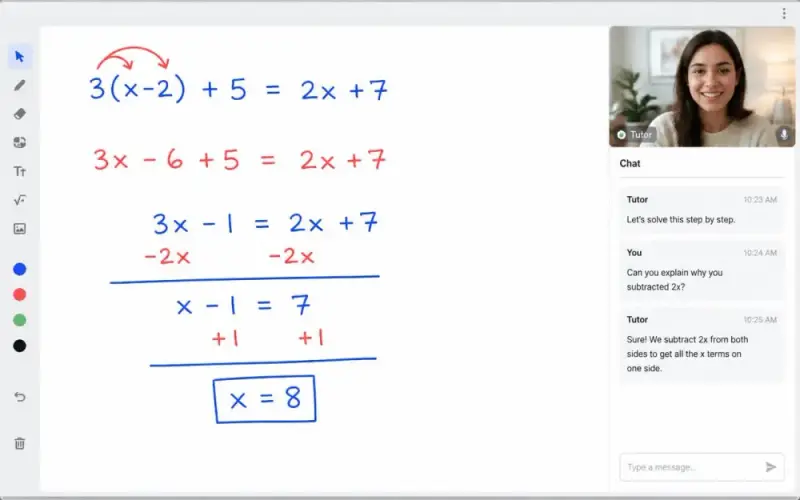
How a tutor talks a student through a maths question at this level. The student does the working on the shared whiteboard; the tutor asks the next question.
A 6.5 m ladder leans against a wall and its top reaches 6 m up the wall. How far is the foot of the ladder from the wall?
- Sketch the right-angled triangle. The ladder is the longest side (hypotenuse) at 6.5 m, the wall is one shorter side at 6 m, and the ground distance is x.
- Pythagoras' theorem for a shorter side: x² + 6² = 6.5², so x² = 6.5² minus 6².
- 6.5² = 42.25 and 6² = 36, so x² = 42.25 minus 36 = 6.25.
- x = √6.25 = 2.5. Check: 2.5² + 6² = 6.25 + 36 = 42.25, which is 6.5².
Answer: The foot of the ladder is 2.5 m from the wall.
The slip we see most often
Adding the squares (36 + 42.25) as if the unknown were the longest side. Fix: label the hypotenuse first, then ask whether the answer is sensible. A shorter side must be shorter than the 6.5 m ladder.

Signs your child could use help
- The options form is due and maths confidence is shaky
- Expanding and factorising brackets still goes wrong most of the time
- Pythagoras and trigonometry get muddled in every test
- The school has mentioned tiers and I want my child to keep Higher open
- Spends hours on maths homework and still gets it wrong
- Says they are 'just not a maths person' before GCSE even starts
One of these on its own is normal. Two or three together usually point to a specific gap, and finding it is what the free assessment is for.
Taught to your curriculum, wherever you live
Common Core State Standards, Grade 8
Grade 8 centres on linear equations, functions, and analysing two- and three-dimensional space using distance, angle, similarity and congruence, including the Pythagorean theorem. State maths tests are taken every year in Grades 3 to 8.
Level: Grade 8
National Curriculum in England: Key Stage 3, Year 9
Year 9 is the last year of Key Stage 3, with no national maths test. Key Stage 4 begins in Year 10, when most pupils work towards GCSEs. Maths is a compulsory core subject, and schools may start GCSE content earlier.
Provincial curricula, Grade 8
Ontario's Grade 8 maths includes scientific notation, the Pythagorean theorem, scatter plots and simple and compound interest. Grade 9 follows with the de-streamed MTH1W course and the EQAO Grade 9 Assessment of Mathematics.
Level: Grade 8
Australian Curriculum v9: Mathematics, Year 8
Year 8 covers irrational numbers, exponent laws, expanding and factorising linear expressions, graphing linear relations, Pythagoras' theorem, circle area and circumference, congruence and similarity. There is no NAPLAN in Year 8; the tests are in Years 7 and 9.
Level: Year 8
Inside a 45-minute Year 9 maths lesson
One 45-minute session. Tutors adjust the timings to your child.
6 min
Retrieval starter
Four questions on earlier topics, mixed the way GCSE papers mix them.
7 min
School check
Homework or classwork from this week that is not yet clear.
12 min
Core topic
One idea taught with worked examples and a diagram.
14 min
GCSE-style practice
Questions from routine to multi-step, with working set out line by line.
6 min
Summary and next step
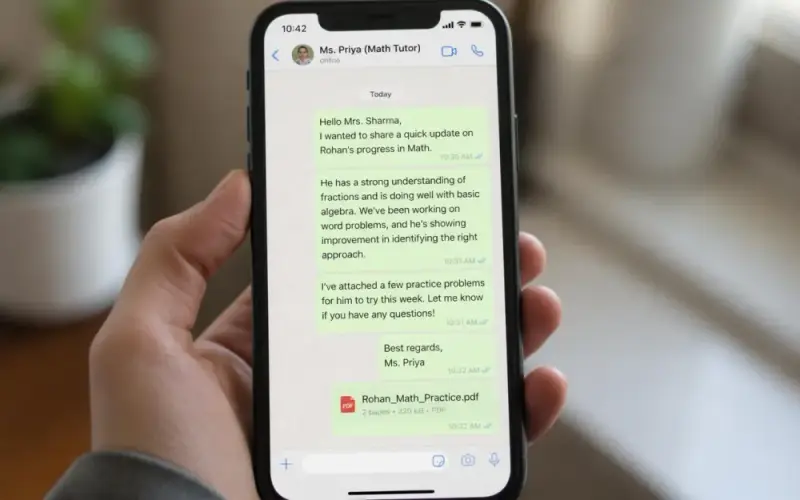
Your child names the key idea. You get a WhatsApp update.
Who teaches your child
Every TaleemSquare math tutor passes the same five checks before their first class. Your child keeps the same tutor each week, and if the fit is not right we switch tutor at no cost. Tutors are based in the US, UK, Canada, Australia, Pakistan and India, and all of them teach in English.
Identity and references checked
Every tutor is identity-verified and reference-checked before teaching a student.
Subject test
Tutors pass a subject test before they are matched with a child.
Spoken-English assessment
Lessons are taught in English, so every tutor passes a spoken-English assessment.
Live sample lesson
Tutors teach a live sample lesson before they are hired, to show they can explain clearly.
Open to parents
Classes are one-to-one in a password-protected room. Sit in on any class or ask for a recording.
How we teach Year 9 maths
Finish Key Stage 3 properly
We start with a gap check across algebra, ratio and geometry, because GCSE questions assume all three. Gaps found now cost far less to fix than gaps found in Year 10.
Preview GCSE wording
Once a topic is secure, we show how it appears in GCSE-style questions, including multi-step and 'show that' questions, so the exam style is not a surprise later.
Keep the Higher door open
Schools choose GCSE tier entry later. We secure the basics first, then introduce the harder ideas Year 9 touches, such as trigonometry and quadratics, so your child has choices.
Little and often
Each lesson opens with short questions on Year 7 and 8 topics, because GCSE papers mix topics and expect recall from earlier years.
Simple monthly plans
£69a month for 2 one-to-one maths lessons a week
About £8.63 a lesson, or £11.50 per hour of live one-to-one tutoring.
- Free 45-minute trial assessment, no card details
- No contract, cancel any month
- No registration fee
- 4-class money-back promise
- Switch tutor at no cost
- WhatsApp update after every class
Starter
2 lessons a week, best for keeping up with school
£69/mo
EnrollGrowthMost chosen
3 lessons a week, best for catching up + building confidence
£95/mo
EnrollIntensive
4 lessons a week, best for exam prep & fast improvement
£119/mo
EnrollCommon worries, honest answers
“Will Year 9 results decide which set or tier my child gets?”
Schools decide sets, and later the GCSE tier, using their own evidence, so we cannot promise either. Strengthening the weakest topics gives your child the best chance to show what they can do in the school's assessments.
“My child hates maths and wants to drop it.”
Maths cannot be dropped: it is a compulsory core subject at Key Stage 4. The realistic aim is to make it less painful. Tutors rebuild confidence with questions your child can answer, then raise the difficulty gradually.
“I worry they are too far behind to catch up before GCSE starts.”
Starting in Year 9 leaves time before the Year 11 exams. The free assessment shows the biggest gaps, lessons start there, and WhatsApp updates report progress honestly, without promising a grade.
Frequently asked questions
What maths is taught in Year 9?
Is maths compulsory when we choose GCSE options?
How much does a Year 9 maths tutor cost?
How will the tutor match my child's school, and does this apply outside England?
Do schools start GCSE maths in Year 9?
Which GCSEs will my Year 9 child sit, and will they change?
Sources
Book a free 45-minute assessment
Your child meets a tutor for a real one-to-one session. You get an honest read on where they are and what would help, even if the answer is that they don't need tutoring right now.
- 1
We reply on WhatsApp
Usually within 10 minutes, to find a time that suits your family.
- 2
Your child meets the tutor
A relaxed 45-minute session to see their level and how they learn.
- 3
You decide
You get a recommendation and a plan. No card details, no pressure.