
Primary school, Year 1 · Ages 6-7
Year 1 Maths Tutor: Gentle One-to-One Lessons Online
Playful one-to-one maths that builds number sense and follows the Australian Curriculum and your child's school.
Prefer to ask a question first? Chat on WhatsApp
Already decided? Choose a plan and enroll now, and we schedule the first class in your time zone.

How it works, in short
TaleemSquare Year 1 maths tutoring is live, one-to-one online lessons of 45 minutes, following the Australian Curriculum (Version 9) and your child's own school. Tutors teach numbers to 120, tens and ones, adding and subtracting within 20, skip counting, patterns, measuring length and sequencing events, using objects, pictures and games on an interactive whiteboard.
There is no national test in Year 1, because NAPLAN numeracy starts in Year 3. The aim here is a confident start with number, not test preparation. A free assessment comes first, and plans start at A$130 a month for two 45-minute lessons a week, about A$30 a week.
- Format
- Live, one-to-one, online
- Lesson length
- 45 minutes
- Level
- Ages 6-7
- Price
- From A$130 a month
- Per hour of tutoring
- About A$21.67
- Families taught
- 500+ since 2023
What changes after a term of lessons
At home with numbers to 120
Reads, orders and counts numbers to at least 120, and knows that 47 is four tens and seven ones.
Adds and subtracts within 20
Uses ten-frames, number bonds to 10 and strategies like making ten, instead of counting every step on fingers.
Explains their thinking
Says how they solved a problem, shares and groups objects equally, and spots the repeating part of a pattern.
What we cover
Lessons follow your child's own school or homeschool curriculum. These are the areas we work on most at this level.
Numbers to 120
Recognising, representing and ordering numbers to at least 120 with objects, numerals, number lines and charts.
Tens and ones
Partitioning one- and two-digit numbers in different ways, including splitting a two-digit number into tens and ones.
Skip counting and equal groups
Counting in twos, fives and tens, and finding how many are in a collection by making equal groups.
Adding and subtracting within 20
Number bonds to 10, then strategies such as counting on and making ten, using objects first and number sentences later.
Sharing and grouping problems
Practical problems about equal sharing, equal grouping and simple money transactions, solved with objects and drawings.
Patterns
Continuing and creating skip counting patterns and repeating patterns with numbers, shapes and objects, and naming the repeating unit.
Length, time and comparing
Comparing length, mass, capacity and duration, measuring length end to end with uniform units, and ordering events by days and weeks.
Shapes, directions and data
Sorting familiar shapes, giving and following directions, and collecting data with tally marks to make simple displays.
One typical question, worked through
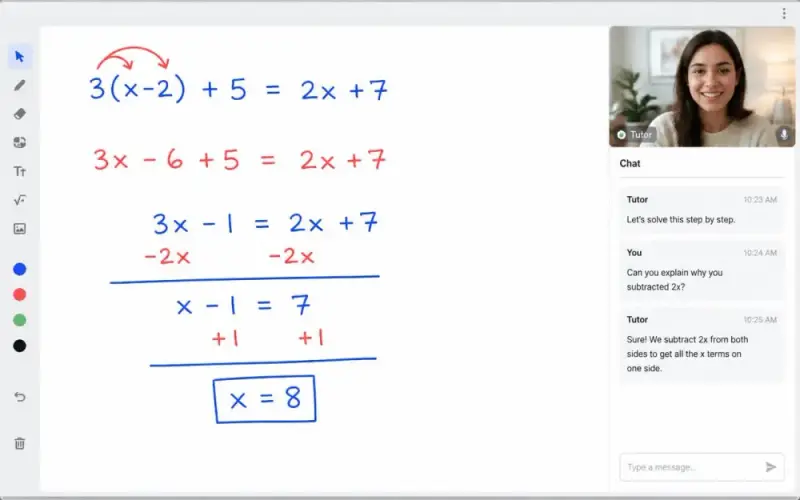
How a tutor talks a student through a maths question at this level. The student does the working on the shared whiteboard; the tutor asks the next question.
Mia has 8 stickers and her brother gives her 6 more. How many stickers does Mia have now?
- Draw a ten-frame and put in 8 counters. Two spaces are empty, so 8 is 2 away from 10.
- Split the 6 into 2 and 4. Move the 2 into the frame to make 10, and keep the 4 beside it.
- Now it is 10 and 4 more, which is 14.
- Check another way: start at 8 and count on six fingers, 9, 10, 11, 12, 13, 14. It matches.
Answer: 14 stickers
The slip we see most often
A common slip is counting the 8 again from 1 and losing track, which often lands on 13 or 15. The fix is to keep 8 as a block and count on or make ten, so only the 6 needs counting.

Signs your child could use help
- Counts on fingers for every sum, even 3 plus 2
- Writes teen numbers backwards, such as 61 for 16
- Loses their place counting past 20 or in tens
- Says maths is boring or hides from the homework sheet
- The teacher says number bonds to 10 are not yet secure
- Understands with objects but freezes when a worksheet shows only numbers
One of these on its own is normal. Two or three together usually point to a specific gap, and finding it is what the free assessment is for.
Taught to your curriculum, wherever you live
Common Core State Standards, Grade 1
Grade 1 concentrates on adding and subtracting within 20, whole number relationships and place value with tens and ones, measuring lengths with units, and composing and decomposing shapes. It is the same age group as Year 1 in Australia.
Level: Grade 1
National Curriculum in England: Year 2 (Key Stage 1)
Children of this age are in Year 2, the last year of Key Stage 1. They count in steps of 2, 3, 5 and 10, read and write numbers to at least 100, recall the 2, 5 and 10 times tables and tell the time to five minutes.
Level: Year 2
Ontario Mathematics curriculum (2020), Grade 1
Ontario's Grades 1-8 curriculum covers number, algebra, data, spatial sense and financial literacy. In Grade 1, children recognise Canadian coins and bills and write simple code to order a sequence of steps. Provincial EQAO testing starts in Grade 3.
Level: Grade 1
Australian Curriculum v9: Mathematics, Year 1
Year 1 covers numbers to at least 120, addition and subtraction within 20, skip counting, patterns, measuring length with informal units and simple data. NAPLAN numeracy is sat in Years 3, 5, 7 and 9, so there is no NAPLAN in Year 1.
Inside a 45-minute Year 1 maths lesson
One 45-minute session. Tutors adjust the timings to your child.
5 min
Counting warm-up
Counting forwards and backwards, and skip counting in twos, fives and tens.
8 min
Make it real
Objects or pictures on the whiteboard introduce today's idea, such as making ten.
12 min
Guided practice
Your child solves problems with the tutor using ten-frames and number lines, then without them.
12 min
Game time
A quick maths game, such as spin and add, to practise the same skill a different way.
8 min
Show and tell
Your child explains one answer aloud and picks one idea to remember for next time.
Who teaches your child
Every TaleemSquare math tutor passes the same five checks before their first class. Your child keeps the same tutor each week, and if the fit is not right we switch tutor at no cost. Tutors are based in the US, UK, Canada, Australia, Pakistan and India, and all of them teach in English.
Identity and references checked
Every tutor is identity-verified and reference-checked before teaching a student.
Subject test
Tutors pass a subject test before they are matched with a child.
Spoken-English assessment
Lessons are taught in English, so every tutor passes a spoken-English assessment.
Live sample lesson
Tutors teach a live sample lesson before they are hired, to show they can explain clearly.
Open to parents
Classes are one-to-one in a password-protected room. Sit in on any class or ask for a recording.
How we teach Year 1 maths
Objects before symbols
Counters, ten-frames and drawings on the whiteboard come first, so 8 plus 6 is something your child can see before it becomes a number sentence.
Short, playful bursts
Each 45-minute lesson is split into several quick activities and games, so a six-year-old stays interested instead of sitting through one long task.
Say it out loud
Your child counts and explains aloud, so the tutor can hear whether a mistake is a miscount, a missing idea or just tiredness.
Easy follow-up at home
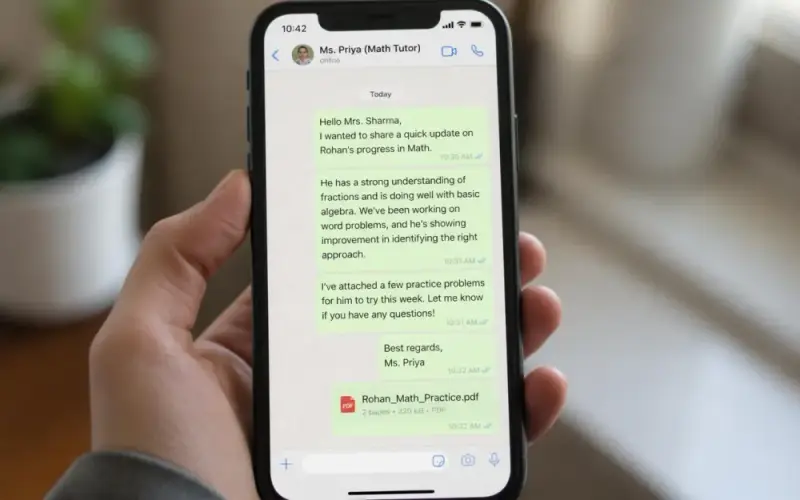
After lessons you get a WhatsApp update, and the tutor can suggest a simple game to try at home, such as counting stairs or sorting the shopping into tens.
Simple monthly plans
A$130a month for 2 one-to-one maths lessons a week
About A$16.25 a lesson, or A$21.67 per hour of live one-to-one tutoring.
- Free 45-minute trial assessment, no card details
- No contract, cancel any month
- No registration fee
- 4-class money-back promise
- Switch tutor at no cost
- WhatsApp update after every class
Starter
2 lessons a week, best for keeping up with school
A$130/mo
EnrollGrowthMost chosen
3 lessons a week, best for catching up + building confidence
A$179/mo
EnrollIntensive
4 lessons a week, best for exam prep & fast improvement
A$229/mo
EnrollCommon worries, honest answers
“Is Year 1 too young for a maths tutor?”
Many Year 1 children do not need one. Tutoring helps most when counting or adding within 10 still feels hard, or your child already dislikes maths. The free assessment shows where they are, and we will tell you plainly if games at home would be enough.
“Can a six-year-old really focus for 45 minutes online?”
Lessons are built from short activities and games rather than one long task, and a parent is welcome to sit nearby at first. If concentration is the problem, tell the tutor and the plan changes. If the fit is wrong, a tutor rematch is free.
“The homework uses methods I never learned.”
Ten-frames, number lines and part-part-whole diagrams are standard in Year 1 classrooms. The tutor teaches them the way the curriculum describes, and you can send a homework sheet so lessons match what the class is doing.
Frequently asked questions
What maths is taught in Year 1 in Australia?
Is there a NAPLAN or national maths test in Year 1?
How much does a Year 1 maths tutor cost?
How does the tutor match my child's school and state?
How many lessons a week does a Year 1 child need?
When should I worry about my Year 1 child's maths?
Sources
- Australian Curriculum v9 Mathematics, Year 1: content descriptions and achievement standard (QCAA)
- NAPLAN 2027: information for parents and carers (NAP)
- Mathematics K-10 Syllabus (2022) implementation (NSW Department of Education)
- Victorian Curriculum F-10 Version 2.0 (VCAA)
- Common Core State Standards for Mathematics: Grade 1 introduction
Book a free 45-minute assessment
Your child meets a tutor for a real one-to-one session. You get an honest read on where they are and what would help, even if the answer is that they don't need tutoring right now.
- 1
We reply on WhatsApp
Usually within 10 minutes, to find a time that suits your family.
- 2
Your child meets the tutor
A relaxed 45-minute session to see their level and how they learn.
- 3
You decide
You get a recommendation and a plan. No card details, no pressure.