
Primary school, Year 2 · Ages 7-8
Year 2 Maths Tutor for Place Value, Time and Number Facts
One-to-one Year 2 maths that makes place value and number facts click, following the Australian Curriculum.
Prefer to ask a question first? Chat on WhatsApp
Already decided? Choose a plan and enroll now, and we schedule the first class in your time zone.

How it works, in short
TaleemSquare Year 2 maths tutoring is live, one-to-one online lessons of 45 minutes, following the Australian Curriculum (Version 9) and your child's own school. Tutors teach numbers to 1000, regrouping in addition and subtraction, addition facts to 20, arrays and the twos table, halves, quarters and eighths, reading analog clocks and simple graphs.
There is no national test in Year 2. NAPLAN numeracy starts in Year 3, so this year is for securing place value and number facts first. A free assessment comes first, and plans start at A$130 a month for two 45-minute lessons a week, about A$30 a week.
- Format
- Live, one-to-one, online
- Lesson length
- 45 minutes
- Level
- Ages 7-8
- Price
- From A$130 a month
- Per hour of tutoring
- About A$21.67
- Families taught
- 500+ since 2023
What changes after a term of lessons
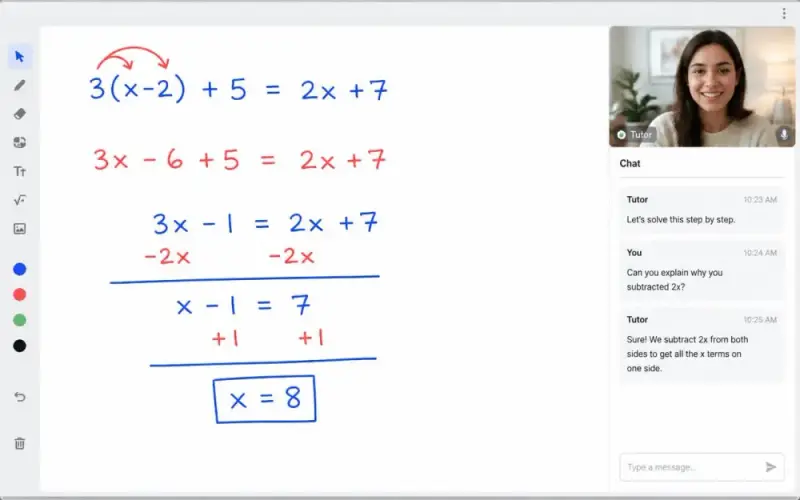
Understands three-digit numbers
Knows what each digit is worth in numbers to 1000 and can regroup, so 135 can be 13 tens and 5 ones.
Subtracts with regrouping
Adds and subtracts two-digit numbers, including when the ones need regrouping, and explains why the method works.
Reads time and uses equal groups
Tells the time on an analog clock to the quarter-hour and uses arrays and equal groups to begin multiplying and dividing.
What we cover
Lessons follow your child's own school or homeschool curriculum. These are the areas we work on most at this level.
Numbers to 1000
Recognising, representing and ordering numbers to at least 1000 on number lines, with objects and numerals, and knowing what each digit is worth.
Partitioning and regrouping
Splitting two- and three-digit numbers in standard and non-standard ways, which makes subtraction with regrouping make sense.
Adding and subtracting
Adding and subtracting one- and two-digit numbers with number sentences, number lines and mental strategies, including practical word problems.
Number facts and patterns
Recalling addition facts to 20 and the multiplication facts for twos, and describing patterns that increase or decrease by a constant amount.
Equal groups and arrays
Using repeated addition, equal grouping, arrays and sharing so that multiplication and division start as pictures your child can draw.
Halves, quarters and eighths
Naming and showing halves, quarters and eighths of shapes, objects and events, and knowing the parts must be equal.
Time and measurement
Reading analog clocks to the hour, half-hour and quarter-hour, using calendars, and measuring length, capacity and mass with uniform units.
Shapes, position and data
Classifying shapes by their number of sides, finding positions on simple maps, and collecting survey data to draw graphs.
One typical question, worked through
How a tutor talks a student through a maths question at this level. The student does the working on the shared whiteboard; the tutor asks the next question.
What is 82 take away 47?
- Estimate first: 82 is close to 80 and 47 is close to 50, so the answer should be about 30.
- Show 82 as 8 tens and 2 ones. We cannot take 7 ones from 2 ones, so regroup one ten into ten ones. Now it is 7 tens and 12 ones.
- Take away: 12 ones minus 7 ones leaves 5 ones, and 7 tens minus 4 tens leaves 3 tens.
- Put it together: 3 tens and 5 ones is 35.
- Check by adding: 35 plus 47 is 82, and 35 is close to the estimate of 30.
Answer: 35
The slip we see most often
A common slip is taking the smaller digit from the larger in each column (7 minus 2 is 5, 8 minus 4 is 4) and answering 45. The fix is the estimate and the check: 45 plus 47 is 92, not 82.

Signs your child could use help
- Still counts on fingers for sums like 7 plus 8
- Cannot say what 10 more or 100 more than a number is
- Gets stuck on subtraction when the ones digit is smaller
- Reads an analog clock wrongly, or avoids it altogether
- Loses their place when skip counting in twos, fives and tens
- Homework ends in tears, and worksheets come back half finished
One of these on its own is normal. Two or three together usually point to a specific gap, and finding it is what the free assessment is for.
Taught to your curriculum, wherever you live
Common Core State Standards, Grade 2
Grade 2 concentrates on base-ten notation, fluency with addition and subtraction, standard units of measure, and describing and analysing shapes. It matches Year 2 in Australia by age and sits one year before the first annual state tests.
Level: Grade 2
National Curriculum in England: Year 3 (Key Stage 2)
Children of this age are in Year 3, the first year of Key Stage 2. They read and write numbers to 1,000, learn the 3, 4 and 8 times tables and count up and down in tenths. The multiplication tables check comes in Year 4.
Level: Year 3
Ontario Mathematics curriculum (2020), Grade 2
Ontario's Grades 1-8 curriculum covers number, algebra, data, spatial sense and financial literacy every year. Grade 2 prepares children for Grade 3, where they are expected to know the × 2, × 5 and × 10 facts and take the first EQAO assessment.
Level: Grade 2
Australian Curriculum v9: Mathematics, Year 2
Year 2 covers numbers to at least 1000, addition and subtraction of one- and two-digit numbers, halves, quarters and eighths, and time to the quarter-hour. NAPLAN numeracy is sat in Years 3, 5, 7 and 9, so Year 2 has no NAPLAN.
Inside a 45-minute Year 2 maths lesson
One 45-minute session. Tutors adjust the timings to your child.
6 min
Number facts warm-up
Addition facts to 20, skip counting and one quick place value question.
12 min
Teach the idea
One idea with blocks or drawings, such as regrouping or reading the time.
13 min
Guided practice
Questions that move from pictures to number sentences, with the tutor stepping back as your child gains confidence.
8 min
Maths game
A short game that practises the same skill in a new way.
6 min
Explain and wrap up
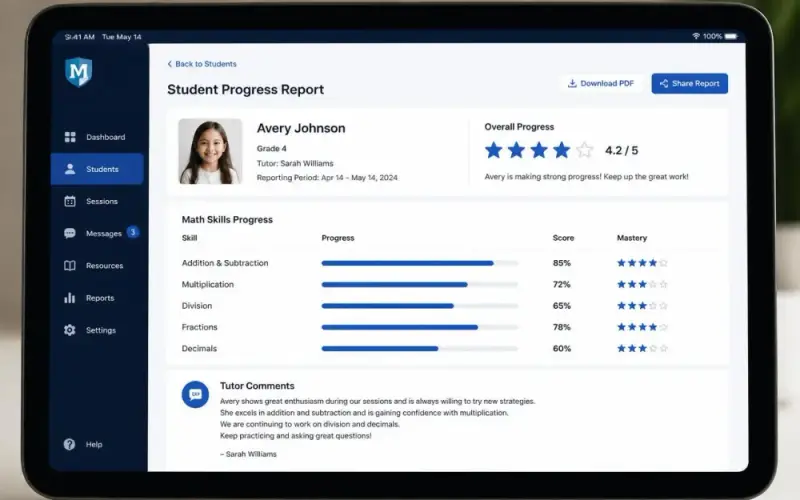
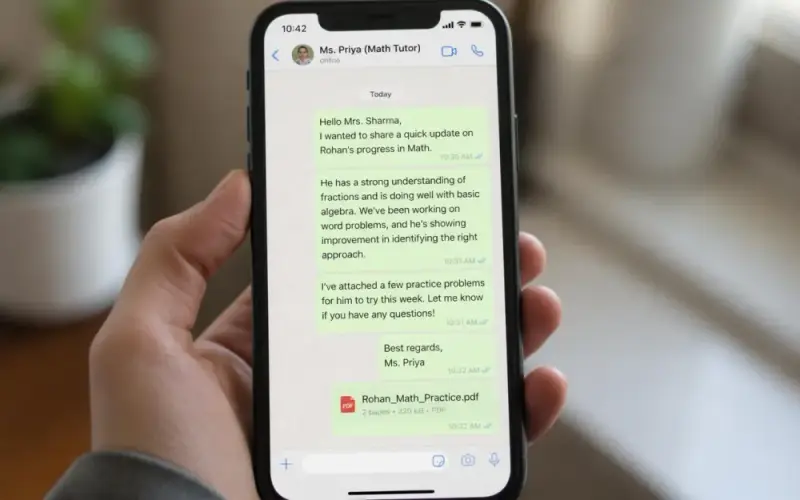
Your child explains one answer aloud. You get a WhatsApp note on progress.
Who teaches your child
Every TaleemSquare math tutor passes the same five checks before their first class. Your child keeps the same tutor each week, and if the fit is not right we switch tutor at no cost. Tutors are based in the US, UK, Canada, Australia, Pakistan and India, and all of them teach in English.
Identity and references checked
Every tutor is identity-verified and reference-checked before teaching a student.
Subject test
Tutors pass a subject test before they are matched with a child.
Spoken-English assessment
Lessons are taught in English, so every tutor passes a spoken-English assessment.
Live sample lesson
Tutors teach a live sample lesson before they are hired, to show they can explain clearly.
Open to parents
Classes are one-to-one in a password-protected room. Sit in on any class or ask for a recording.
How we teach Year 2 maths
Place value you can build
Base-ten blocks and drawn hundreds, tens and ones show why 82 take away 47 needs regrouping, before any rule is memorised.
Number facts in small doses
A few minutes of addition facts to 20 and the twos table in each lesson builds recall without pages of drills.
Pictures before number sentences
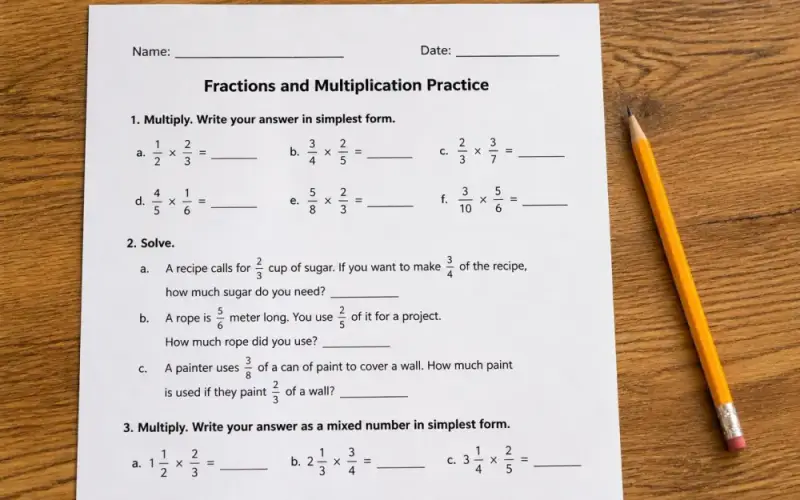
Arrays, equal groups and quick drawings lead to number sentences, so a word problem always has a clear first step.
Clocks and calendars you can touch
A big analog clock face and a calendar on the whiteboard make time concrete, and the tutor links them to your child's day.
Simple monthly plans
A$130a month for 2 one-to-one maths lessons a week
About A$16.25 a lesson, or A$21.67 per hour of live one-to-one tutoring.
- Free 45-minute trial assessment, no card details
- No contract, cancel any month
- No registration fee
- 4-class money-back promise
- Switch tutor at no cost
- WhatsApp update after every class
Starter
2 lessons a week, best for keeping up with school
A$130/mo
EnrollGrowthMost chosen
3 lessons a week, best for catching up + building confidence
A$179/mo
EnrollIntensive
4 lessons a week, best for exam prep & fast improvement
A$229/mo
EnrollCommon worries, honest answers
“My child can do the sums but doesn't understand why.”
That gap shows up in Year 2, when regrouping and three-digit numbers arrive. Tutors use blocks and drawings so your child can see why a method works, and ask them to explain, because a rule learned without meaning tends to break down on harder questions.
“Will my child be ready for NAPLAN in Year 3?”
NAPLAN is a snapshot, and ACARA says students are not expected to study for it. The best Year 2 preparation is secure place value, addition and subtraction, and time. We cannot promise a result, but we can close the gaps that matter first.
“I was taught 'borrowing' and the school says 'regrouping'.”
The words differ, but the idea is the same: trading one ten for ten ones. Tutors use the school's language and show it with blocks, and you can send a homework sheet so the method matches what your child sees in class.
Frequently asked questions
What maths is taught in Year 2 in Australia?
Is there a test in Year 2, and does NAPLAN start next year?
How much does a Year 2 maths tutor cost?
Should my Year 2 child know their times tables yet?
How does the tutor match my child's school and state?
How do I know if my Year 2 child needs a tutor?
Sources
- Australian Curriculum v9 Mathematics, Year 2: content descriptions and achievement standard (QCAA)
- NAPLAN 2027: information for parents and carers (NAP)
- Mathematics K-10 Syllabus (2022) implementation (NSW Department of Education)
- Victorian Curriculum F-10 Version 2.0 (VCAA)
- National curriculum in England: mathematics programmes of study (DfE)
Book a free 45-minute assessment
Your child meets a tutor for a real one-to-one session. You get an honest read on where they are and what would help, even if the answer is that they don't need tutoring right now.
- 1
We reply on WhatsApp
Usually within 10 minutes, to find a time that suits your family.
- 2
Your child meets the tutor
A relaxed 45-minute session to see their level and how they learn.
- 3
You decide
You get a recommendation and a plan. No card details, no pressure.