
Secondary school, Year 10 · Ages 14-15
Year 10 Maths Tutor: Starting GCSE Maths with Confidence
One-to-one Year 10 maths for the first GCSE year, on Foundation or Higher tier, matched to your exam board.
Prefer to ask a question first? Chat on WhatsApp
Already decided? Choose a plan and enroll now, and we schedule the first class in your time zone.

How it works, in short
TaleemSquare Year 10 maths tutoring is live, one-to-one online lessons of 45 minutes for the first year of GCSE Maths, following the National Curriculum in England and your child's exam board. Tutors cover algebraic manipulation, simultaneous equations, percentages, indices, standard form, ratio, graphs, similarity and right-angled trigonometry on Foundation or Higher tier.
GCSE Maths is usually sat in Year 11 as three papers, one without a calculator. Foundation tier leads to grades 1 to 5 and Higher tier to grades 4 to 9, and grade 4 is the standard pass. Plans start at £69 a month for two 45-minute lessons a week (about £8.63 a lesson).
- Format
- Live, one-to-one, online
- Lesson length
- 45 minutes
- Level
- Ages 14-15
- Price
- From £69 a month
- Per hour of tutoring
- About £11.50
- Families taught
- 500+ since 2023
What changes after a term of lessons
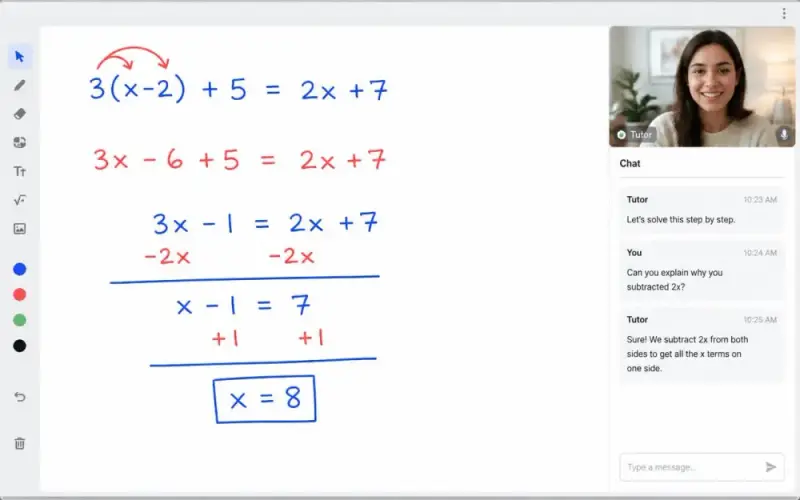
Fluent GCSE algebra
Expands, factorises, rearranges and solves, including simultaneous equations, and sketches linear and quadratic graphs.
Secure number and ratio
Handles percentages, index laws, standard form and ratio problems accurately, with and without a calculator.
Exam-ready habits
Sets out working so method marks are earned, reads command words such as 'show that' and 'explain', and checks answers for sense.
What we cover
Lessons follow your child's own school or homeschool curriculum. These are the areas we work on most at this level.
Algebraic manipulation
Expanding, factorising, simplifying and rearranging expressions and formulae, the skill that most later GCSE topics lean on.
Simultaneous equations
Solving pairs of linear equations by elimination or substitution, and checking the answers in both equations.
Percentages and ratio
Repeated percentage change, reverse percentages, ratio sharing and problems that mix ratio, fractions and percentages.
Indices, standard form and surds
Index laws, calculations in standard form and simplifying surds, with and without a calculator.
Rounding, estimation and bounds
Significant figures, estimating answers, and the upper and lower bounds of rounded measurements.
Graphs
Straight-line graphs and their equations, and non-linear graphs such as quadratics, with sketching skills for exam questions.
Data and sampling
Sampling, scatter graphs and time series, and comparing sets of data using averages and measures of spread.
Shape, similarity and trigonometry
Compound shapes, angles, transformations, similarity, plans and elevations, right-angled trigonometry and bearings; Higher tier adds circle theorems.
One typical question, worked through
How a tutor talks a student through a maths question at this level. The student does the working on the shared whiteboard; the tutor asks the next question.
Solve the simultaneous equations 2x + 3y = 12 and 2x + y = 8.
- Label them (1) and (2). Both contain 2x, so subtracting one from the other removes x.
- Subtract (2) from (1) term by term: 2x minus 2x = 0, 3y minus y = 2y, 12 minus 8 = 4. So 2y = 4 and y = 2.
- Substitute y = 2 into (2): 2x + 2 = 8, so 2x = 6 and x = 3.
- Check in the equation you did not use to find x: (1) gives 2 × 3 + 3 × 2 = 6 + 6 = 12, which matches.
Answer: x = 3 and y = 2.
The slip we see most often
Subtracting the left-hand sides but adding the right-hand sides (12 + 8), or leaving a term out. Fix: subtract every term in the same pass, then check both answers in an equation you did not use to find them.

Signs your child could use help
- Understood Year 9 maths but GCSE questions look much harder
- Mock or end-of-year test marks are far below the target grade
- Unsure whether Foundation or Higher tier is the right fit
- Loses method marks because working is not set out clearly
- Forgets last term's topics by the time the next test arrives
- Panics at the thought of three exam papers in Year 11
One of these on its own is normal. Two or three together usually point to a specific gap, and finding it is what the free assessment is for.
Taught to your curriculum, wherever you live
Common Core high school standards, Grade 9 courses
Common Core's high school standards are grouped by topic (number, algebra, functions, modeling, geometry, statistics) rather than by grade, so Grade 9 maths depends on the course, such as Algebra 1 or Geometry. States must test maths once in high school.
Level: Grade 9
GCSE Mathematics, Key Stage 4 (Year 10)
GCSE courses usually begin in Year 10, with the exams in Year 11. Exam boards such as AQA and Pearson Edexcel set three papers graded 9 to 1, with Foundation and Higher tiers. Boards also provide formulae sheets with the papers.
Provincial curricula, Grade 9
Ontario's Grade 9 maths is the de-streamed MTH1W course. EQAO's Grade 9 Assessment of Mathematics is given near the end of the course and counts towards the final course mark. Other provinces set their own Grade 9 courses.
Level: Grade 9
Australian Curriculum v9: Mathematics, Year 9
Year 9 covers linear and quadratic functions, expanding binomial products, distance and gradient on the Cartesian plane, trigonometric ratios and scientific notation. NAPLAN numeracy is sat in Year 9; the 2027 window is 10 to 22 March.
Level: Year 9
Inside a 45-minute Year 10 GCSE maths lesson
One 45-minute session. Tutors adjust the timings to your child.
6 min
Retrieval starter
Four mixed questions on earlier topics, the way GCSE papers mix them.
7 min
Class check
Anything from this week's lesson or homework that is not clear.
12 min
Teach
One GCSE topic taught with worked examples set out as a mark scheme expects.
14 min
Exam-style practice
Questions from routine to multi-step, with working checked line by line.
6 min
Review and plan
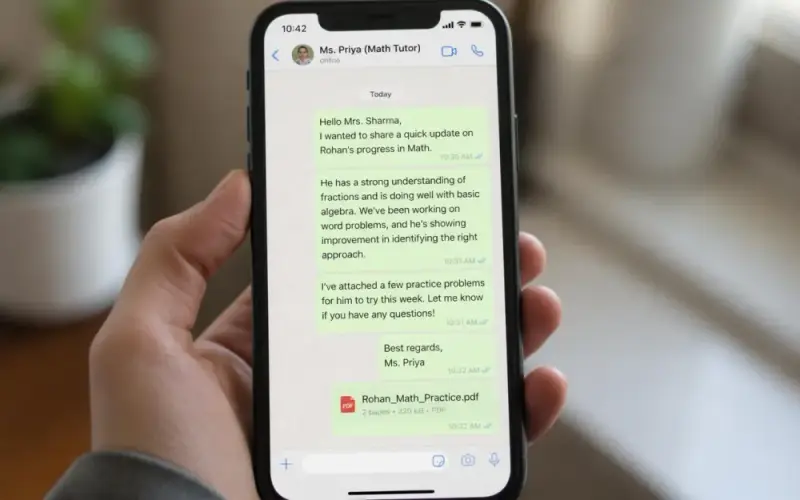
Your child names the main idea. You get a WhatsApp update on next lesson's focus.
Who teaches your child
Every TaleemSquare math tutor passes the same five checks before their first class. Your child keeps the same tutor each week, and if the fit is not right we switch tutor at no cost. Tutors are based in the US, UK, Canada, Australia, Pakistan and India, and all of them teach in English.
Identity and references checked
Every tutor is identity-verified and reference-checked before teaching a student.
Subject test
Tutors pass a subject test before they are matched with a child.
Spoken-English assessment
Lessons are taught in English, so every tutor passes a spoken-English assessment.
Live sample lesson
Tutors teach a live sample lesson before they are hired, to show they can explain clearly.
Open to parents
Classes are one-to-one in a password-protected room. Sit in on any class or ask for a recording.
How we teach Year 10 GCSE maths
Match the board and tier
We ask for your child's exam board, tier and textbook, and follow the class order. Grades 4 and 5 are available on both tiers, so we secure that shared content first while the tier is undecided.
Working that earns marks
Exam answers earn credit for method as well as the final number. Your child practises setting out steps, so one arithmetic slip costs a mark, not the whole question.
Use the formulae sheet well
Exam boards provide formulae sheets with current GCSE Maths papers. We spend less time on memorising and more on choosing the right formula and using it correctly.
Spaced practice, not cramming
Each lesson revisits earlier topics, because GCSE papers mix topics from the whole course and Year 10 is the year to start building recall.
Simple monthly plans
£69a month for 2 one-to-one maths lessons a week
About £8.63 a lesson, or £11.50 per hour of live one-to-one tutoring.
- Free 45-minute trial assessment, no card details
- No contract, cancel any month
- No registration fee
- 4-class money-back promise
- Switch tutor at no cost
- WhatsApp update after every class
Starter
2 lessons a week, best for keeping up with school
£69/mo
EnrollGrowthMost chosen
3 lessons a week, best for catching up + building confidence
£95/mo
EnrollIntensive
4 lessons a week, best for exam prep & fast improvement
£119/mo
EnrollCommon worries, honest answers
“Should my child be on Foundation or Higher tier?”
The school makes the tier decision, so we cannot choose it for you. Tutors can show how your child copes with Higher-style questions and which topics hold them back, which gives you a better conversation with the maths teacher.
“Year 10 feels like a big jump. Are they already behind?”
GCSE brings many new topics quickly, so it feels fast for almost everyone. If Key Stage 3 gaps are showing, fixing them now is much easier than in Year 11, when mock results and revision compete for time.
“What if they don't get a grade 4?”
Grade 4 is the standard pass, and students who miss it continue studying maths after Year 11, so it is not the end of the road. The aim in Year 10 is steady progress, with no nasty surprises later, and we never promise a grade.
Frequently asked questions
What is taught in Year 10 GCSE Maths?
How is GCSE Maths examined, and what are the tiers?
How much does a Year 10 maths tutor cost?
How will the tutor match my child's school, and does this apply outside England?
Will my child have to memorise GCSE Maths formulae?
What happens if my child doesn't get grade 4 in GCSE Maths?
Sources
- Pearson Edexcel GCSE (9-1) Mathematics: qualification overview
- AQA GCSE Mathematics (8300): features and benefits
- Ofqual: proposed changes to the assessment of mathematics, physics and combined science GCSEs (outcome)
- GCSE factsheet for parents (DfE and Ofqual)
- Oak National Academy: Year 10 foundation maths units
Book a free 45-minute assessment
Your child meets a tutor for a real one-to-one session. You get an honest read on where they are and what would help, even if the answer is that they don't need tutoring right now.
- 1
We reply on WhatsApp
Usually within 10 minutes, to find a time that suits your family.
- 2
Your child meets the tutor
A relaxed 45-minute session to see their level and how they learn.
- 3
You decide
You get a recommendation and a plan. No card details, no pressure.