
Primary school, Year 6 · Ages 10-11
Year 6 Maths Tutor for SATs, the 11+ and Year 7
One-to-one Year 6 maths for the May SATs, 11+ content where it applies, and a confident start in Year 7.
Prefer to ask a question first? Chat on WhatsApp
Already decided? Choose a plan and enroll now, and we schedule the first class in your time zone.

How it works, in short
TaleemSquare Year 6 maths tutoring is live, one-to-one online lessons of 45 minutes that follow the National Curriculum in England and your child's school. Year 6 is where ratio, simple algebra, long division, fractions with different denominators, areas of triangles and parallelograms, and numbers up to 10,000,000 arrive. Tutors repair earlier gaps first.
Year 6 pupils sit the KS2 maths tests in May (12 and 13 May in 2027), and some also sit 11+ papers for grammar or independent schools. A scaled score of 100 means the expected standard. Plans start at £69 a month for two 45-minute lessons a week (about £8.63 a lesson).
- Format
- Live, one-to-one, online
- Lesson length
- 45 minutes
- Level
- Ages 10-11
- Price
- From £69 a month
- Per hour of tutoring
- About £11.50
- Families taught
- 500+ since 2023
What changes after a term of lessons
Secure long methods
Uses long multiplication and long division with confidence, and estimates first so a slip shows up before it costs a mark.
Comfortable with ratio and early algebra
Shares quantities in a ratio, scales amounts up and down, and solves missing-number problems written with letters.
Calm on SATs-style papers
Works through arithmetic and reasoning questions at a steady pace, and knows what to do when one looks unfamiliar.
What we cover
Lessons follow your child's own school or homeschool curriculum. These are the areas we work on most at this level.
Numbers up to 10,000,000
Reading, writing, ordering and rounding numbers up to ten million, finding the value of each digit and using negative numbers in context.
Long multiplication and long division
Multiplying up to four digits by two digits, then long division, with remainders shown as whole numbers, fractions or rounded answers.
Fractions, decimals and percentages
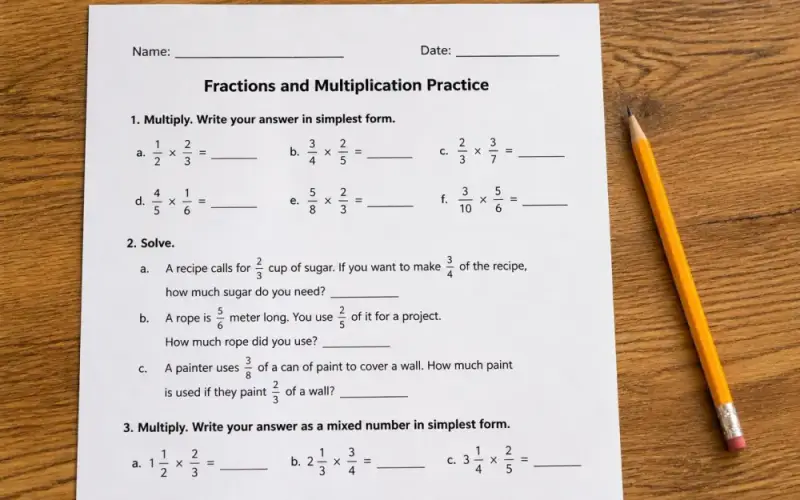
Adding and subtracting fractions with different denominators, multiplying fractions, dividing by whole numbers, and converting between fractions, decimals and percentages.
Ratio and proportion
Comparing quantities, sharing in a given ratio, using scale factors to enlarge shapes and using percentages to compare amounts.
Algebra
Using simple formulae, describing linear number sequences, finding pairs of numbers that satisfy an equation and writing missing-number problems with letters.
Area, perimeter and volume
Area of triangles and parallelograms, volume of cuboids, and converting between units, including miles and kilometres.
Angles, shapes and position
Angles in triangles, quadrilaterals and regular polygons, parts of a circle, nets, and coordinates in all four quadrants with reflections and translations.
Pie charts, line graphs and the mean
Reading and drawing pie charts and line graphs, then calculating the mean as an average, plus the order of operations in multi-step sums.
One typical question, worked through
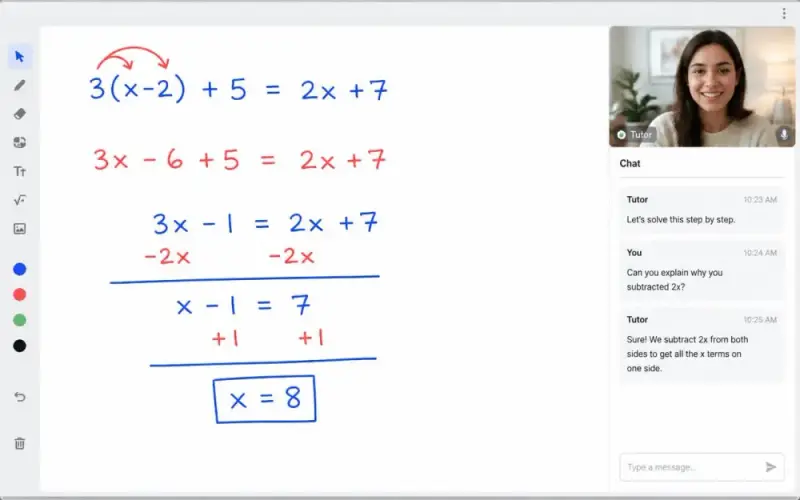
How a tutor talks a student through a maths question at this level. The student does the working on the shared whiteboard; the tutor asks the next question.
Ravi and Mia share 72 stickers in the ratio 5 : 3. How many more stickers does Ravi get than Mia?
- Add the parts of the ratio first: 5 + 3 = 8 equal parts.
- Find the value of one part: 72 ÷ 8 = 9 stickers.
- Ravi has 5 parts: 5 × 9 = 45. Mia has 3 parts: 3 × 9 = 27.
- Check the shares add back to the total: 45 + 27 = 72. The question asks for the difference: 45 minus 27 = 18.
Answer: Ravi gets 18 more stickers than Mia.
The slip we see most often
Dividing 72 by 5, or by 3, instead of by the 8 total parts. Fix: always add the ratio numbers first, and check that the two shares make 72. A shortcut also works: the difference is 2 parts, and 2 × 9 = 18.

Signs your child could use help
- Gets full marks on class tests but panics on practice SATs papers
- Gives up on long division as soon as there is a remainder
- Ratio questions look like a foreign language
- Takes too long on the arithmetic paper and leaves questions blank
- The teacher says they are working towards the expected standard
- An 11+ or school entrance test is coming and nothing is planned
One of these on its own is normal. Two or three together usually point to a specific gap, and finding it is what the free assessment is for.
Taught to your curriculum, wherever you live
Common Core State Standards, Grade 5
Grade 5 centres on adding and subtracting fractions, multiplying and dividing fractions in limited cases, decimals to thousandths within place value, two-digit divisors and volume. State maths tests are taken every year in Grades 3 to 8.
Level: Grade 5
National Curriculum in England: Year 6 and the KS2 tests
Pupils take three KS2 maths papers in May: arithmetic (30 minutes) and two reasoning papers (40 minutes each), reported as scaled scores where 100 is the expected standard. The 11+ is separate, set by each area or school, and does not always include maths.
Provincial curricula, Grade 5
Ontario's 2020 maths curriculum has six areas of learning, and Grade 5 includes percentages, probability experiments and basic budgets. There is no EQAO test in Grade 5: Ontario assesses maths in Grades 3, 6 and 9.
Level: Grade 5
Australian Curriculum v9: Mathematics, Year 5
Year 5 covers decimals greater than one, fractions with related denominators, common percentages, multiplication and division strategies, angles in degrees and chance experiments. NAPLAN numeracy is sat in Year 5; the 2027 window is 10 to 22 March.
Level: Year 5
Inside a 45-minute Year 6 maths lesson
One 45-minute session. Tutors adjust the timings to your child.
6 min
Arithmetic starter
Six quick questions in the style of the SATs arithmetic paper, each checked by estimating.
6 min
Revisit
A skill from Years 3 to 5 that today's topic depends on.
12 min
New learning
Today's Year 6 topic taught with a bar model or diagram on the whiteboard.
14 min
Practice
Questions that move from routine to a multi-step reasoning problem.
7 min
Explain and wrap up
Your child explains one answer in their own words. You get a WhatsApp summary.
Who teaches your child
Every TaleemSquare math tutor passes the same five checks before their first class. Your child keeps the same tutor each week, and if the fit is not right we switch tutor at no cost. Tutors are based in the US, UK, Canada, Australia, Pakistan and India, and all of them teach in English.
Identity and references checked
Every tutor is identity-verified and reference-checked before teaching a student.
Subject test
Tutors pass a subject test before they are matched with a child.
Spoken-English assessment
Lessons are taught in English, so every tutor passes a spoken-English assessment.
Live sample lesson
Tutors teach a live sample lesson before they are hired, to show they can explain clearly.
Open to parents
Classes are one-to-one in a password-protected room. Sit in on any class or ask for a recording.
How we teach Year 6 maths
Plan backwards from May
Lessons are mapped to the KS2 test dates. Early weeks repair gaps from Years 3 to 5, because the papers draw on all of Key Stage 2, and timed practice grows as May approaches.
Long methods without the fear
Place value counters and arrays show why long multiplication and long division work. Your child then practises the written layout until it feels automatic.
Ratio and algebra made concrete
Both topics are new in Year 6. Bar models and tables of values come first, so letters and ratio signs have a picture behind them.
After the tests, look ahead
Once the papers are done, lessons turn to Year 7: negative numbers, fractions and first equations, so the move to secondary school feels familiar.

Simple monthly plans
£69a month for 2 one-to-one maths lessons a week
About £8.63 a lesson, or £11.50 per hour of live one-to-one tutoring.
- Free 45-minute trial assessment, no card details
- No contract, cancel any month
- No registration fee
- 4-class money-back promise
- Switch tutor at no cost
- WhatsApp update after every class
Starter
2 lessons a week, best for keeping up with school
£69/mo
EnrollGrowthMost chosen
3 lessons a week, best for catching up + building confidence
£95/mo
EnrollIntensive
4 lessons a week, best for exam prep & fast improvement
£119/mo
EnrollCommon worries, honest answers
“My child gets stressed about SATs and I don't want to add to it.”
Lessons are calm and routine. Practice questions are short and marked together, and the tutor talks about what your child can already do and what to fix next, never about predicted scores. We do not promise a particular scaled score.
“We have the 11+ as well as SATs. Is that too much?”
The two overlap because both draw on Key Stage 2 maths, so much of the work counts twice. If an 11+ date is close, lessons lean towards that format first and the SATs follow in May. Check whether your area's test includes maths at all.
“They are behind from Years 4 and 5. Can you fix that and cover Year 6?”
Yes. The free assessment finds the earliest missing step, and lessons split time between repairing it and the current Year 6 topic, so your child keeps up in class while the older gap closes.
Frequently asked questions
What maths does my child learn in Year 6?
When are the Year 6 maths SATs, and when do we get results?
How much does a Year 6 maths tutor cost?
How will the tutor match what my child's school teaches?
What does a SATs scaled score mean?
Does the 11+ include maths?
Book a free 45-minute assessment
Your child meets a tutor for a real one-to-one session. You get an honest read on where they are and what would help, even if the answer is that they don't need tutoring right now.
- 1
We reply on WhatsApp
Usually within 10 minutes, to find a time that suits your family.
- 2
Your child meets the tutor
A relaxed 45-minute session to see their level and how they learn.
- 3
You decide
You get a recommendation and a plan. No card details, no pressure.