
Primary school, Year 3 · Ages 8-9
Year 3 Maths Tutor for Times Tables and NAPLAN Numeracy
One-to-one Year 3 maths on the Australian Curriculum, with calm preparation for the online NAPLAN numeracy test in March.
Prefer to ask a question first? Chat on WhatsApp
Already decided? Choose a plan and enroll now, and we schedule the first class in your time zone.

How it works, in short
TaleemSquare Year 3 maths tutoring is live, one-to-one online lessons of 45 minutes, following the Australian Curriculum (Version 9) and your child's own school. Tutors cover numbers beyond 10 000, adding and subtracting three-digit numbers, multiplication and division with arrays, the 3, 4, 5 and 10 times tables, unit fractions, time to the minute, angles, data and chance.
Year 3 is the first NAPLAN year. The 2027 window is 10 to 22 March, and the numeracy test is 45 minutes, online, tailored to each student, with no calculator. A free assessment comes first, and plans start at A$130 a month for two 45-minute lessons a week, about A$30 a week.
- Format
- Live, one-to-one, online
- Lesson length
- 45 minutes
- Level
- Ages 8-9
- Price
- From A$130 a month
- Per hour of tutoring
- About A$21.67
- Families taught
- 500+ since 2023
What changes after a term of lessons
Quick with the 3, 4, 5 and 10 tables
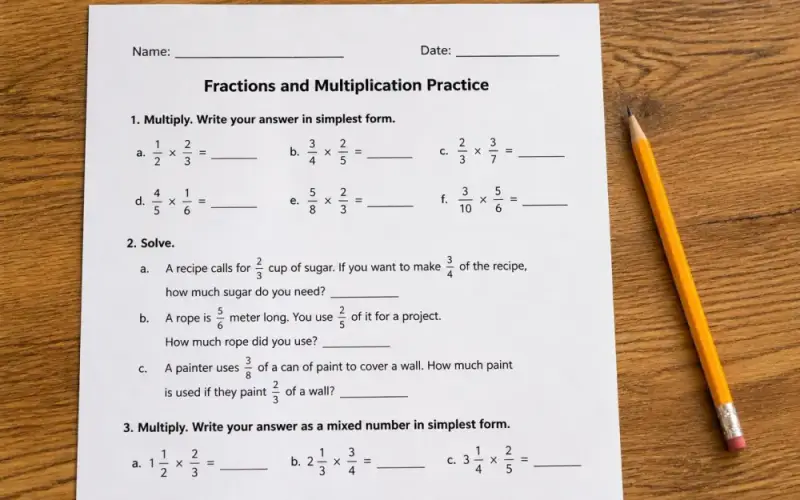
Recalls these multiplication facts and the matching division facts well enough to use them inside bigger problems.
Secure with place value and fractions
Reads and orders large numbers, regroups when adding and subtracting, and recognises unit fractions such as 1/2, 1/3, 1/4, 1/5 and 1/10.
Calm with NAPLAN-style questions
Reads a question twice, estimates, works step by step and checks, on a screen as well as on paper.
What we cover
Lessons follow your child's own school or homeschool curriculum. These are the areas we work on most at this level.
Numbers beyond 10 000
Recognising, representing and ordering large numbers, and using place value to partition and regroup three-digit numbers.
Adding and subtracting
Adding and subtracting two- and three-digit numbers by partitioning, regrouping and number lines, checking with estimation or the inverse operation.
Multiplication and division
Multiplying and dividing one- and two-digit numbers with arrays, diagrams and number sentences, and solving word problems about groups and sharing.
Times tables
Recalling the 3, 4, 5 and 10 multiplication facts and linking them to division, while keeping the twos table fresh.
Unit fractions
Recognising and representing unit fractions including 1/2, 1/3, 1/4, 1/5 and 1/10, and combining fractions with the same denominator to make a whole.
Time and money
Reading analog and digital clocks to the nearest minute, relating hours, minutes and seconds, and representing dollars and cents in different ways.
Measurement, angles and shape
Choosing metric units for length, mass and capacity, comparing angles with right angles, and classifying shapes by their key features.
Data and chance
Collecting data, creating and comparing graphs, and describing the possible outcomes of simple chance experiments.
One typical question, worked through
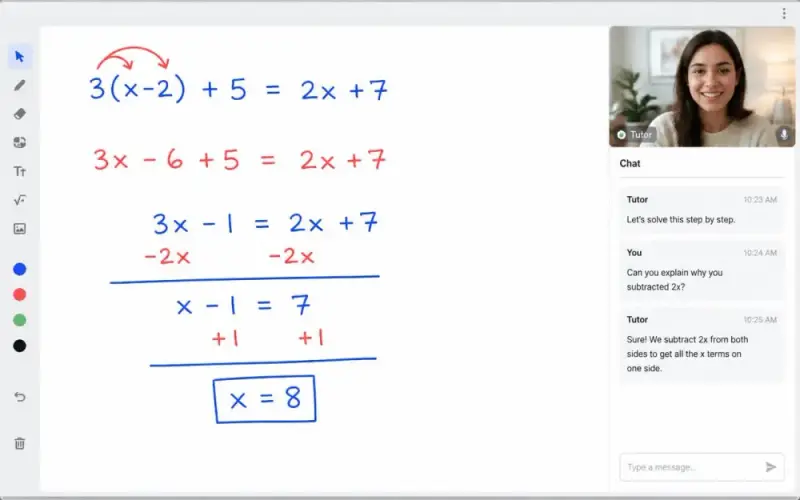
How a tutor talks a student through a maths question at this level. The student does the working on the shared whiteboard; the tutor asks the next question.
Sam packs 5 pencils in each box. He fills 6 boxes and has 3 pencils left over. How many pencils does Sam have altogether?
- Read it twice and underline what is asked: how many pencils altogether.
- Draw 6 boxes with 5 pencils in each and count in fives: 5, 10, 15, 20, 25, 30. So 6 × 5 is 30.
- Add the 3 loose pencils: 30 plus 3 is 33.
- Check: 33 is a little more than 30, which fits the story.
Answer: 33 pencils
The slip we see most often
A common slip is answering 30 and forgetting the leftover pencils, or adding every number in the story (5 + 6 + 3 = 14). The fix is to draw the boxes first and tick each number off once it has been used.

Signs your child could use help
- Knows the 5 and 10 tables but guesses the 3s and 4s
- Reads the time wrongly, or counts the minutes very slowly
- Rushes word problems and answers a different question
- Gets worried about NAPLAN in March
- Not used to dragging, dropping and typing answers on a screen
- Slips on three-digit subtraction that needs regrouping
One of these on its own is normal. Two or three together usually point to a specific gap, and finding it is what the free assessment is for.
Taught to your curriculum, wherever you live
Common Core State Standards, Grade 3
Grade 3 focuses on multiplication and division within 100, unit fractions, rectangular arrays and area, and two-dimensional shapes. US federal law requires annual state tests in maths from Grade 3 to Grade 8, so this is the first year of state testing.
Level: Grade 3
National Curriculum in England: Year 4 (Key Stage 2)
Children aged 8 to 9 are in Year 4. They should know every times table up to 12 × 12 by the end of the year, and take the on-screen multiplication tables check in June: 25 timed questions with no pass mark.
Level: Year 4
Ontario Mathematics (2020) and EQAO Grade 3
Ontario students sit EQAO's online Grade 3 reading, writing and mathematics assessment each spring, from 4 May to 8 June in 2027. The maths part is four stages of about 30 minutes, and results are not part of report card grades.
Level: Grade 3
Australian Curriculum v9 and NAPLAN, Year 3
Year 3 is the first NAPLAN year. Numeracy is a 45-minute online test in the 10 to 22 March 2027 window, reported as Exceeding, Strong, Developing or Needs additional support. Schools teach number, algebra, measurement, space, statistics and probability, which is what the test draws on.
Inside a 45-minute Year 3 maths lesson
One 45-minute session. Tutors adjust the timings to your child.
5 min
Times tables warm-up
A quick recall game with the 3, 4, 5 and 10 tables, mixed up.
6 min
Revisit
One earlier skill that today's topic depends on, such as place value.
12 min
New idea
Taught with arrays, number lines or fraction strips on the whiteboard.
14 min
Practice and test-style questions
Questions on today's topic, including a few in the style of the online numeracy test.
8 min
Explain and wrap up
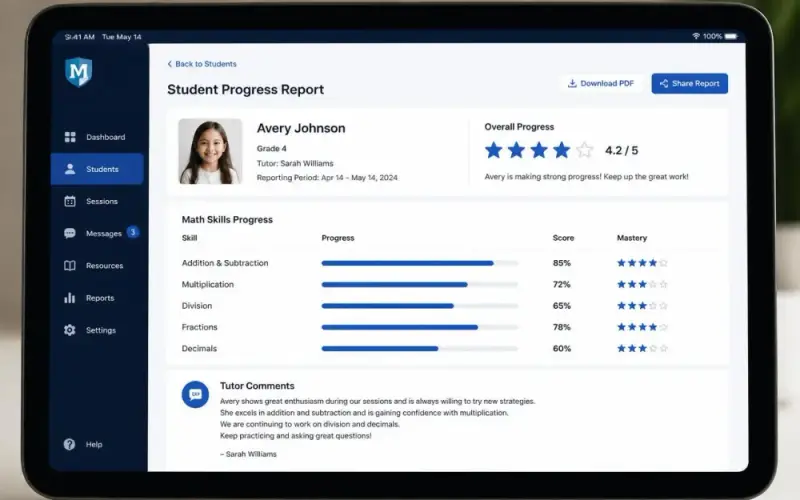
Your child explains one answer aloud. You get a WhatsApp note on progress.
Who teaches your child
Every TaleemSquare math tutor passes the same five checks before their first class. Your child keeps the same tutor each week, and if the fit is not right we switch tutor at no cost. Tutors are based in the US, UK, Canada, Australia, Pakistan and India, and all of them teach in English.
Identity and references checked
Every tutor is identity-verified and reference-checked before teaching a student.
Subject test
Tutors pass a subject test before they are matched with a child.
Spoken-English assessment
Lessons are taught in English, so every tutor passes a spoken-English assessment.
Live sample lesson
Tutors teach a live sample lesson before they are hired, to show they can explain clearly.
Open to parents
Classes are one-to-one in a password-protected room. Sit in on any class or ask for a recording.
How we help with Year 3 maths and NAPLAN
Build the maths, not just the test
ACARA says students are not expected to study for NAPLAN. So lessons strengthen the year-level maths behind it: place value, multiplication, fractions and time.
Times tables that stick
The 3, 4, 5 and 10 tables are practised in short, mixed rounds and linked to arrays and division, so recall becomes fast and flexible.
Comfortable on a screen
NAPLAN is taken on a device. Lessons use an interactive whiteboard, and tutors can walk through the question types on the official NAP public demonstration site.
A routine for word problems
Underline what is asked, note the numbers, estimate, solve and check. The routine cuts the careless errors that tutors see most often.

Simple monthly plans
A$130a month for 2 one-to-one maths lessons a week
About A$16.25 a lesson, or A$21.67 per hour of live one-to-one tutoring.
- Free 45-minute trial assessment, no card details
- No contract, cancel any month
- No registration fee
- 4-class money-back promise
- Switch tutor at no cost
- WhatsApp update after every class
Starter
2 lessons a week, best for keeping up with school
A$130/mo
EnrollGrowthMost chosen
3 lessons a week, best for catching up + building confidence
A$179/mo
EnrollIntensive
4 lessons a week, best for exam prep & fast improvement
A$229/mo
EnrollCommon worries, honest answers
“My child gets anxious about NAPLAN.”
NAPLAN is a snapshot of one week, not a pass or fail, and ACARA says children do not need to study. We keep lessons calm and explain what the test looks like. If your child is not more confident after the first four paid lessons, you can request a full refund of those lessons within 14 days of the fourth.
“Is it too late to start before March?”
A few focused weeks on times tables, place value and word problems can lift confidence, even if they cannot cover everything. We start with the topics your child finds hardest, and we make no promise about a particular proficiency level.
“My child knows the work but makes careless mistakes.”
Careless errors are usually a habit, not a gap in knowledge. Tutors teach a short checking routine, with estimating, rereading the question and testing the answer, and then practise it until it becomes automatic, including on screen.
Frequently asked questions
What maths is taught in Year 3 in Australia?
What is in the Year 3 NAPLAN numeracy test?
When is NAPLAN 2027, and how are results reported?
Does my Year 3 child need to study for NAPLAN?
How much does a Year 3 maths tutor cost?
How does the tutor match my child's school and state?
Sources
Book a free 45-minute assessment
Your child meets a tutor for a real one-to-one session. You get an honest read on where they are and what would help, even if the answer is that they don't need tutoring right now.
- 1
We reply on WhatsApp
Usually within 10 minutes, to find a time that suits your family.
- 2
Your child meets the tutor
A relaxed 45-minute session to see their level and how they learn.
- 3
You decide
You get a recommendation and a plan. No card details, no pressure.