
Primary school, Year 4 · Ages 9-10
Year 4 Maths Tutor and NSW Opportunity Class Maths
One-to-one Year 4 maths on the Australian Curriculum, with Mathematical Reasoning practice for the NSW Opportunity Class test.
Prefer to ask a question first? Chat on WhatsApp
Already decided? Choose a plan and enroll now, and we schedule the first class in your time zone.

How it works, in short
TaleemSquare Year 4 maths tutoring is live, one-to-one online lessons of 45 minutes, following the Australian Curriculum (Version 9) and your child's own school. Tutors cover tenths and hundredths, equivalent fractions, multiplication facts to 10 × 10, perimeter and area, angles, symmetry and grid references, and the multi-step problem solving that Year 4 builds toward.
In NSW, children who apply sit the Opportunity Class Placement Test in Year 4 for Year 5 entry. It is computer-based and held in May, and Mathematical Reasoning is one of three sections. For 2028 entry it is on 11 and 12 May 2027. Plans start at A$130 a month for two 45-minute lessons a week, about A$30 a week.
- Format
- Live, one-to-one, online
- Lesson length
- 45 minutes
- Level
- Ages 9-10
- Price
- From A$130 a month
- Per hour of tutoring
- About A$21.67
- Families taught
- 500+ since 2023
What changes after a term of lessons
Fluent with tables to 10 × 10
Recalls multiplication facts to 10 × 10 and the related division facts quickly enough to use inside bigger problems.
Confident with fractions and decimals
Finds equivalent fractions, counts by fractions on a number line, and reads tenths and hundredths as decimals.
Steady on multi-step problems
Breaks a longer problem into steps, estimates to check, and explains each step aloud.
What we cover
Lessons follow your child's own school or homeschool curriculum. These are the areas we work on most at this level.
Tenths and hundredths
Extending place value to tenths and hundredths, and writing them as decimals and fractions.
Fractions
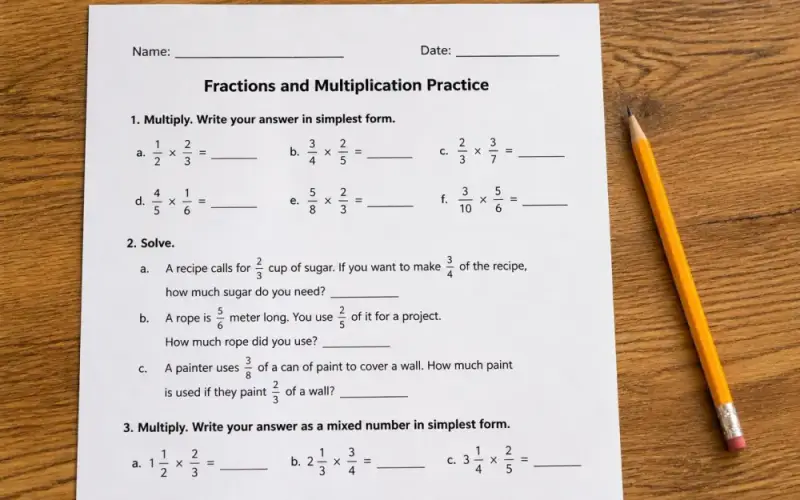
Finding equivalent fractions using related denominators, counting by fractions including mixed numerals, and placing them on number lines.
Multiplication and division
Facts up to 10 × 10 with related division facts, and multiplying and dividing by 10 and 100 without a calculator.
Efficient addition and subtraction
Choosing efficient mental and written strategies, and using rounding and estimation to check that an answer is reasonable.
Unknowns and number properties
Finding unknown values in addition and subtraction equations, and using the properties of odd and even numbers.
Perimeter, area and time
Measuring and approximating perimeter and area, reading unmarked or partial scales, and solving problems about the duration of time.
Angles, symmetry and position
Estimating and comparing angles (acute, obtuse, straight, reflex), line and rotational symmetry, and grid references.
Data and chance
Choosing displays to compare data, running chance experiments, and describing the relationships between outcomes.
One typical question, worked through
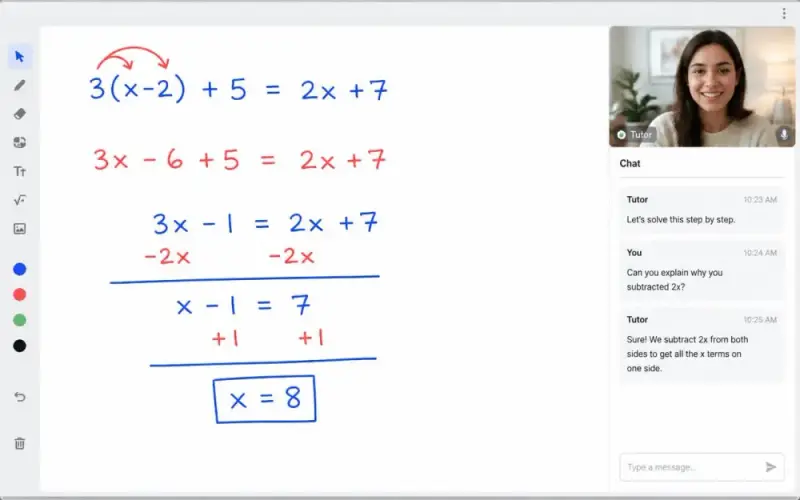
How a tutor talks a student through a maths question at this level. The student does the working on the shared whiteboard; the tutor asks the next question.
Tom has 5 packs of 12 stickers. He gives 18 stickers away and shares the rest equally among 3 friends. How many stickers does each friend get?
- Underline the actions in order: 5 packs of 12, give away 18, share what is left among 3.
- Find the total: 5 × 12 is 5 × 10 plus 5 × 2, which is 50 plus 10, so 60 stickers.
- Give 18 away: 60 take away 20 is 40, then add 2 back because we only took 18. That leaves 42.
- Share 42 among 3: 30 ÷ 3 is 10 and 12 ÷ 3 is 4, so each friend gets 14.
- Check backwards: 14 × 3 is 42, and 42 plus 18 is 60, which is 5 × 12.
Answer: 14 stickers each
The slip we see most often
A common slip is sharing all 60 stickers among 3 friends (20 each) and forgetting the 18 given away. That is exactly the kind of tempting wrong answer a multiple-choice test can include. The fix is to tick each action in the story as it is used.

Signs your child could use help
- Knows tables to 5 but still stalls on the 7s, 8s and 9s
- Goes quiet on questions with more than one step
- Cannot tell which fraction is bigger when the bottom numbers differ
- Finishes tests slowly, even when the answers are right
- Reads a problem and picks the wrong operation
- We want to try for an Opportunity Class but don't know where to start
One of these on its own is normal. Two or three together usually point to a specific gap, and finding it is what the free assessment is for.
Taught to your curriculum, wherever you live
Common Core State Standards, Grade 4
Grade 4 centres on multi-digit multiplication and division, equivalent fractions with adding, subtracting and multiplying by whole numbers, and classifying shapes by angles and symmetry. Annual state maths tests run in Grades 3 to 8.
Level: Grade 4
National Curriculum in England: Year 5 (Key Stage 2)
England has no national maths test in Year 5: the multiplication tables check is in Year 4 and the SATs are in Year 6. Year 5 teaches long multiplication, decimals to three places and percentages as parts per 100.
Level: Year 5
Ontario and British Columbia, Grade 4
Ontario expects multiplication facts to 10 × 10 in Grade 4, and its elementary EQAO maths tests are in Grades 3 and 6. British Columbia's Foundation Skills Assessment covers numeracy in Grades 4 and 7, administered from 28 September to 6 November in 2026-27.
Level: Grade 4
Australian Curriculum v9 and the NSW OC test, Year 4
Year 4 covers tenths and hundredths, equivalent fractions and tables to 10 × 10. NAPLAN numeracy is sat in Years 3 and 5, not Year 4. In NSW, Year 4 students may sit the Opportunity Class Placement Test in May for Year 5 entry.
Inside a 45-minute Year 4 maths lesson
One 45-minute session. Tutors adjust the timings to your child.
6 min
Tables and mental maths
Mixed multiplication facts to 10 × 10 and quick mental strategies.
6 min
Revisit
One earlier skill that today's topic depends on, such as place value or fraction strips.
12 min
New learning
Taught with a visual model on the whiteboard, then a worked example.
13 min
Reasoning problem
A multi-step problem, with five answer choices to check against when it helps for the OC test.
8 min
Review and wrap up
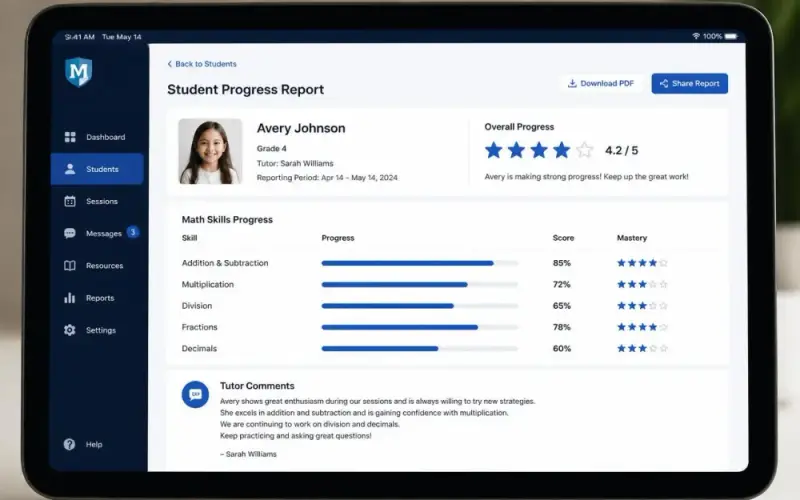
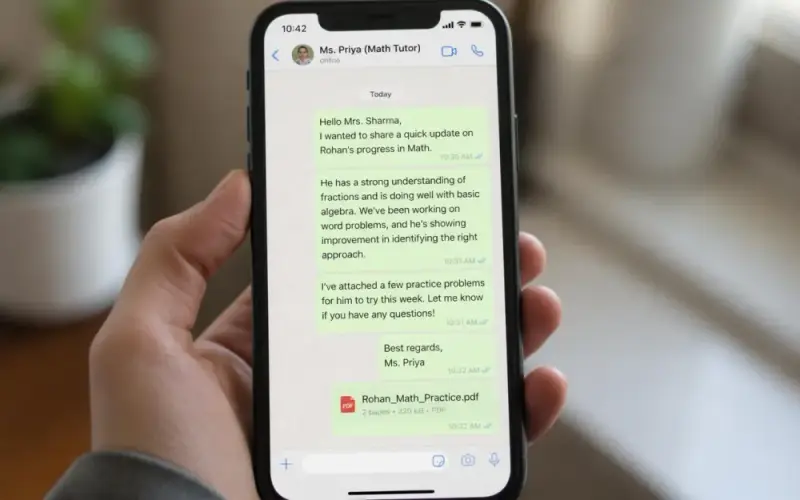
Your child explains one answer aloud. You get a WhatsApp note on progress.
Who teaches your child
Every TaleemSquare math tutor passes the same five checks before their first class. Your child keeps the same tutor each week, and if the fit is not right we switch tutor at no cost. Tutors are based in the US, UK, Canada, Australia, Pakistan and India, and all of them teach in English.
Identity and references checked
Every tutor is identity-verified and reference-checked before teaching a student.
Subject test
Tutors pass a subject test before they are matched with a child.
Spoken-English assessment
Lessons are taught in English, so every tutor passes a spoken-English assessment.
Live sample lesson
Tutors teach a live sample lesson before they are hired, to show they can explain clearly.
Open to parents
Classes are one-to-one in a password-protected room. Sit in on any class or ask for a recording.
How we prepare Year 4 students, including for the OC test
Fluency first
Tables to 10 × 10 and mental strategies come first, because reasoning questions ask children to use maths in new situations, and slow facts eat the time.
Reasoning out loud
On unfamiliar problems your child says what is asked, what is known and what to try first. The tutor then models tidy working on the whiteboard.
Multiple-choice habits
The OC maths section is multiple choice with five options. Estimating first and checking each option against the question helps rule out tempting wrong answers.
No calculator, little paper
Students get no calculator and two A4 sheets for working, so we practise short, neat working and mental checks instead of long written methods.
Simple monthly plans
A$130a month for 2 one-to-one maths lessons a week
About A$16.25 a lesson, or A$21.67 per hour of live one-to-one tutoring.
- Free 45-minute trial assessment, no card details
- No contract, cancel any month
- No registration fee
- 4-class money-back promise
- Switch tutor at no cost
- WhatsApp update after every class
Starter
2 lessons a week, best for keeping up with school
A$130/mo
EnrollGrowthMost chosen
3 lessons a week, best for catching up + building confidence
A$179/mo
EnrollIntensive
4 lessons a week, best for exam prep & fast improvement
A$229/mo
EnrollCommon worries, honest answers
“Will tutoring get my child into an Opportunity Class?”
We cannot promise that, and no honest tutor can. Offers depend on test performance, school choices and the places available. Maths is one of three equally weighted sections, alongside Reading and Thinking Skills. Lessons strengthen the maths and familiarity with the format.
“We don't live in NSW.”
The placement test is held only in NSW, and families must be living in NSW by the start of the entry year. Outside NSW, Year 4 tutoring focuses on fractions, decimals and multi-step problems, with NAPLAN numeracy coming in Year 5.
“The test is on a computer and my child has never done one.”
The NSW Department of Education publishes online practice tests that copy the real software and timing. Tutors can talk through the format, pacing and how to use the working paper, so test day holds fewer surprises.
Frequently asked questions
What maths is taught in Year 4 in Australia?
What is the NSW Opportunity Class Placement Test?
When is the OC test, and how do we apply?
What maths is in the OC Mathematical Reasoning test?
How much does a Year 4 maths tutor cost?
How does the tutor match my child's school and state?
Sources
- Australian Curriculum v9 Mathematics, Year 4: content descriptions and achievement standard (QCAA)
- Application process: opportunity class Year 5 entry in 2028 (NSW Department of Education)
- Placement test (NSW Department of Education)
- Opportunity class practice tests (NSW Department of Education)
- Get ready for the Opportunity Class Placement Test (NSW Department of Education)
Book a free 45-minute assessment
Your child meets a tutor for a real one-to-one session. You get an honest read on where they are and what would help, even if the answer is that they don't need tutoring right now.
- 1
We reply on WhatsApp
Usually within 10 minutes, to find a time that suits your family.
- 2
Your child meets the tutor
A relaxed 45-minute session to see their level and how they learn.
- 3
You decide
You get a recommendation and a plan. No card details, no pressure.