
Primary school, Year 6 · Ages 11-12
Year 6 Maths Tutor for Selective Tests and High School
Live one-to-one Year 6 maths that follows the Australian Curriculum and prepares for selective tests and high school.
Prefer to ask a question first? Chat on WhatsApp
Already decided? Choose a plan and enroll now, and we schedule the first class in your time zone.

How it works, in short
TaleemSquare Year 6 maths tutoring is live, one-to-one online lessons of 45 minutes that follow the Australian Curriculum (Version 9) and your child's own school. Tutors cover fractions, decimals, percentages and discounts, unknown values in equations, metric units, area, angles, coordinates in all four quadrants, data and chance, repairing gaps from Years 4 and 5 first.
Year 6 has no NAPLAN; that comes in Year 7. The milestones are selective entry and the move to high school: NSW's Selective High School Placement Test is held in May, and Western Australia's ASET for Perth Modern runs from mid-February to March. Plans start at A$130 a month for two 45-minute lessons a week, about A$30 a week.
- Format
- Live, one-to-one, online
- Lesson length
- 45 minutes
- Level
- Ages 11-12
- Price
- From A$130 a month
- Per hour of tutoring
- About A$21.67
- Families taught
- 500+ since 2023
What changes after a term of lessons
Secure fractions, decimals and percentages
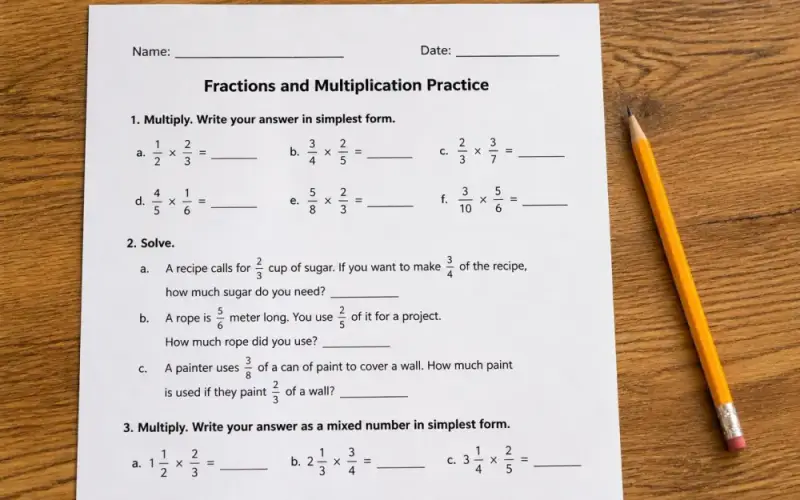
Adds and subtracts fractions using equivalent fractions, works with decimals, and finds percentages and discounts of amounts, checking answers by estimating.
Calm with multi-step problems
Reads a worded problem, chooses the steps, works them in order and checks that the answer makes sense, the habit selective-style questions reward.
Ready for high school maths
Starts Year 7 with number, early algebra ideas and measurement secure, so the jump in pace and abstraction feels manageable.
What we cover
Lessons follow your child's own school or homeschool curriculum. These are the areas we work on most at this level.
Integers, primes and squares
Negative numbers in real situations such as temperatures and money, plus prime, composite and square numbers used to solve problems and simplify calculations.
Fractions
Comparing, ordering and placing common fractions on a number line, and adding and subtracting them using equivalent fractions.
Decimals and percentages
Adding and subtracting decimals, multiplying and dividing them by multiples of powers of 10, and finding fractions, decimals and percentages of amounts, including discounts.
Patterns and unknowns
Rules for number and growing patterns, and finding unknown values in equations that use brackets and a mix of operations.
Measurement and time
Converting metric units of length, mass and capacity, using the area formula for rectangles, and reading timetables to find the duration of trips.
Angles
Angles on a straight line, angles at a point and vertically opposite angles, used to find unknown angles and explain the reasoning.
Space and coordinates
Plotting points in all four quadrants of the Cartesian plane, describing how coordinates change, and building tessellations from transformations.
Data and chance
Comparing data sets by mode, range and shape, questioning claims in the media, and placing probabilities on a scale from 0 to 1.
One typical question, worked through
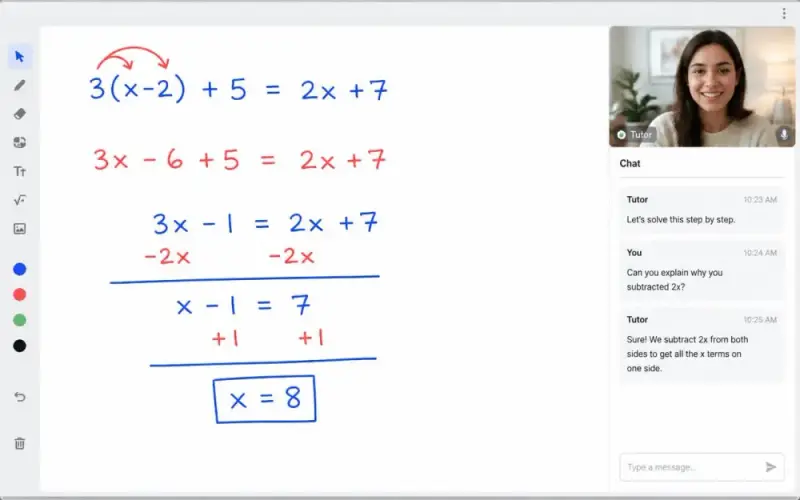
How a tutor talks a student through a maths question at this level. The student does the working on the shared whiteboard; the tutor asks the next question.
A jacket costs $64. It is 25% off in a sale, and Mia then uses an $8 voucher on the sale price. How much does she pay?
- Read the last line first: we want what Mia pays, so the answer must be less than $64.
- 25% is one quarter, so the discount is $64 divided by 4, which is $16.
- Take the discount off: $64 minus $16 gives a sale price of $48.
- Now use the voucher on the sale price: $48 minus $8 is $40.
- Check by working backwards: $40 plus $8 is $48, and $48 is three quarters of $64 because 16 times 3 is 48.
Answer: Mia pays $40.
The slip we see most often
Answering $16, the discount, instead of what Mia pays, or taking the voucher off first so the answer comes out as $42. Underline what the question asks for, and do the steps in the order the story tells them.

Signs your child could use help
- Quick with number facts but loses marks on long word problems
- Mixes up fractions and decimals when comparing sizes
- Is sitting, or thinking about sitting, a selective high school test
- Rushes multi-step questions and answers a different question to the one asked
- Dreads high school maths because letters and negative numbers look unfamiliar
- Still counts on fingers for facts the class has moved past
One of these on its own is normal. Two or three together usually point to a specific gap, and finding it is what the free assessment is for.
Taught to your curriculum, wherever you live
Common Core State Standards, Grade 6
Grade 6 focuses on ratios and rates, dividing fractions, negative numbers, early expressions and equations, area and statistics. It is the start of middle school in many districts. States test maths every year in Grades 3 to 8, for example STAAR in Texas.
Level: Grade 6
National Curriculum in England: Year 7 (Key Stage 3)
Children of this age are in Year 7, the first year of secondary school. There is no national maths test in Years 7 to 9, so schools assess progress themselves. The Year 6 SATs and any 11+ tests are sat a year earlier.
Level: Year 7 (first year of secondary school)
Provincial mathematics curricula, Grade 6
Each province sets its own Grade 6 maths. The content overlaps with Year 6: fractions, decimals, percentages, integers and geometry. In Ontario, EQAO assesses maths in Grades 3 and 6.
Level: Grade 6
Australian Curriculum (Version 9): Mathematics, Year 6
Six strands: number, algebra, measurement, space, statistics and probability. NAPLAN is sat in Years 3, 5, 7 and 9, so Year 6 has none. The main tests are selective entry: NSW's placement test and WA's ASET are both sat in Year 6 for Year 7 entry.
Inside a 45-minute Year 6 maths lesson
One 45-minute session. Tutors adjust the timings to your child.
5 min
Number warm-up
Quick mental questions on facts, fractions and percentages.
7 min
Review
One earlier skill that today's topic depends on, or a school homework question that did not make sense.
12 min
New idea
Taught on the whiteboard with diagrams, fraction strips and number lines before any rule.
14 min
Problem solving
Multi-step word problems, with your child explaining each step and choosing the method.
7 min
Wrap-up
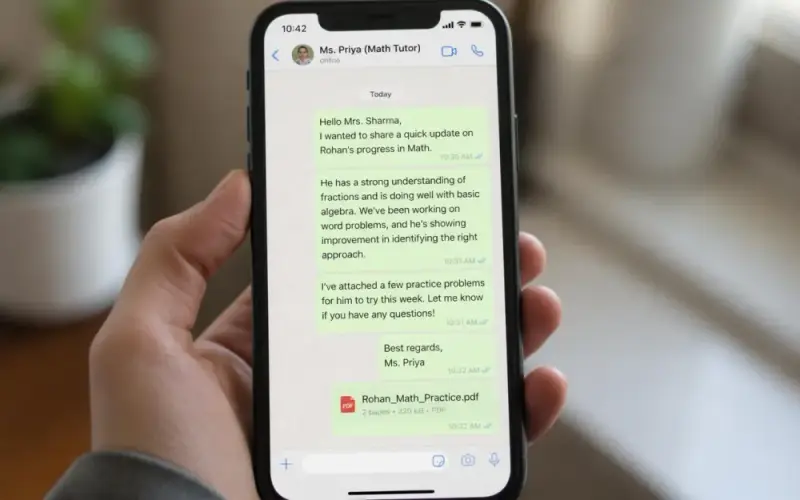
Your child sums up the method in their own words. You get a WhatsApp note on progress.
Who teaches your child
Every TaleemSquare math tutor passes the same five checks before their first class. Your child keeps the same tutor each week, and if the fit is not right we switch tutor at no cost. Tutors are based in the US, UK, Canada, Australia, Pakistan and India, and all of them teach in English.
Identity and references checked
Every tutor is identity-verified and reference-checked before teaching a student.
Subject test
Tutors pass a subject test before they are matched with a child.
Spoken-English assessment
Lessons are taught in English, so every tutor passes a spoken-English assessment.
Live sample lesson
Tutors teach a live sample lesson before they are hired, to show they can explain clearly.
Open to parents
Classes are one-to-one in a password-protected room. Sit in on any class or ask for a recording.
How we teach Year 6 maths
Close Year 4 and 5 gaps first
Year 6 fractions and percentages rest on earlier equivalence and place value. The free assessment finds the first step that slipped, and lessons start there.
Reasoning, not rote
Selective-style questions reward choosing a method. The tutor asks your child to explain why each step is needed before checking the answer.
Timed work added gradually
If your child is sitting a selective test, short timed sets are added once the maths is secure. The test uses concepts up to Year 6, so the skill is applying them to unfamiliar problems.
A smooth step into Year 7
Late in the year, lessons preview integers, ratio and simple algebra with friendly examples, so letters in maths are not a shock in high school.
Simple monthly plans
A$130a month for 2 one-to-one maths lessons a week
About A$16.25 a lesson, or A$21.67 per hour of live one-to-one tutoring.
- Free 45-minute trial assessment, no card details
- No contract, cancel any month
- No registration fee
- 4-class money-back promise
- Switch tutor at no cost
- WhatsApp update after every class
Starter
2 lessons a week, best for keeping up with school
A$130/mo
EnrollGrowthMost chosen
3 lessons a week, best for catching up + building confidence
A$179/mo
EnrollIntensive
4 lessons a week, best for exam prep & fast improvement
A$229/mo
EnrollCommon worries, honest answers
“Will tutoring get my child into a selective school?”
We cannot promise that, and no honest tutor can. Places depend on test results, how many students apply and each school's rules. NSW Education says students do not have to study extra maths, so lessons focus on secure Year 6 maths and practice with unfamiliar problems.
“My child knows the maths but freezes against the clock.”
We build pace slowly. Tutors teach children to estimate, to skip a hard question and come back, and to show working neatly. Short timed sets come in only once the maths itself feels comfortable.
“High school starts next year and I worry about the jump.”
Year 7 brings new teachers, faster lessons and the first real algebra. Year 6 lessons build the number fluency underneath and add a light preview of integers and letters, without teaching Year 7 early or dropping school work.
Frequently asked questions
What maths is taught in Year 6 in Australia?
When is the NSW Selective High School Placement Test?
What is the ASET for Perth Modern in Western Australia?
Do Year 6 students sit NAPLAN?
How much does a Year 6 maths tutor cost?
Will the tutor follow my child's school and state?
Sources
- Selective high school placement test (NSW Department of Education)
- Selective high school practice tests (NSW Department of Education)
- Gifted and Talented application guidelines, 2028 intake (WA Department of Education)
- NAPLAN 2027 information for parents and carers (NAP)
- Year 6 mathematics content descriptions, Australian Curriculum Version 9 (QCAA)
Book a free 45-minute assessment
Your child meets a tutor for a real one-to-one session. You get an honest read on where they are and what would help, even if the answer is that they don't need tutoring right now.
- 1
We reply on WhatsApp
Usually within 10 minutes, to find a time that suits your family.
- 2
Your child meets the tutor
A relaxed 45-minute session to see their level and how they learn.
- 3
You decide
You get a recommendation and a plan. No card details, no pressure.