
Secondary school, Year 7 · Ages 12-13
Year 7 Maths Tutor Online for NAPLAN and High School
One-to-one Year 7 maths for the first year of high school, with NAPLAN numeracy in March.
Prefer to ask a question first? Chat on WhatsApp
Already decided? Choose a plan and enroll now, and we schedule the first class in your time zone.

How it works, in short
TaleemSquare Year 7 maths tutoring is live, one-to-one online lessons of 45 minutes that follow the Australian Curriculum (Version 9) and your child's school. Tutors cover fractions, decimals and percentages, integers, ratio, early algebra, area and volume, angle rules, statistics and probability, supporting the first year of high school, which starts at Year 7 in every state and territory.
Year 7 is a NAPLAN year. The 2027 window runs from 10 to 22 March, and the numeracy test is 65 minutes, online and tailored to each student's answers. NAPLAN is not pass or fail, and ACARA says students are not expected to study for it. Plans start at A$130 a month for two 45-minute lessons a week, about A$30 a week.
- Format
- Live, one-to-one, online
- Lesson length
- 45 minutes
- Level
- Ages 12-13
- Price
- From A$130 a month
- Per hour of tutoring
- About A$21.67
- Families taught
- 500+ since 2023
What changes after a term of lessons
Confident with ratio and rational numbers
Uses fractions, decimals and percentages together, and shares quantities in a given ratio, checking each answer for sense.
Starts algebra with understanding
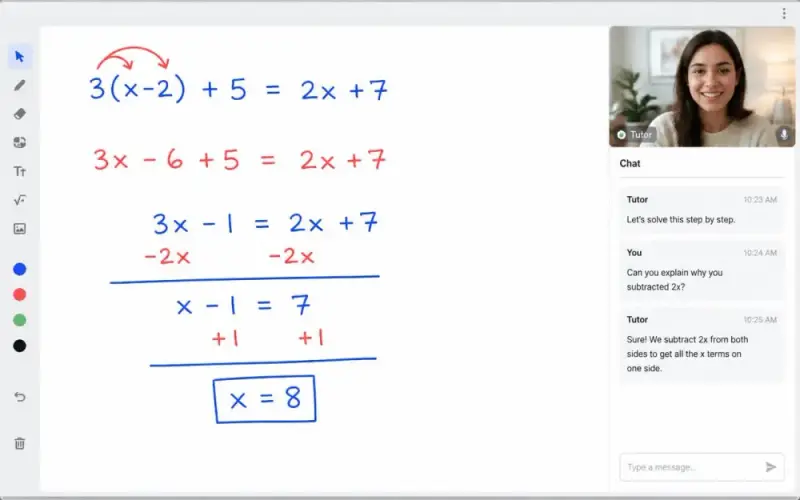
Writes expressions with letters, substitutes into formulas and solves simple linear equations, checking each solution by substituting it back.
Familiar with the NAPLAN format
Has seen the online question types and the short non-calculator start, so March feels like a normal maths task rather than a surprise.
What we cover
Lessons follow your child's own school or homeschool curriculum. These are the areas we work on most at this level.
Squares, roots and primes
Perfect squares and square roots, writing numbers as products of prime factors with exponents, and place value using powers of 10.
Fractions, decimals and percentages
Equivalent forms on a number line, rounding decimals sensibly, and all four operations with positive fractions, decimals and percentages.
Integers
Comparing, ordering, adding and subtracting negative numbers in temperature, money and number line problems.
Ratio
Recognising, writing and solving ratio problems, including sharing amounts and scaling recipes or plans.
Introduction to algebra
Variables and everyday formulas, writing expressions with brackets, substituting values and solving one-variable linear equations with whole-number answers.
Patterns and graphs
Tables of values from growing patterns and function rules, plotted on the Cartesian plane, and describing what a graph of real data shows.
Area, volume and angles
Area of triangles and parallelograms, volume of rectangular and triangular prisms, angle rules for parallel lines and the 180 degree angle sum of a triangle.
Statistics and chance
Mean, median, mode and range, stem-and-leaf plots, comparing distributions, and probabilities of single-stage events.
One typical question, worked through
How a tutor talks a student through a maths question at this level. The student does the working on the shared whiteboard; the tutor asks the next question.
Blue and white paint are mixed in the ratio 3:5. A painter makes 24 litres of paint. How many litres of blue paint are used?
- The ratio 3:5 means every 3 parts of blue go with 5 parts of white, so there are 3 plus 5, which is 8 parts in all.
- The 8 parts make 24 litres, so one part is 24 divided by 8, which is 3 litres.
- Blue is 3 parts, so the blue paint is 3 times 3 litres, which is 9 litres.
- Check: white is 5 times 3, which is 15 litres, and 9 plus 15 is 24. The ratio 9:15 simplifies to 3:5.
Answer: 9 litres of blue paint.
The slip we see most often
Dividing 24 by 3 or by 5 instead of by the 8 total parts, or taking 3 out of 5 of the total. Draw 8 equal boxes first, label three blue and five white, and the picture shows what each number means.

Signs your child could use help
- Primary maths was easy but Year 7 feels much faster
- Avoids any question that has letters in it
- Each new teacher explains it differently and the method gets muddled
- Worried about NAPLAN so soon after starting high school
- Still unsure how to add fractions or work with negative numbers
- Homework takes far longer than it did in Year 6
One of these on its own is normal. Two or three together usually point to a specific gap, and finding it is what the free assessment is for.
Taught to your curriculum, wherever you live
Common Core State Standards, Grade 7
Grade 7 covers proportional relationships, operations with rational numbers, expressions and equations, scale drawings, angles, area and volume, and probability. States test maths every year in Grades 3 to 8.
Level: Grade 7
National Curriculum in England: Year 8 (Key Stage 3)
Children of this age are in Year 8. There is no national maths test in Key Stage 3, so schools set their own tests and assessments. GCSE courses usually start in Year 10.
Level: Year 8 (Key Stage 3)
Provincial mathematics curricula, Grade 7
Each province sets its own Grade 7 maths: integers, fractions and decimals, ratios and rates, early algebra, geometry and data. In Ontario, EQAO assesses maths in Grades 3, 6 and 9, so Grade 7 has no EQAO test.
Level: Grade 7
Australian Curriculum (Version 9): Mathematics, Year 7
Year 7 is the first year of secondary school in every state and territory. NAPLAN numeracy is sat in March: 65 minutes, online, with a short non-calculator section first. Results use four levels, from Needs additional support to Exceeding.
Inside a 45-minute Year 7 maths lesson
One 45-minute session. Tutors adjust the timings to your child.
5 min
Mental starter
Quick questions on fractions, integers and number facts, no calculator.
8 min
Homework check
Anything from this week's class that did not make sense.
12 min
New idea
Taught on the whiteboard with worked examples and diagrams.
14 min
Practice
Questions moving from routine to problem solving, some in the style of NAPLAN numeracy.
6 min
Summary
Your child explains the method in their own words. You receive a WhatsApp update.
Who teaches your child
Every TaleemSquare math tutor passes the same five checks before their first class. Your child keeps the same tutor each week, and if the fit is not right we switch tutor at no cost. Tutors are based in the US, UK, Canada, Australia, Pakistan and India, and all of them teach in English.
Identity and references checked
Every tutor is identity-verified and reference-checked before teaching a student.
Subject test
Tutors pass a subject test before they are matched with a child.
Spoken-English assessment
Lessons are taught in English, so every tutor passes a spoken-English assessment.
Live sample lesson
Tutors teach a live sample lesson before they are hired, to show they can explain clearly.
Open to parents
Classes are one-to-one in a password-protected room. Sit in on any class or ask for a recording.
How we teach Year 7 maths
Check the primary foundations
Year 7 assumes fractions, decimals and written methods are secure. A short diagnostic finds which of these slipped before ratio and algebra lean on them.
Letters as numbers
Variables are introduced as numbers we have not named yet and tested by substituting values, so the rules of algebra make sense instead of feeling arbitrary.
NAPLAN familiarity without cramming
ACARA says students need not study for NAPLAN. We spend a little time on the online question types and the non-calculator start, and the rest on the maths itself.
Alongside your child's class
Share the topic list or homework. Lessons follow the order of the school's program and give extra time to whatever was rushed.

Simple monthly plans
A$130a month for 2 one-to-one maths lessons a week
About A$16.25 a lesson, or A$21.67 per hour of live one-to-one tutoring.
- Free 45-minute trial assessment, no card details
- No contract, cancel any month
- No registration fee
- 4-class money-back promise
- Switch tutor at no cost
- WhatsApp update after every class
Starter
2 lessons a week, best for keeping up with school
A$130/mo
EnrollGrowthMost chosen
3 lessons a week, best for catching up + building confidence
A$179/mo
EnrollIntensive
4 lessons a week, best for exam prep & fast improvement
A$229/mo
EnrollCommon worries, honest answers
“Maths has suddenly felt hard since starting high school.”
The move brings new teachers, faster lessons and the first real algebra all at once. Tutors rebuild confidence by revisiting the primary skills under each new topic, so Year 7 has solid ground to stand on.
“NAPLAN is so soon after we start and I do not want my child stressed.”
NAPLAN is not pass or fail, and ACARA says students are not expected to study for it. We do not drill for the test. We make the maths secure and let your child try the online question types, so the format is familiar.
“What if my child is placed in a lower maths class?”
If your school groups students by level, a tutor can close the gaps behind a placement and keep your child's work close to the class program. We cannot promise a change of class, but closing the gaps helps your child keep up with the work in whichever class they are in.
Frequently asked questions
What maths is taught in Year 7?
When is NAPLAN for Year 7 in 2027, and what is on the numeracy test?
Does my Year 7 child need a tutor for NAPLAN?
Is Year 7 the first year of high school in every state?
How much does a Year 7 maths tutor cost?
Will the tutor follow my child's school and state?
Book a free 45-minute assessment
Your child meets a tutor for a real one-to-one session. You get an honest read on where they are and what would help, even if the answer is that they don't need tutoring right now.
- 1
We reply on WhatsApp
Usually within 10 minutes, to find a time that suits your family.
- 2
Your child meets the tutor
A relaxed 45-minute session to see their level and how they learn.
- 3
You decide
You get a recommendation and a plan. No card details, no pressure.