
Secondary school, Year 8 · Ages 13-14
Victorian Selective Entry Test Maths Tutor for Year 8
One-to-one online lessons in the Year 8 maths, reading and writing behind Victoria's selective entry high schools exam.
Prefer to ask a question first? Chat on WhatsApp
Already decided? Choose a plan and enroll now, and we schedule the first class in your time zone.

How it works, in short
TaleemSquare offers live one-to-one online lessons of 45 minutes for Year 8 students preparing for the Victorian selective entry high schools exam, sat for Year 9 entry. Lessons cover Year 8 maths, which the exam does not go beyond, plus reading and writing if you want them. We do not run separate verbal reasoning or quantitative reasoning courses.
The exam is held in June each year. The exam for 2027 entry was on Saturday 20 June 2026, and about 1,000 Year 9 places are shared across four schools, so we promise no outcome. Plans start at A$130 a month for two 45-minute lessons a week, about A$30 a week, with a free assessment first.
- Format
- Live, one-to-one, online
- Lesson length
- 45 minutes
- Level
- Ages 13-14
- Price
- From A$130 a month
- Per hour of tutoring
- About A$21.67
- Families taught
- 500+ since 2023
What changes after a term of lessons
Secure in Year 8 maths
Handles integers, fractions, percentages, ratio, algebra and measurement at Year 8 level, the ceiling for the exam's required knowledge.
Calm with unfamiliar questions
Has a plan for a question with no obvious method: draw it, try numbers, test a guess, then move on if stuck.
Ready for a long exam
Knows what a 60-minute Mathematics and Quantitative Reasoning section feels like, and practises working without a calculator.
What we cover
Lessons follow your child's own school or homeschool curriculum. These are the areas we work on most at this level.
Integers, fractions and index laws
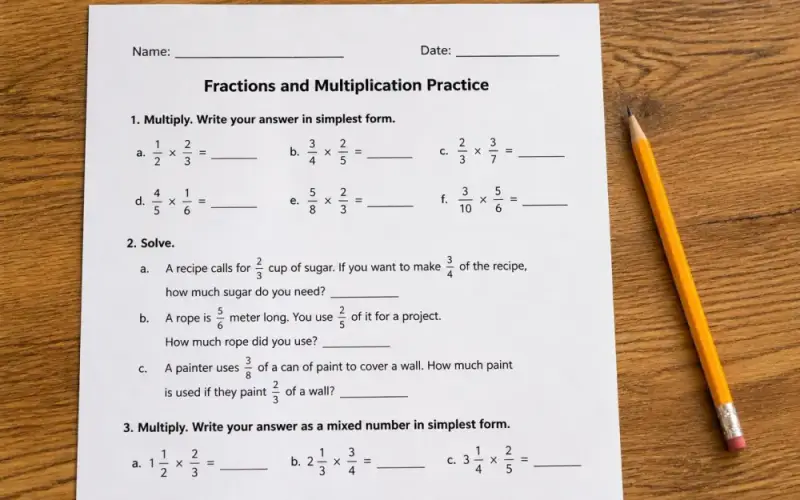
The four operations with integers and rational numbers, index notation and the index laws, using efficient mental and written strategies.
Percentages, ratio and rates
Percentage increase and decrease, profit and loss, and ratio and rate problems, including distance, speed and time.
Algebra and linear relationships
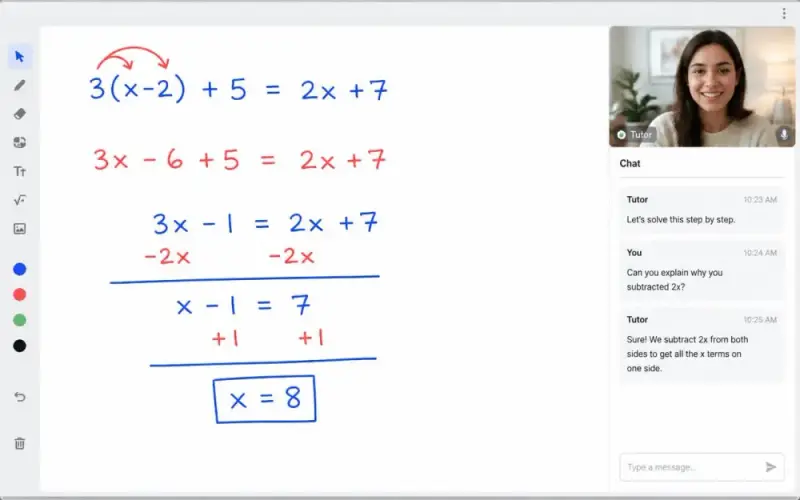
Expanding and factorising, simplifying expressions, solving linear equations, and plotting and reading linear graphs.
Measurement
Converting units of area and volume, perimeter and area of quadrilaterals and circles, volume of prisms, and time durations.
Geometry and transformations
Congruence, transformations and the properties of plane shapes, including angles and symmetry.
Probability and data
Venn diagrams and two-way tables, probabilities from 0 to 1, and how outliers change the mean and median.
Quantitative reasoning and technique
Thinking with numbers, patterns and shapes in unfamiliar settings, without a calculator, while pacing a long paper and moving on when stuck.
Reading and writing
Optional. Reading shares a 55-minute section with Verbal Reasoning, and Writing has two tasks in 40 minutes, so lessons can practise both.
One typical question, worked through
How a tutor talks a student through a maths question at this level. The student does the working on the shared whiteboard; the tutor asks the next question.
A bike shop sets the selling price of a bike at 30% more than it paid for it. In a sale, it takes 10% off that selling price, and the bike sells for $585. How much did the shop pay for the bike?
- Pretend the shop paid $100. A 30% mark-up makes the selling price $130.
- The sale takes 10% off $130, which is $13, so the sale price is $117. For every $100 the shop paid, the sale price is $117.
- So $585 is 117% of the cost. Divide: 585 ÷ 117 = 5, so 1% is $5 and 100% is $500.
- Check forward: $500 plus 30% is $650. Ten percent of $650 is $65, and $650 minus $65 is $585. It matches.
Answer: $500
The slip we see most often
Treating a 30% rise and a 10% fall as one 20% rise, or taking the 10% off the cost instead of off the selling price. Each percentage applies to a different amount. The fix is to follow one starting number, such as $100, through each step in order.

Signs your child could use help
- Strong in Year 8 maths but the exam sounds like a different game
- Dislikes puzzle questions with no obvious method to follow
- Algebra or percentages still trip them up
- Gets anxious when told a test is meant to be hard
- Reads well but has never planned a timed written piece
- We have heard of the exam but not what is in it
One of these on its own is normal. Two or three together usually point to a specific gap, and finding it is what the free assessment is for.
Taught to your curriculum, wherever you live
Specialized high school admissions tests, set locally
The nearest US comparison is New York City's SHSAT, taken by eighth and ninth graders applying to the city's specialized high schools. Most districts have no equivalent, and gifted programs use their own methods. Grade 8 maths covers linear equations, functions and the Pythagorean theorem.
Level: Grade 8
Key Stage 3 maths, no national selective test
England's selective tests are mostly sat at 11 (the 11+), and independent schools set their own entry tests and dates. Year 9 maths follows the Key Stage 3 national curriculum, and there are no national tests at this stage.
Level: Year 9
Provincial maths, Grade 8
Canada has no national equivalent and education is run by each province. In Ontario, a school board committee can identify a student as exceptional on the basis of giftedness, and EQAO assesses maths in Grades 6 and 9.
Level: Grade 8
Victorian selective entry high schools exam, Year 9 entry
Sat in Year 8 for Nossal, Suzanne Cory, The Mac.Robertson Girls' and Melbourne High. Mathematics and Quantitative Reasoning runs 60 minutes, Reading and Verbal Reasoning 55 and Writing 40. Required knowledge does not exceed the Year 8 curriculum.
Inside a 45-minute selective entry maths lesson
One 45-minute session. Tutors adjust the timings to your child.
5 min
Mental warm-up
Quick calculation and index and fraction facts, no calculator.
12 min
Topic teaching
One Year 7 or 8 topic taught with diagrams on the whiteboard.
14 min
Problem practice
Harder, less familiar problems on the topic, worked through together.
8 min
Short timed set
A few questions against the clock, with a plan for when to skip.
6 min
Review
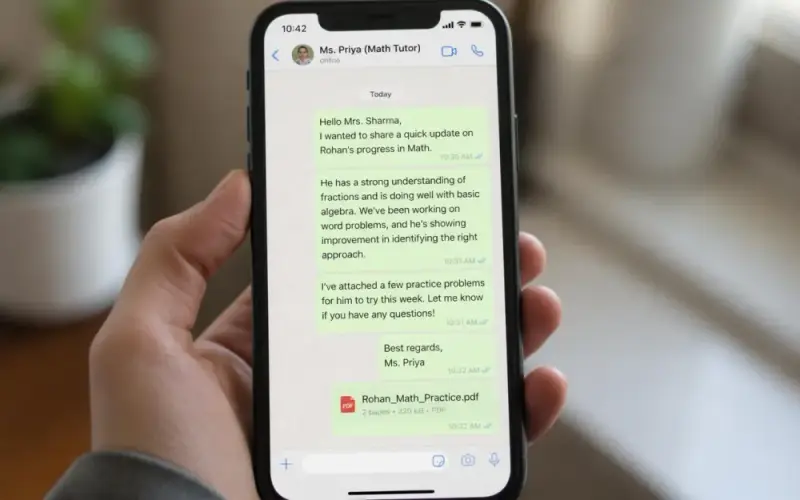
Every error is talked through. You get a WhatsApp summary.
Who teaches your child
Every TaleemSquare math tutor passes the same five checks before their first class. Your child keeps the same tutor each week, and if the fit is not right we switch tutor at no cost. Tutors are based in the US, UK, Canada, Australia, Pakistan and India, and all of them teach in English.
Identity and references checked
Every tutor is identity-verified and reference-checked before teaching a student.
Subject test
Tutors pass a subject test before they are matched with a child.
Spoken-English assessment
Lessons are taught in English, so every tutor passes a spoken-English assessment.
Live sample lesson
Tutors teach a live sample lesson before they are hired, to show they can explain clearly.
Open to parents
Classes are one-to-one in a password-protected room. Sit in on any class or ask for a recording.
How we prepare children for the selective entry test
Year 8 maths first
The exam's required knowledge does not exceed Year 8, so lessons secure integers, percentages, ratio, algebra and measurement before anything else.
Unfamiliar problems, calmly
Quantitative Reasoning means thinking with numbers, patterns and shapes. We practise drawing, trying values and checking, taught as maths problem solving.
Pacing for a paper many do not finish
ACER says candidates often answer only about half the questions correctly and many do not finish. We practise an informed guess, moving on and returning if time allows.
No calculator, by design
Calculators are not permitted in the exam room, so mental and written methods stay sharp through every lesson.
Simple monthly plans
A$130a month for 2 one-to-one maths lessons a week
About A$16.25 a lesson, or A$21.67 per hour of live one-to-one tutoring.
- Free 45-minute trial assessment, no card details
- No contract, cancel any month
- No registration fee
- 4-class money-back promise
- Switch tutor at no cost
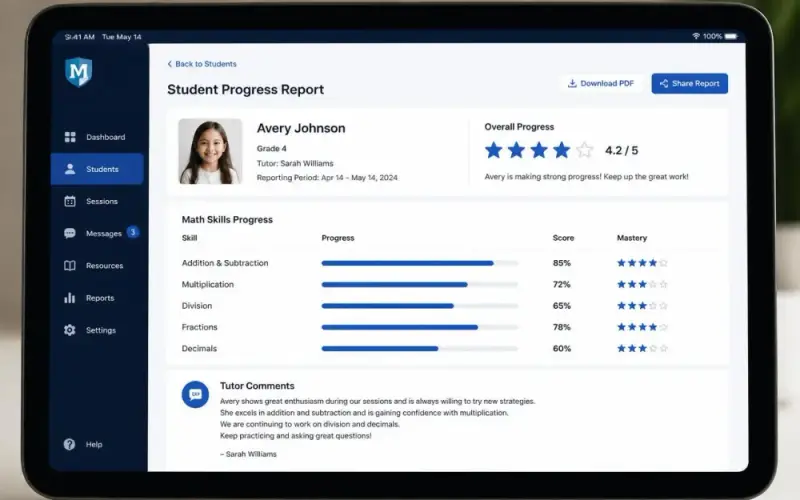
- WhatsApp update after every class
Starter
2 lessons a week, best for keeping up with school
A$130/mo
EnrollGrowthMost chosen
3 lessons a week, best for catching up + building confidence
A$179/mo
EnrollIntensive
4 lessons a week, best for exam prep & fast improvement
A$229/mo
EnrollCommon worries, honest answers
“Will tutoring get my child a place?”
We cannot promise that. About 1,000 Year 9 places are shared across four schools, and about 85% of them are offered in order of exam performance. Lessons can make Year 8 maths solid and the exam less strange, but the schools and ACER decide offers.
“My child will be upset if it feels too hard.”
That is normal for this exam. ACER says it is not unusual for candidates to answer only half the questions correctly and many do not finish, and it asks parents to avoid unnecessary performance pressure. We practise staying calm and moving on, and share honest progress notes by WhatsApp.
“Do you teach verbal or quantitative reasoning?”
Not as separate courses. We teach maths, reading and writing. ACER describes Quantitative Reasoning as thinking with numbers, patterns and shapes, and tutors practise that as maths problem solving. We do not run verbal reasoning classes, and Verbal Reasoning shares its section with Reading.
Frequently asked questions
When is the Victorian selective entry test?
What is in the selective entry exam?
Which schools can my child enter, and how are places offered?
How much does selective entry test tutoring cost?
Does my child need to prepare for the exam?
What does TaleemSquare cover for the selective entry test?
Book a free 45-minute assessment
Your child meets a tutor for a real one-to-one session. You get an honest read on where they are and what would help, even if the answer is that they don't need tutoring right now.
- 1
We reply on WhatsApp
Usually within 10 minutes, to find a time that suits your family.
- 2
Your child meets the tutor
A relaxed 45-minute session to see their level and how they learn.
- 3
You decide
You get a recommendation and a plan. No card details, no pressure.