
Secondary school, Year 8 · Ages 13-14
Year 8 Maths Tutor Online: Algebra and Selective Entry
One-to-one Year 8 maths covering algebra, Pythagoras and rates, plus the Victorian selective entry exam for Year 9.
Prefer to ask a question first? Chat on WhatsApp
Already decided? Choose a plan and enroll now, and we schedule the first class in your time zone.

How it works, in short
TaleemSquare Year 8 maths tutoring is live, one-to-one online lessons of 45 minutes that follow the Australian Curriculum (Version 9) and your child's school. Tutors cover integers and rational numbers, exponent laws, expanding and factorising, linear equations and graphs, rates, circles, Pythagoras' theorem, congruence, sampling and probability, fixing gaps from Year 7 first.
There is no NAPLAN in Year 8; it returns in Year 9. The main milestone is Victoria's selective entry high school exam for Year 9, which Year 8 students sit in June and which includes a 60-minute Mathematics and Quantitative Reasoning section. Plans start at A$130 a month for two 45-minute lessons a week, about A$30 a week.
- Format
- Live, one-to-one, online
- Lesson length
- 45 minutes
- Level
- Ages 13-14
- Price
- From A$130 a month
- Per hour of tutoring
- About A$21.67
- Families taught
- 500+ since 2023
What changes after a term of lessons
Fluent with linear algebra
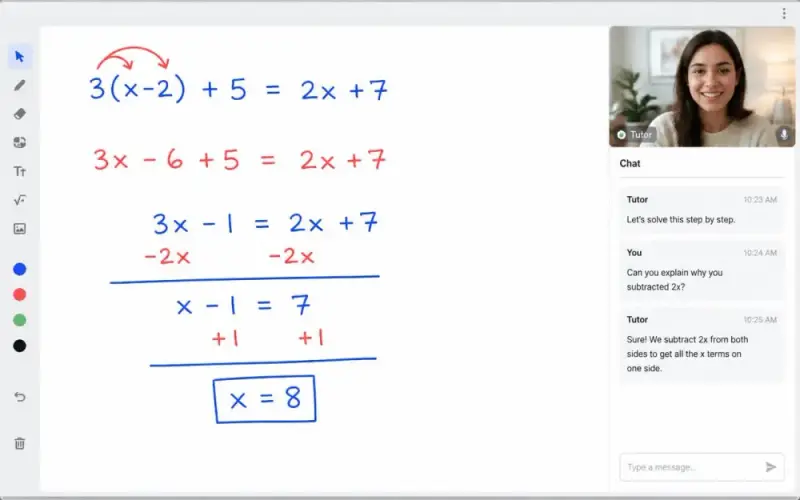
Expands, factorises and rearranges linear expressions, and solves equations and inequalities, checking each answer by substitution.
Confident with Pythagoras and rates
Uses Pythagoras' theorem to find missing sides, compares rates such as speed and unit price, and sets out each step clearly.
Steady on unfamiliar problems
Works through multi-step questions at a calm pace and explains the reasoning, the skill a reasoning-heavy exam such as the Victorian selective test calls for.
What we cover
Lessons follow your child's own school or homeschool curriculum. These are the areas we work on most at this level.
Irrational numbers and exponents
Square roots and pi as irrational numbers, terminating and recurring decimals, and the exponent laws for positive whole-number and zero exponents.
Integers and rational numbers
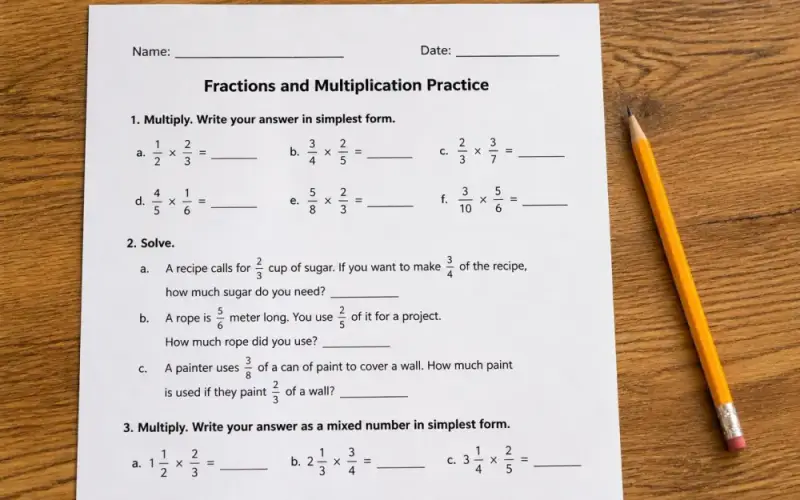
All four operations with integers, fractions, decimals and percentages, choosing efficient strategies and checking by estimation.
Linear expressions
Creating, expanding, factorising, rearranging and simplifying linear expressions using the distributive property.
Linear equations and graphs
Graphing linear relations, solving linear equations and one-variable inequalities algebraically and graphically, and modelling real situations.
Rates and ratios
Comparing quantities in different units, speed and unit pricing, and ratio problems including financial contexts.
Circles and composite shapes
Circumference and area of circles, area and perimeter of composite shapes, and volume and capacity of prisms.
Pythagoras and congruence
Side lengths of right-angled triangles, conditions for congruent and similar triangles, and properties of quadrilaterals.
Sampling and probability
Census versus sample, how sample size affects variation, complementary events, and tree diagrams, two-way tables and Venn diagrams for two events.
One typical question, worked through
How a tutor talks a student through a maths question at this level. The student does the working on the shared whiteboard; the tutor asks the next question.
A 5 metre ladder leans against a vertical wall. Its foot is 1.4 metres from the base of the wall. How high up the wall does the ladder reach?
- Sketch a right-angled triangle. The ladder is the longest side, the hypotenuse, at 5 m. The ground distance is 1.4 m, and the height up the wall is the missing short side.
- Pythagoras says the squares of the two short sides add up to the square of the longest side, so height squared plus 1.4 squared equals 5 squared.
- 1.4 squared is 1.96 and 5 squared is 25, so height squared is 25 minus 1.96, which is 23.04.
- The square root of 23.04 is 4.8, because 4.8 times 4.8 is 23.04.
- Check: 23.04 plus 1.96 is 25, which is 5 squared, and 4.8 m is less than the 5 m ladder, as it should be.
Answer: The ladder reaches 4.8 metres up the wall.
The slip we see most often
Adding the squares, 1.96 plus 25, as if the ladder were a short side. That gives about 5.2 m, higher than the ladder is long. The longest side is opposite the right angle, and when it is known you subtract.

Signs your child could use help
- Understood Year 7 maths but expanding brackets now causes errors
- Gets the method right, then slips on negative signs
- Is thinking about the Victorian selective entry exam for Year 9
- Cannot start a word problem without a worked example
- Pythagoras and rates questions leave them guessing which formula to use
- Maths marks slipped this year and confidence is dropping
One of these on its own is normal. Two or three together usually point to a specific gap, and finding it is what the free assessment is for.
Taught to your curriculum, wherever you live
Common Core State Standards, Grade 8
Grade 8 covers linear equations, functions, the Pythagorean theorem, transformations, congruence and similarity, and scatter plots. In many districts students begin Algebra 1 in Grade 8 or Grade 9. States test maths every year in Grades 3 to 8.
Level: Grade 8
National Curriculum in England: Year 9 (Key Stage 3)
Children of this age are in Year 9, the last year of Key Stage 3. There is no national maths test, though some schools begin GCSE content here and GCSE courses usually start in Year 10.
Level: Year 9 (Key Stage 3)
Provincial mathematics curricula, Grade 8
Each province sets its own Grade 8 maths: integers, rational numbers, linear relations, the Pythagorean theorem and data. In Ontario there is no EQAO test in Grade 8; the Grade 9 maths assessment follows.
Level: Grade 8
Australian Curriculum (Version 9): Mathematics, Year 8
Year 8 builds linear algebra, rates, Pythagoras' theorem and sampling. There is no NAPLAN in Year 8; it returns in Year 9. In Victoria, students sit the selective entry high school exam in Year 8 for Year 9 entry.
Inside a 45-minute Year 8 maths lesson
One 45-minute session. Tutors adjust the timings to your child.
6 min
Retrieval starter
Three quick questions on earlier algebra and number.
7 min
Homework check
Anything from this week's class that did not make sense.
12 min
Core topic
Today's idea taught on the whiteboard with worked examples.
14 min
Problem solving
Multi-step and reasoning questions, some in the style of selective entry papers.
6 min
Wrap-up
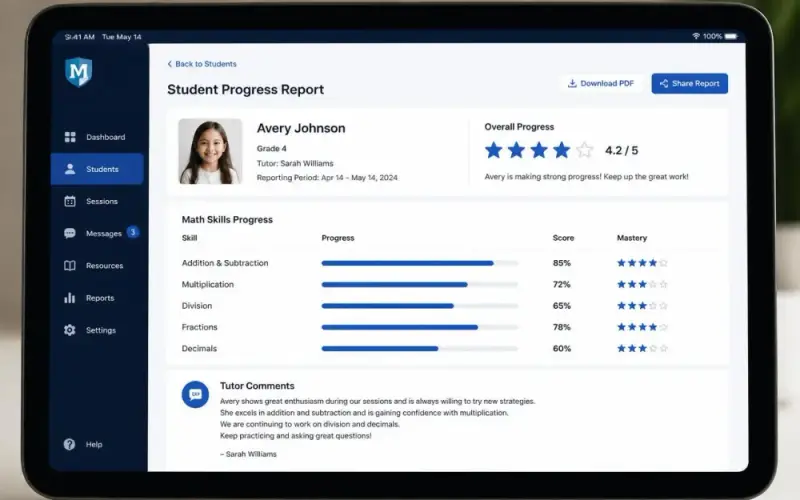
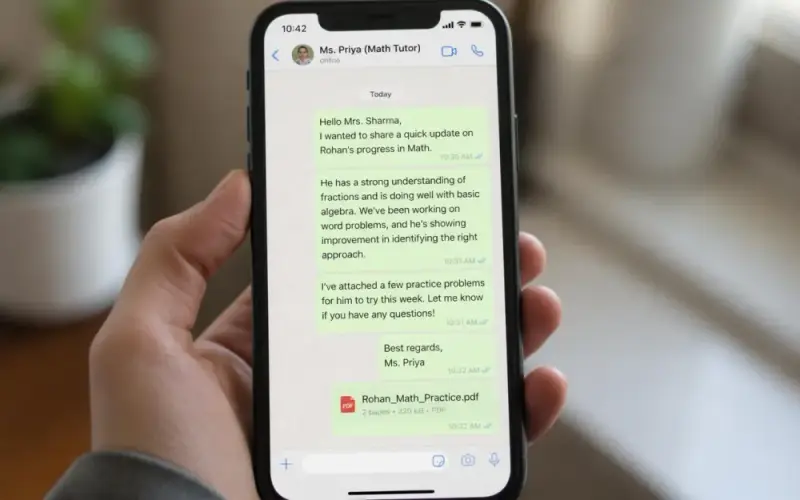
Your child sums up the method. You receive a WhatsApp update.
Who teaches your child
Every TaleemSquare math tutor passes the same five checks before their first class. Your child keeps the same tutor each week, and if the fit is not right we switch tutor at no cost. Tutors are based in the US, UK, Canada, Australia, Pakistan and India, and all of them teach in English.
Identity and references checked
Every tutor is identity-verified and reference-checked before teaching a student.
Subject test
Tutors pass a subject test before they are matched with a child.
Spoken-English assessment
Lessons are taught in English, so every tutor passes a spoken-English assessment.
Live sample lesson
Tutors teach a live sample lesson before they are hired, to show they can explain clearly.
Open to parents
Classes are one-to-one in a password-protected room. Sit in on any class or ask for a recording.
How we teach Year 8 maths
Algebra built on number sense
We check negative numbers, fractions and the order of operations first, because many Year 8 algebra errors start there rather than in the algebra itself.
Picture before formula
Pythagoras, circles and rates are sketched on the whiteboard first, so your child knows which formula fits instead of guessing.
Selective exam practice when it fits
For families sitting the Victorian exam, we add timed sets of maths and quantitative reasoning, with number, pattern and shape puzzles, once the Year 8 maths is secure.
Mistakes explained out loud
Your child talks through wrong answers, so the tutor can tell whether the cause was a slip, a misread question or a missing idea.
Simple monthly plans
A$130a month for 2 one-to-one maths lessons a week
About A$16.25 a lesson, or A$21.67 per hour of live one-to-one tutoring.
- Free 45-minute trial assessment, no card details
- No contract, cancel any month
- No registration fee
- 4-class money-back promise
- Switch tutor at no cost
- WhatsApp update after every class
Starter
2 lessons a week, best for keeping up with school
A$130/mo
EnrollGrowthMost chosen
3 lessons a week, best for catching up + building confidence
A$179/mo
EnrollIntensive
4 lessons a week, best for exam prep & fast improvement
A$229/mo
EnrollCommon worries, honest answers
“Should we try for the Victorian selective entry exam?”
That is your family's decision, and a tutor cannot guarantee a place. About 1,000 Year 9 places are offered across four schools, and offers depend on exam results and the schools' offer rules. The Department says the required knowledge does not go beyond the Year 8 curriculum.
“Algebra has fallen apart since Year 7.”
Year 8 algebra moves from substituting numbers to expanding, factorising and rearranging. Usually one earlier idea, such as negative numbers or fractions, is missing. The free assessment finds it, and lessons start there.
“My child has lost interest in maths this year.”
When maths turns abstract, some children decide they are not a maths person. Live one-to-one lessons with an interactive whiteboard let the tutor tie each topic to a real use, such as ladders for Pythagoras, and small wins show up in your WhatsApp updates.
Frequently asked questions
What maths is taught in Year 8?
When is the Victorian selective entry exam?
What is in the Victorian selective entry exam?
Is there NAPLAN in Year 8?
How much does a Year 8 maths tutor cost?
Will the tutor follow my child's school and state?
Sources
- Selective entry high schools (Victorian Government)
- Victorian Selective Entry High Schools: dates and registration (ACER)
- Victorian Selective Entry High Schools: exam format (ACER)
- Year 8 mathematics content descriptions, Australian Curriculum Version 9 (QCAA)
- Mathematics Version 2.0 familiarisation resources (VCAA)
Book a free 45-minute assessment
Your child meets a tutor for a real one-to-one session. You get an honest read on where they are and what would help, even if the answer is that they don't need tutoring right now.
- 1
We reply on WhatsApp
Usually within 10 minutes, to find a time that suits your family.
- 2
Your child meets the tutor
A relaxed 45-minute session to see their level and how they learn.
- 3
You decide
You get a recommendation and a plan. No card details, no pressure.