
Secondary school, Year 9 · Ages 14-15
Year 9 Maths Tutor Online for NAPLAN and Algebra
One-to-one Year 9 maths that builds algebra and trigonometry for the senior years and covers NAPLAN numeracy in March.
Prefer to ask a question first? Chat on WhatsApp
Already decided? Choose a plan and enroll now, and we schedule the first class in your time zone.

How it works, in short
TaleemSquare Year 9 maths tutoring is live, one-to-one online lessons of 45 minutes that follow the Australian Curriculum (Version 9) and your child's school. Tutors cover exponent laws, expanding and factorising, gradient and linear graphs, quadratics, volume and surface area, Pythagoras, right-angled trigonometry, surveys and compound probability, repairing gaps from Years 7 and 8 first.
Year 9 is the last NAPLAN year. The 2027 window runs from 10 to 22 March, and the numeracy test is 65 minutes, online, with a short non-calculator section first. NAPLAN is not pass or fail. Plans start at A$130 a month for two 45-minute lessons a week, about A$30 a week.
- Format
- Live, one-to-one, online
- Lesson length
- 45 minutes
- Level
- Ages 14-15
- Price
- From A$130 a month
- Per hour of tutoring
- About A$21.67
- Families taught
- 500+ since 2023
What changes after a term of lessons
Confident with algebra and graphs
Expands binomial products, factorises simple quadratics, and finds the gradient, midpoint and distance between points on the Cartesian plane.
Comfortable with right-angled triangles
Chooses between Pythagoras' theorem and the sine, cosine and tangent ratios, and sets out the working clearly.
Ready for Year 10 and beyond
Enters Year 10 with algebra, graphs and trigonometry secure, the foundations that senior maths courses in Years 11 and 12 build on.
What we cover
Lessons follow your child's own school or homeschool curriculum. These are the areas we work on most at this level.
Real numbers, exponents and scientific notation
Rational and irrational numbers, exponent laws with integer exponents extended to variables, and scientific notation for very large and very small measurements.
Expanding and factorising
Simplifying algebraic expressions, expanding binomial products and factorising monic quadratic expressions.
Gradient and linear graphs
The gradient of a line segment, the midpoint of an interval and the distance between two points on the Cartesian plane.
Quadratics
Identifying and graphing quadratic functions, solving quadratic equations graphically and numerically, and solving simple monic quadratics algebraically.
Volume and surface area
Right prisms and cylinders, with units handled carefully, plus absolute, relative and percentage error in measurements.
Pythagoras and trigonometry
Angle properties, scale and similarity, Pythagoras' theorem, and the sine, cosine and tangent ratios in right-angled triangles.
Statistics and surveys
How surveys collect data, how sampling affects results, comparing data sets by centre, spread and outliers, and choosing suitable displays.
Compound probability
Listing outcomes of compound events with and without replacement using tree diagrams and tables, and finding probabilities for and and or events.
One typical question, worked through
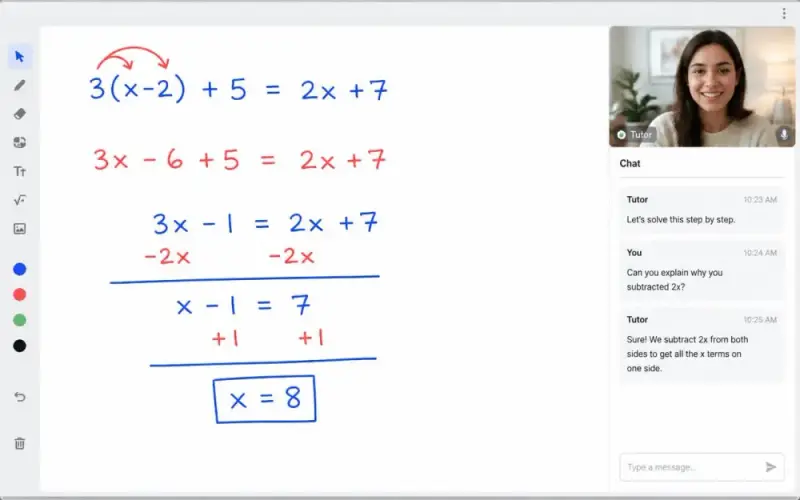
How a tutor talks a student through a maths question at this level. The student does the working on the shared whiteboard; the tutor asks the next question.
A straight line passes through the points (2, 7) and (6, 15). Find the gradient and the equation of the line.
- Label the points: first point (2, 7), second point (6, 15). Gradient is rise over run, so subtract the y values and the x values in the same order.
- The rise is 15 minus 7, which is 8. The run is 6 minus 2, which is 4. The gradient is 8 divided by 4, which is 2.
- The line has the form y = 2x + c. Put in the point (2, 7): 7 = 2 times 2 plus c, so 7 = 4 + c and c = 3.
- The equation is y = 2x + 3. Check with the other point (6, 15): 2 times 6 plus 3 is 15, which matches.
Answer: The gradient is 2 and the equation is y = 2x + 3.
The slip we see most often
Subtracting in opposite orders, such as 15 minus 7 over 2 minus 6, which gives a gradient of negative 2. The line climbs from left to right, so its gradient must be positive. Use that sense check every time.

Signs your child could use help
- Maths marks are slipping as algebra gets more abstract
- Mixes up expanding and factorising, or drops negative signs
- Cannot tell when to use Pythagoras and when to use sine, cosine or tangent
- Anxious about NAPLAN or unsure what is on the numeracy test
- Unsure which maths course to take in Years 10 and 11
- Knows the method in class but loses marks on unfamiliar questions
One of these on its own is normal. Two or three together usually point to a specific gap, and finding it is what the free assessment is for.
Taught to your curriculum, wherever you live
Common Core State Standards, high school (Algebra 1 or Geometry)
In most US districts, Grade 9 is the first year of high school. Common Core high school maths is usually taught as Algebra 1 and Geometry, covering linear and quadratic equations, functions, congruence, similarity and right-triangle trigonometry. High school testing varies by state.
Level: Grade 9 (first year of high school)
National Curriculum in England: Year 10 (GCSE courses begin)
Children of this age are usually in Year 10, when two-year GCSE maths courses start, with the exams at the end of Year 11. The Key Stage 3 national curriculum ends in Year 9.
Level: Year 10 (GCSE courses begin)
Provincial mathematics curricula, Grade 9
Each province sets its own Grade 9 maths. The content overlaps with Year 9: linear relations, exponents, geometry and data. In Ontario, EQAO assesses Grade 9 maths.
Level: Grade 9
Australian Curriculum (Version 9): Mathematics, Year 9
Year 9 adds quadratics, gradient, surface area, trigonometry and compound probability. NAPLAN numeracy is sat in March, and Year 9 is the last NAPLAN year. NSW teaches Stage 5 of its Mathematics K-10 Syllabus in Years 9 and 10.
Inside a 45-minute Year 9 maths lesson
One 45-minute session. Tutors adjust the timings to your child.
6 min
Retrieval starter
Quick questions on algebra, fractions and negative numbers, no calculator.
7 min
Homework check
Anything from this week's class that did not make sense.
13 min
Core topic
Taught on the whiteboard with worked examples and graphs.
13 min
Independent practice
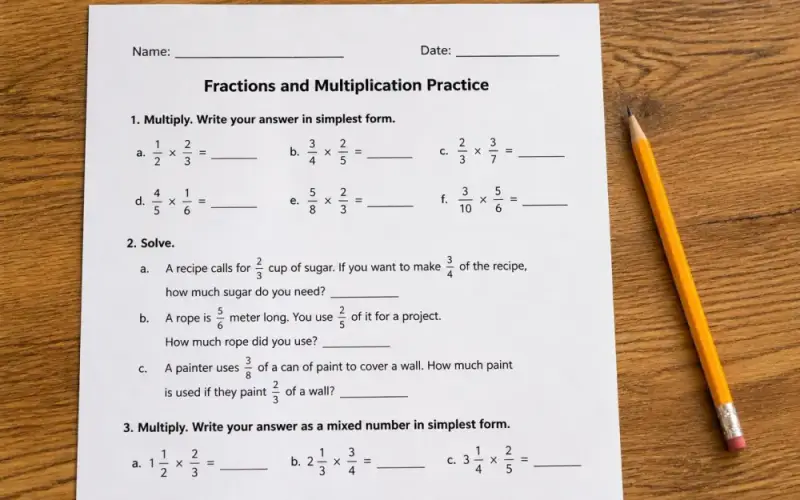
Questions from routine to problem solving, some in the style of NAPLAN numeracy.
6 min
Summary
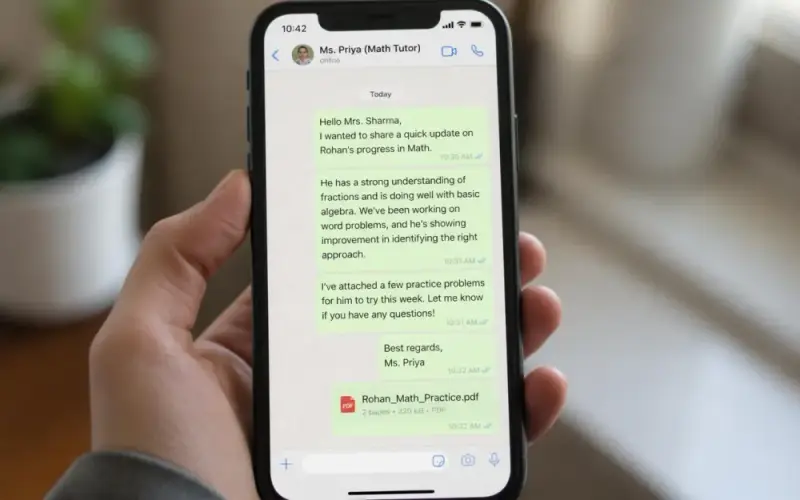
Your child explains the method. You receive a WhatsApp update.
Who teaches your child
Every TaleemSquare math tutor passes the same five checks before their first class. Your child keeps the same tutor each week, and if the fit is not right we switch tutor at no cost. Tutors are based in the US, UK, Canada, Australia, Pakistan and India, and all of them teach in English.
Identity and references checked
Every tutor is identity-verified and reference-checked before teaching a student.
Subject test
Tutors pass a subject test before they are matched with a child.
Spoken-English assessment
Lessons are taught in English, so every tutor passes a spoken-English assessment.
Live sample lesson
Tutors teach a live sample lesson before they are hired, to show they can explain clearly.
Open to parents
Classes are one-to-one in a password-protected room. Sit in on any class or ask for a recording.
How we teach Year 9 maths
Algebra from the ground up
Expanding and factorising are shown with area diagrams first and as rules second, so quadratics make sense when they arrive.
Choosing the right tool
A simple routine helps your child decide between Pythagoras, sine, cosine and tangent: which sides are known, and which one is needed.
NAPLAN familiarity without cramming
ACARA says students need not study for NAPLAN. We cover the online question types and the non-calculator start briefly, and spend the rest on the maths.
Looking ahead to senior maths
The tutor shows where each Year 9 topic comes back in Years 10 to 12, so your child sees why it matters and can choose courses knowing their strengths.
Simple monthly plans
A$130a month for 2 one-to-one maths lessons a week
About A$16.25 a lesson, or A$21.67 per hour of live one-to-one tutoring.
- Free 45-minute trial assessment, no card details
- No contract, cancel any month
- No registration fee
- 4-class money-back promise
- Switch tutor at no cost
- WhatsApp update after every class
Starter
2 lessons a week, best for keeping up with school
A$130/mo
EnrollGrowthMost chosen
3 lessons a week, best for catching up + building confidence
A$179/mo
EnrollIntensive
4 lessons a week, best for exam prep & fast improvement
A$229/mo
EnrollCommon worries, honest answers
“Does NAPLAN actually matter in Year 9?”
It is a snapshot, not a pass or fail test. In Western Australia, a Year 9 numeracy score of 570 or more prequalifies a student for the WACE numeracy standard. Ask your school how results are used in your state, and keep the focus on understanding the maths.
“Algebra has got harder and my child has lost confidence.”
Year 9 algebra adds quadratics and graphs on top of earlier skills. Tutors find the missing step, often negative numbers, fractions or Year 8 equations, and rebuild from there with worked examples, so confidence returns with correct answers.
“We are unsure which maths to take in Year 10 and beyond.”
Schools set their own Year 10 options and entry rules, so ask them first. A tutor cannot choose for you, but can show whether any gaps sit in algebra, graphs or trigonometry and close them, which keeps more options open.
Frequently asked questions
What maths is taught in Year 9?
When is NAPLAN for Year 9 in 2027, and what is on the numeracy test?
Does my Year 9 child need a tutor for NAPLAN?
How does Year 9 NAPLAN count in Western Australia?
How much does a Year 9 maths tutor cost?
Will the tutor follow my child's school and state?
Sources
- NAPLAN 2027 information for parents and carers (NAP)
- NAPLAN numeracy (NAP)
- OLNA and prequalification through Year 9 NAPLAN: information for parents (SCSA, Western Australia)
- Year 9 mathematics content descriptions, Australian Curriculum Version 9 (QCAA)
- Mathematics K-10 Syllabus (2022) for Years 7-10 (NSW Department of Education)
Book a free 45-minute assessment
Your child meets a tutor for a real one-to-one session. You get an honest read on where they are and what would help, even if the answer is that they don't need tutoring right now.
- 1
We reply on WhatsApp
Usually within 10 minutes, to find a time that suits your family.
- 2
Your child meets the tutor
A relaxed 45-minute session to see their level and how they learn.
- 3
You decide
You get a recommendation and a plan. No card details, no pressure.