
Elementary and middle school · Ages 8-12
Fractions Tutor for Kids: Grades 3 to 6, One-to-One
Fractions taught with strips, number lines and drawings first, so the rules finally make sense to your child.
Prefer to ask a question first? Chat on WhatsApp
Already decided? Choose a plan and enroll now, and we schedule the first class in your time zone.

How it works, in short
Fractions tutoring at TaleemSquare is live, one-to-one online help for children who find fractions confusing, usually between third and sixth grade. Tutors start with fraction strips, area models and number lines, then build to equivalent fractions, comparing, adding and subtracting with unlike denominators, multiplying, and dividing fractions.
Fractions are where many children first fall behind, and ratios, percents and algebra all lean on them later. The free assessment finds where your child's understanding breaks down. Plans start at $85 a month for two 45-minute lessons a week.
- Format
- Live, one-to-one, online
- Lesson length
- 45 minutes
- Level
- Ages 8-12
- Price
- From $85 a month
- Price per class
- About $9 to $11
- Per hour of tutoring
- About $14.17
- Free trial
- A 45-minute assessment, no card
- Families taught
- 500+ since 2023
What changes after a term of lessons
Sees a fraction as a number
Places fractions on a number line, compares them and can explain why 3/4 is bigger than 2/3.
Adds and subtracts any fractions
Finds a common denominator, including with mixed numbers, and checks that the answer is sensible.
Multiplies and divides with meaning
Knows why multiplying by a fraction can make a number smaller and why dividing by 1/8 gives a bigger answer.
What we cover
Lessons follow your child's own school or homeschool curriculum. These are the areas we work on most at this level.
Unit fractions and the number line
What 1/2, 1/3 and 1/4 mean as equal parts, and placing fractions between 0 and 1, and beyond, on a number line.
Equivalent fractions
Why 2/4, 3/6 and 4/8 name the same amount, then making equivalent fractions by multiplying the top and bottom by the same number.
Comparing and ordering
Comparing fractions with the same numerator or denominator, using benchmarks such as 1/2, and common denominators when no shortcut works.
Adding and subtracting
Like denominators first, then unlike denominators and mixed numbers, with a model drawn before any rule is used.
Multiplying fractions
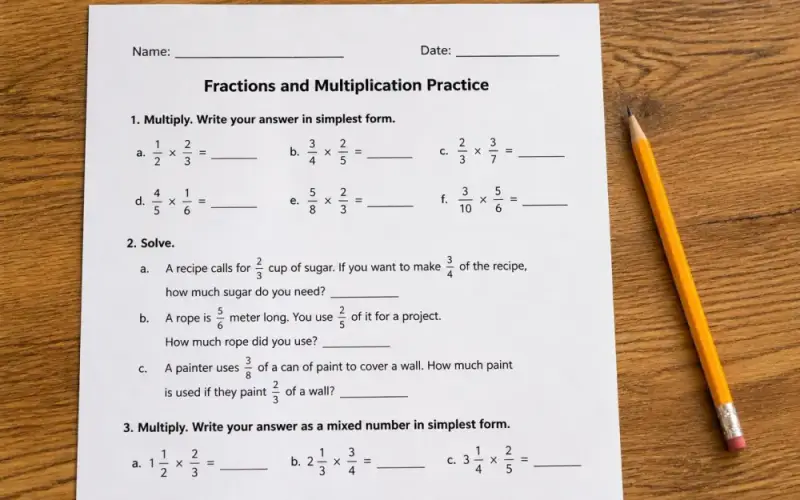
A fraction times a whole number, then a fraction times a fraction, shown with area models so the answer makes sense.
Dividing fractions
Dividing unit fractions by whole numbers, then fractions by fractions, using how-many-groups-fit thinking before the shortcut rule.
Fractions, decimals and percents
Tenths and hundredths as decimals, and how fractions, decimals and percents describe the same amount in different ways.
Fraction word problems
Recipe, measurement and sharing problems: deciding which operation fits and checking the answer against the story.
One typical question, worked through
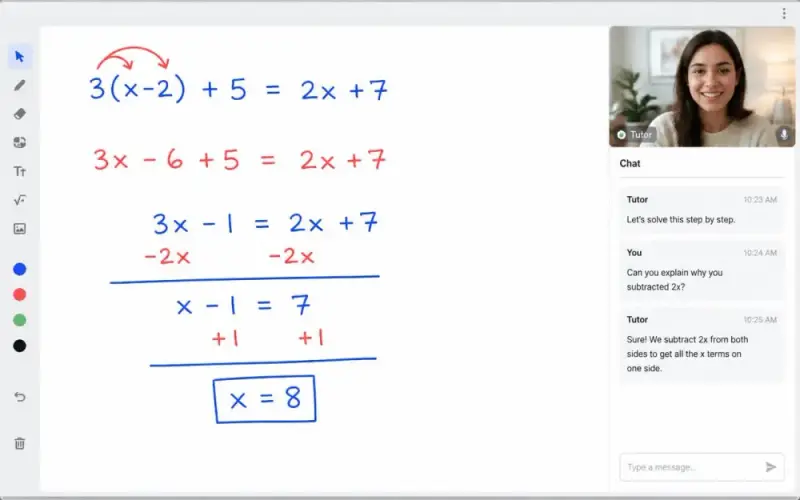
How a tutor talks a student through a math question at this level. The student does the working on the shared whiteboard; the tutor asks the next question.
Sam ate 3/8 of a pizza and Lily ate 1/4 of it. How much of the pizza did they eat together?
- The denominators are different, so the pieces are different sizes. Eighths work for both, because 4 goes into 8.
- Rewrite 1/4 in eighths by multiplying the top and bottom by 2: 1/4 = 2/8.
- Add the eighths: 3/8 + 2/8 = 5/8.
- Check with a drawing: shade 3 slices, then 2 more, of a pizza cut into 8. That is 5 of the 8 slices.
Answer: 5/8 of the pizza
The slip we see most often
Adding the tops and the bottoms: 3/8 + 1/4 = 4/12. That is 1/3, which is less than the 3/8 Sam ate on his own, so it cannot be right. The pieces have to be the same size before they are added.

Signs your child could use help
- Thinks 1/8 is bigger than 1/4 because 8 is bigger
- Adds tops and bottoms, so 1/2 + 1/3 becomes 2/5
- Follows the rule in class but forgets it by the test
- Gets stuck as soon as a mixed number appears
- Freezes on recipe or measurement word problems
- Teacher says fractions are holding back the rest of math
One of these on its own is normal. Two or three together usually point to a specific gap, and finding it is what the free assessment is for.
Taught to your curriculum, wherever you live
Common Core Grades 3-6 (or your state's standards)
Grade 3 introduces fractions as numbers on a number line, Grade 4 covers equivalent fractions and adding like denominators, Grade 5 adds unlike denominators and multiplies fractions, and Grade 6 divides fractions by fractions.
National Curriculum in England, Years 3-6
Fractions build from unit fractions in Year 3 to Year 6, where pupils add and subtract fractions with different denominators, multiply simple pairs of fractions and divide fractions by whole numbers. Fractions also appear in the Key Stage 2 maths SATs.
Level: Years 4-7
Provincial math curricula, such as Ontario
Canadian provinces teach fractions in their number strand from the early grades. Ontario's 2020 curriculum, for example, includes fractions in every grade from 1 to 8, moving from fair sharing to adding, subtracting, multiplying and dividing fractions.
Level: Grades 3-6
Australian Curriculum v9.0, Years 3-6
Year 3 works with unit fractions on number lines, Year 4 with equivalent fractions, Year 5 adds and subtracts fractions with the same denominator, and Year 6 with related denominators, alongside decimals and percentages.
Level: Years 3-6
What a fractions lesson looks like
One 45-minute session. Tutors adjust the timings to your child.
5 min
Estimate warm-up
Which fraction is bigger, and how do you know?
12 min
Model the idea
A new idea shown with strips, an area model or a number line.
13 min
Guided practice
Your child draws and solves while the tutor watches each step.
10 min
Word problem
A recipe, measurement or sharing problem using today's idea.
5 min
Wrap-up
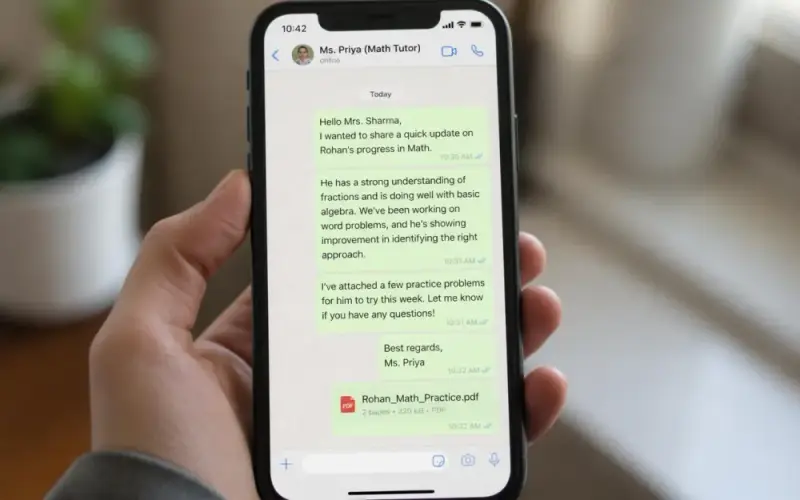
A summary for you on WhatsApp and one thing to practice.
Who teaches your child
Every TaleemSquare math tutor passes the same five checks before their first class. Your child keeps the same tutor each week, and if the fit is not right we switch tutor at no cost. Tutors are based in the US, UK, Canada, Australia, Pakistan and India, and all of them teach in English.
Identity and references checked
Every tutor is identity-verified and reference-checked before teaching a student.
Subject test
Tutors pass a subject test before they are matched with a child.
Spoken-English assessment
Lessons are taught in English, so every tutor passes a spoken-English assessment.
Live sample lesson
Tutors teach a live sample lesson before they are hired, to show they can explain clearly.
Open to parents
Classes are one-to-one in a password-protected room. Sit in on any class or ask for a recording.
How we teach fractions
Models before rules
Fraction strips, area models and number lines come first, so every rule your child learns has a picture behind it.
One idea at a time
Equivalence is secure before adding, and adding is secure before multiplying, so new steps never sit on shaky ones.
Estimate, then calculate
Your child says roughly how big the answer should be first, which catches slips like 1/2 + 1/3 = 2/5 straight away.
Your school's methods
Tutors use the models and words from your child's class, then add a second way to see it when the first one is not clicking.
Simple monthly plans
$85a month for 2 one-to-one math lessons a week
About $10.63 a lesson, or $14.17 per hour of live one-to-one tutoring. With four lessons a week it is $9.31 a lesson.
- Free 45-minute trial assessment, no card details
- No contract, cancel any month
- No registration fee
- 4-class money-back promise
- Switch tutor at no cost
- WhatsApp update after every class
Starter
2 lessons a week, best for keeping up with school
$85/mo
EnrollGrowthMost chosen
3 lessons a week, best for catching up + building confidence
$119/mo
EnrollIntensive
4 lessons a week, best for exam prep & fast improvement
$149/mo
EnrollCommon worries, honest answers
“My child learns the fraction rule in class and forgets it a week later.”
That usually means the rule was never linked to a picture. Tutors rebuild the idea with models first, so the rule becomes something your child can work out again instead of something to memorize.
“My child is in middle school and still stuck on fractions. Is that too late?”
No. Many middle schoolers are missing one or two fraction ideas from earlier grades. The assessment finds which ones, and fixing them often makes ratios, percents and equations easier as well.
“Will this clash with how the school teaches fractions?”
No. Share a worksheet or textbook page and the tutor will use the same methods and words, adding another model only when it helps your child see the idea.
Frequently asked questions
Why are fractions so hard for kids?
What grade do kids learn fractions?
How can I help my child understand fractions at home?
How do you add fractions with different denominators?
Is online tutoring good for fractions?
How much does a fractions tutor cost?
Book a free 45-minute assessment
Your child meets a tutor for a real one-to-one session. You get an honest read on where they are and what would help, even if the answer is that they don't need tutoring right now.
- 1
We reply on WhatsApp
Usually within 10 minutes, to find a time that suits your family.
- 2
Your child meets the tutor
A relaxed 45-minute session to see their level and how they learn.
- 3
You decide
You get a recommendation and a plan. No card details, no pressure.