
Elementary school · Ages 7-11
Multiplication Tutor: Times Tables to Long Division
Times tables learned through patterns and strategies, then multi-digit multiplication and division, one-to-one and online.
Prefer to ask a question first? Chat on WhatsApp
Already decided? Choose a plan and enroll now, and we schedule the first class in your time zone.

How it works, in short
Multiplication tutoring at TaleemSquare is live, one-to-one online help with times tables and everything built on them: knowing the facts to 10 × 10, multiplying multi-digit numbers, long division and the word problems that use them. Tutors teach strategies such as doubling, splitting and using known facts, so recall comes from understanding rather than rote drilling.
In the US, Common Core expects children to know all products of two one-digit numbers from memory by the end of third grade, and fluent multi-digit multiplication by fifth grade. Plans start at $85 a month after a free assessment.
- Format
- Live, one-to-one, online
- Lesson length
- 45 minutes
- Level
- Ages 7-11
- Price
- From $85 a month
- Price per class
- About $9 to $11
- Per hour of tutoring
- About $14.17
- Free trial
- A 45-minute assessment, no card
- Families taught
- 500+ since 2023
What changes after a term of lessons
Knows the facts by heart
Recalls multiplication facts to 10 × 10 quickly and uses them to work out the matching division facts.
Multiplies big numbers with confidence
Uses area models and then the standard written method for multi-digit multiplication, and checks with an estimate.
Divides step by step
Works through long division without losing the remainder, and knows when an answer makes sense.
What we cover
Lessons follow your child's own school or homeschool curriculum. These are the areas we work on most at this level.
What multiplication means
Equal groups, arrays and repeated addition, so 4 × 6 is a picture before it is a fact to remember.
Times tables strategies
Doubling for the 2s, 4s and 8s, the pattern in the 9s, and splitting hard facts like 7 × 8 into easier ones.
Fact fluency
Short, regular recall practice and games once the strategies are secure, so facts become quick without stress.
Division facts
Division as sharing and as grouping, and using known multiplication facts to find division facts.
Multi-digit multiplication
Area models and partial products first, then the standard written method for problems such as 34 × 26.
Long division
Dividing larger numbers by one-digit and then two-digit divisors, with remainders, and checking by multiplying back.
Multiplication word problems
Equal groups, arrays, area and comparison problems, and deciding whether a story needs multiplying or dividing.
One typical question, worked through
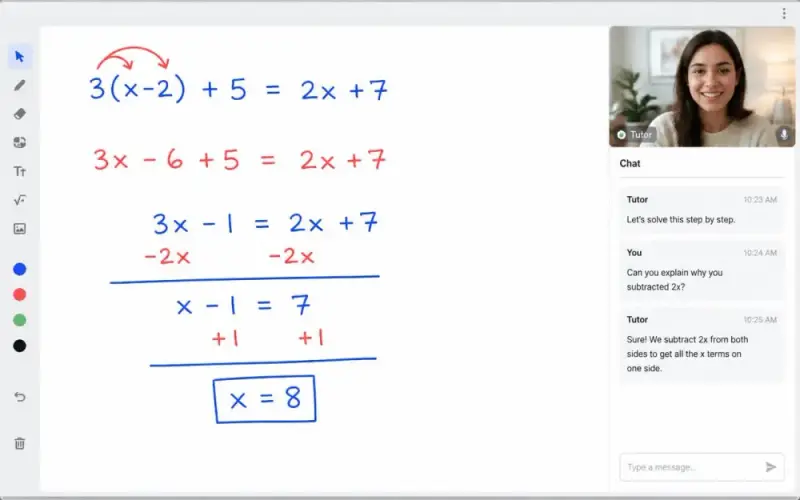
How a tutor talks a student through a math question at this level. The student does the working on the shared whiteboard; the tutor asks the next question.
A school orders 34 boxes of pencils with 26 pencils in each box. How many pencils is that?
- Split both numbers into tens and ones: 34 = 30 + 4 and 26 = 20 + 6.
- Draw a box in four parts and multiply each pair: 30 × 20 = 600, 30 × 6 = 180, 4 × 20 = 80 and 4 × 6 = 24.
- Add the four parts: 600 + 180 + 80 + 24 = 884.
- Check with an estimate: 34 × 26 must be more than 30 × 25 = 750, so 884 is sensible.
Answer: 884 pencils
The slip we see most often
Multiplying only the matching digits, 3 × 2 and 4 × 6, and writing 624. That misses the 30 × 6 and 4 × 20 parts. Because 34 × 26 is more than 30 × 25 = 750, an estimate shows straight away that 624 is too small.

Signs your child could use help
- Skip counts from zero to answer every times tables question
- Knows the 2s, 5s and 10s but guesses the rest
- Times tables practiced at home are forgotten a week later
- Gets lost halfway through a long division problem
- Mixes up when to multiply and when to divide
- Gets anxious during timed math fact tests
One of these on its own is normal. Two or three together usually point to a specific gap, and finding it is what the free assessment is for.
Taught to your curriculum, wherever you live
Common Core Grades 2-5 (or your state's standards)
Grade 2 lays foundations with equal groups and arrays, Grade 3 expects all one-digit facts from memory, Grade 4 multiplies up to four digits by one digit and divides, and Grade 5 multiplies multi-digit numbers fluently with the standard algorithm.
National Curriculum in England, Years 2-6
Pupils learn the 2, 5 and 10 times tables in Year 2 and all tables to 12 × 12 by the end of Year 4, when they take the statutory multiplication tables check in June. Long multiplication and long division follow in Years 5 and 6.
Level: Years 3-6
Provincial math curricula, such as Ontario
Ontario's 2020 math curriculum develops multiplication and division facts from Grade 3, and multi-digit multiplication and division through the junior grades. Other provinces follow a similar path, and tutors follow your province's grade.
Level: Grades 2-5
Australian Curriculum v9.0, Years 2-5
Year 2 uses equal groups and arrays, Year 3 recalls facts for the 2, 3, 4, 5 and 10 times tables, Year 4 recalls facts to 10 × 10, and Year 5 multiplies and divides larger numbers with efficient strategies.
Level: Years 2-5
What a multiplication lesson looks like
One 45-minute session. Tutors adjust the timings to your child.
7 min
Facts warm-up
Ten quick facts, timed only once your child is accurate.
12 min
Strategy or method
A new strategy or written method shown with arrays or an area model.
12 min
Guided practice
Your child works problems while the tutor checks every step.
9 min
Word problem
A real-life problem that needs multiplying or dividing.
5 min
Wrap-up
Facts to practice this week, sent to you on WhatsApp.
Who teaches your child
Every TaleemSquare math tutor passes the same five checks before their first class. Your child keeps the same tutor each week, and if the fit is not right we switch tutor at no cost. Tutors are based in the US, UK, Canada, Australia, Pakistan and India, and all of them teach in English.
Identity and references checked
Every tutor is identity-verified and reference-checked before teaching a student.
Subject test
Tutors pass a subject test before they are matched with a child.
Spoken-English assessment
Lessons are taught in English, so every tutor passes a spoken-English assessment.
Live sample lesson
Tutors teach a live sample lesson before they are hired, to show they can explain clearly.
Open to parents
Classes are one-to-one in a password-protected room. Sit in on any class or ask for a recording.
How we teach multiplication
Meaning before memory
Arrays and equal groups come first, so a forgotten fact can always be worked out again.
A small set of strategies
Doubles, the 5s and 10s, the 9s pattern and splitting cover most facts, leaving only a few hard ones to learn.
Short, regular recall
A few minutes of facts at the start of each lesson, tracked over time, does more than long drills.
Estimate and check
Before any long multiplication or division, your child estimates the answer, then checks the result against it.

Simple monthly plans
$85a month for 2 one-to-one math lessons a week
About $10.63 a lesson, or $14.17 per hour of live one-to-one tutoring. With four lessons a week it is $9.31 a lesson.
- Free 45-minute trial assessment, no card details
- No contract, cancel any month
- No registration fee
- 4-class money-back promise
- Switch tutor at no cost
- WhatsApp update after every class
Starter
2 lessons a week, best for keeping up with school
$85/mo
EnrollGrowthMost chosen
3 lessons a week, best for catching up + building confidence
$119/mo
EnrollIntensive
4 lessons a week, best for exam prep & fast improvement
$149/mo
EnrollCommon worries, honest answers
“We have tried times tables apps and flashcards and they don't stick.”
Apps and flashcards practice recall but rarely give a child a way to work a fact out. Once your child has a few strategies, short recall practice sticks much better.
“My child is in fifth grade and still doesn't know the times tables.”
That is more common than many parents think, and it is fixable. Tutors find which facts are secure, teach strategies for the rest, and practice them alongside fifth grade work so your child does not fall further behind.
“Timed tests make my child anxious.”
Tutors build accuracy first and add gentle timing only when your child is ready, so speed grows without panic.
Frequently asked questions
When should a child know their times tables?
What is the fastest way to learn times tables?
Why does my child struggle with long division?
Should my child learn the standard algorithm for multiplication?
Is online tutoring good for learning times tables?
How much does a multiplication tutor cost?
Sources
- Common Core State Standards: Grade 3, Operations and Algebraic Thinking
- Common Core State Standards: Number and Operations in Base Ten (Grades 4-5)
- National Curriculum in England: mathematics programmes of study
- Standards and Testing Agency: multiplication tables check
- Australian Curriculum v9.0: Mathematics
Book a free 45-minute assessment
Your child meets a tutor for a real one-to-one session. You get an honest read on where they are and what would help, even if the answer is that they don't need tutoring right now.
- 1
We reply on WhatsApp
Usually within 10 minutes, to find a time that suits your family.
- 2
Your child meets the tutor
A relaxed 45-minute session to see their level and how they learn.
- 3
You decide
You get a recommendation and a plan. No card details, no pressure.