Kindergarten to Grade 12 · Ages 5-18
Common Core Math Tutoring That Explains the New Methods
Lessons that teach your child's school methods, connect them to the way you learned, and include you.
Prefer to ask a question first? Chat on WhatsApp
Already decided? Choose a plan and enroll now, and we schedule the first class in your time zone.

How it works, in short
TaleemSquare offers live one-to-one math tutoring for families whose schools teach Common Core methods, such as number lines, area models and breaking numbers apart. The tutor teaches the method your child's class uses, shows how it connects to the standard method you may know, and can walk you through it too, so helping with homework at home gets easier.
Every lesson is 45 minutes, live on Zoom or Google Meet with a shared whiteboard, and you get a WhatsApp update after every class. Every tutor is background-checked and a female supervisor joins every class. Plans start at $85 a month for two 45-minute lessons a week, about $10.63 a lesson, after a free assessment.
- Format
- Live, one-to-one, online
- Lesson length
- 45 minutes
- Level
- Ages 5-18
- Price
- From $85 a month
- Price per class
- About $9 to $11
- Per hour of tutoring
- About $14.17
- Free trial
- A 45-minute assessment, no card
- Families taught
- 500+ since 2023
What we work towards in a term
Every child starts from a different place, so these are goals, not promises. They are set after the free assessment and reviewed as lessons go on: you get an update after every class and a progress report each month.
Methods your child can explain
Your child can show the number line, area model or drawing the teacher asks for, and say why each step works.
A bridge between two ways
Your child sees that the school method and the standard method give the same answer, and uses the standard method when the grade expects it.
Calmer homework at home
You know what the method is doing, so homework time is less about arguing over which way is right.
What we cover
Lessons follow your child's own school or homeschool curriculum. These are the areas we work on most at this level.
Addition and subtraction strategies
Making ten, counting up on an open number line and breaking numbers into tens and ones, the methods Grades 1 to 3 use most.
Area models and partial products
Multiplying by splitting numbers into tens and ones, then linking each part to the steps of the standard multiplication algorithm.
Division with partial quotients
Dividing in friendly chunks with an area model or partial quotients, then moving to long division when your child's grade is ready.
Fractions with models
Using fraction strips, number lines and area models to find equivalent fractions, compare them, and add or subtract them.
Word problems with drawings
Bar models and tape diagrams that show what a problem gives and asks, so your child can choose the operation and write an equation.
Explaining your thinking
Writing a short explanation or showing work in more than one way, which Common Core homework and tests often ask for.
Standard algorithms
The standard methods for adding, subtracting, multiplying and dividing, practiced in the grades where the standards expect fluency with them.
Middle and high school standards
Ratios, expressions, equations and functions in Grades 6 to 8, and Algebra 1, Geometry and Algebra 2, in whatever course your school teaches.
One typical question, worked through
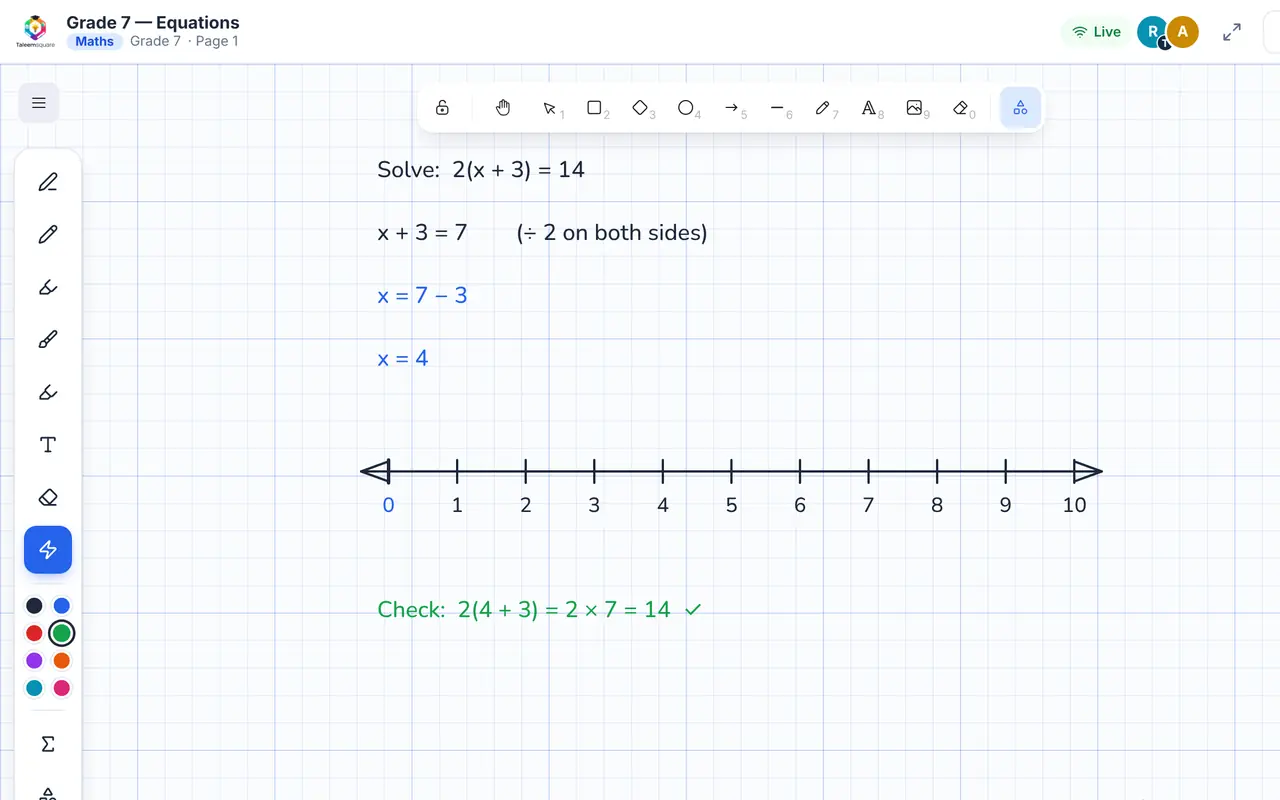
How a tutor talks a student through a math question at this level. The student does the working on the shared whiteboard; the tutor asks the next question.
A Grade 4 homework question: use an area model to find 23 × 14.
- Break each number into tens and ones: 23 = 20 + 3 and 14 = 10 + 4. Draw a rectangle split into 4 boxes.
- Multiply for each box: 20 × 10 = 200, 3 × 10 = 30, 20 × 4 = 80 and 3 × 4 = 12.
- Add the four parts: 200 + 30 + 80 + 12 = 322.
- Bridge to the standard method your child meets in Grade 5: 23 × 4 = 92 (the 80 and 12 boxes) and 23 × 10 = 230 (the 200 and 30 boxes), then 92 + 230 = 322. Same parts, shorter layout.
Answer: 23 × 14 = 322
The slip we see most often
Multiplying only tens by tens and ones by ones, 20 × 10 and 3 × 4, which gives 212. Drawing all four boxes first shows the two middle parts that are easy to miss.

Signs your child could use help
- Homework uses methods you never learned and cannot explain
- Your child gets the right answer but loses points for the method
- Homework time turns into arguments about the right way
- Struggles to explain their thinking in words or drawings
- Follows the steps in class but forgets them at home
- Gets confused when you show the method you learned
One of these on its own is normal. Two or three together usually point to a specific gap, and finding it is what the free assessment is for.
Taught to your curriculum, wherever you live
Common Core and your state's math standards
Tutors follow the standards and curriculum your child's school uses, whether Common Core or a state version of it, and materials such as Eureka Math, enVision or Illustrative Mathematics. Share a photo of the homework, and the tutor teaches the same method before linking it to the standard one.
National Curriculum methods
England's National Curriculum also moves from mental and pictorial methods to formal written methods, such as column addition and long multiplication, through Key Stage 2. Tutors teach the method your child's school uses, including bar models, and show parents how it fits the column methods they learned.
Level: Reception to Year 13
Provincial math curricula
Provinces such as Ontario teach number sense, mental math strategies and visual models alongside written methods. Tutors follow your province's curriculum and your child's classroom methods, and connect them to the standard methods parents know.
Level: Kindergarten to Grade 12
Australian Curriculum mental and written strategies
The Australian Curriculum asks students to use mental and written strategies for calculation, and schools often teach several strategies before one written method. Tutors follow your child's year level and state syllabus, and show how each strategy links to the standard method.
Level: Foundation to Year 12
What a Common Core math lesson with us looks like
One 45-minute session. Tutors adjust the timings to your child.
5 min
Homework check
A look at the method on this week's homework and anything your child found confusing.
12 min
Teach the method
The school's method, drawn and explained on the shared whiteboard with new numbers.
13 min
Practice it
Similar problems your child solves with the method, with the tutor checking each step.
10 min
Bridge to the standard method
The same problem done the standard way, so your child sees that both lead to one answer.
5 min
Wrap-up
A summary for you on WhatsApp, with what to practice before the next lesson.
Who teaches your child
Every TaleemSquare math tutor passes the same five checks before their first class. Your child keeps the same tutor each week, and if the fit is not right we switch tutor at no cost. Tutors are based in the US, UK, Canada, Australia, Pakistan and India, and all of them teach in English.
Identity and references checked
Every tutor is background-checked (a government criminal-record check), identity-verified and reference-checked before teaching a student.
Subject test
Tutors pass a subject test before they are matched with a child.
Spoken-English assessment
Lessons are taught in English, so every tutor passes a spoken-English assessment.
Live sample lesson
Tutors teach a live sample lesson before they are hired, to show they can explain clearly.
Open to parents
Classes are one-to-one in a password-protected room. Sit in on any class or ask for a recording.
Monthly math progress reports
Once a month you get a written report on your child's math: marks for each topic from short tutor-set checks, the change since last month, attendance, homework handed in and the tutor's plan for the next month. Between reports, a WhatsApp update follows every class.
- Topic-by-topic marks, so you can see which skills are secure and which still need work
- What improved, what is still weak and what comes next, in the tutor's own words
- Simple ways to help at home, without having to re-teach the math yourself

Monthly progress report
Ayaan M. · Grade 5 · Math: Fractions
- Assessment
- 84%
- +22 pts
- Attendance
- 92%
- 11 of 12 classes
- Homework
- 90%
- 9 of 10 handed in
Topic mastery
- Understanding fractions18/20Strong
- Equivalent fractions17/20Strong
- Adding and subtracting fractions16/20On track
- Fraction word problems16/20On track
Learning progress
Confidence 3 to 4 of 5
Example report: the student and marks are illustrative and show the format.
How we teach Common Core methods
The school's method first
Tutors start with the method on your child's homework, because that is what the teacher and the tests will ask for.
Then the bridge
Once the method makes sense, the tutor shows how it lines up with the standard method, step by step, using the same numbers.
Parents welcome
You can sit in on any lesson, and the tutor can show you the method so you can help at home without confusion.
An update after every class
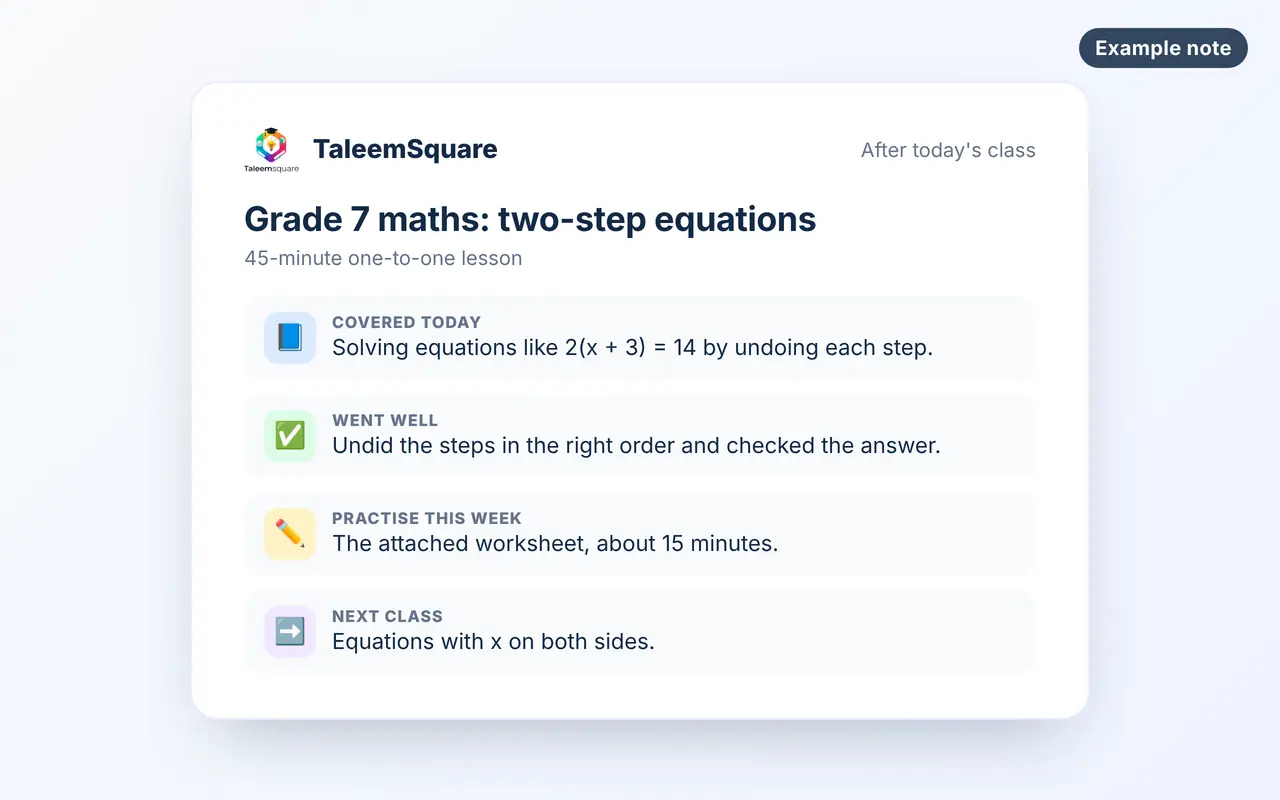
After each lesson you get a WhatsApp update with what was covered and what to practice next.


Simple monthly plans
$85a month for 2 one-to-one math lessons a week (8 a month)
About $10.63 a lesson, or $14.17 per hour of live one-to-one tutoring. With four lessons a week it is $9.31 a lesson.
- Free 45-minute trial assessment, no card details
- No contract, cancel any month
- No registration fee
- 4-class money-back promise
- Switch tutor at no cost
- WhatsApp update after every class
Starter
2 lessons a week (8 a month), best for keeping up with school
$85/mo
EnrollGrowthMost chosen
3 lessons a week (12 a month), best for catching up + building confidence
$119/mo
EnrollIntensive
4 lessons a week (16 a month), best for exam prep & fast improvement
$149/mo
EnrollCommon worries, honest answers
“Why can't my child just use the method I learned?”
Often they can, later. The standards ask for strategies first and name the grade for each standard method, such as multi-digit addition and subtraction in Grade 4 and multiplication in Grade 5. Before then, teachers may ask for the strategy. The tutor teaches the school method and shows how your method fits, so nothing is wasted.
“I want to help with homework, but I do not understand the method.”
That is common. You are welcome to sit in on lessons, and the tutor can walk you through the method with the same numbers your child is using. The WhatsApp update after each class tells you what was covered, so you know what your child is practicing.
“Will learning two methods confuse my child?”
The tutor teaches the school's method first and only adds the standard method once the first one is clear, using the same numbers so the link is easy to see. If two methods at once is too much for your child, the tutor stays with the school method and comes back to the other later.
Frequently asked questions
Can a tutor help with Common Core math homework?
What is Common Core math?
When does Common Core expect the standard algorithm?
Will the tutor teach my child the old way or the new way?
Can parents learn the methods too?
How much does Common Core math tutoring cost?
Sources
- Common Core State Standards for Mathematics
- Common Core State Standards: Grade 4 Number and Operations in Base Ten
- Common Core State Standards: Grade 5 Number and Operations in Base Ten
- Common Core State Standards: Grade 6 The Number System
- GOV.UK: National curriculum in England, mathematics programmes of study
Book a free 45-minute assessment
Your child meets a tutor for a real one-to-one session. You get an honest read on where they are and what would help, even if the answer is that they don't need tutoring right now.
- 1
We reply on WhatsApp
Usually within 10 minutes, to find a time that suits your family.
- 2
Your child meets the tutor
A relaxed 45-minute session to see their level and how they learn.
- 3
You decide
You get a recommendation and a plan. No card details, no pressure.